Lockheed Martin Redirects a GMLRS Rocket in Flight to Hit a Moving Target
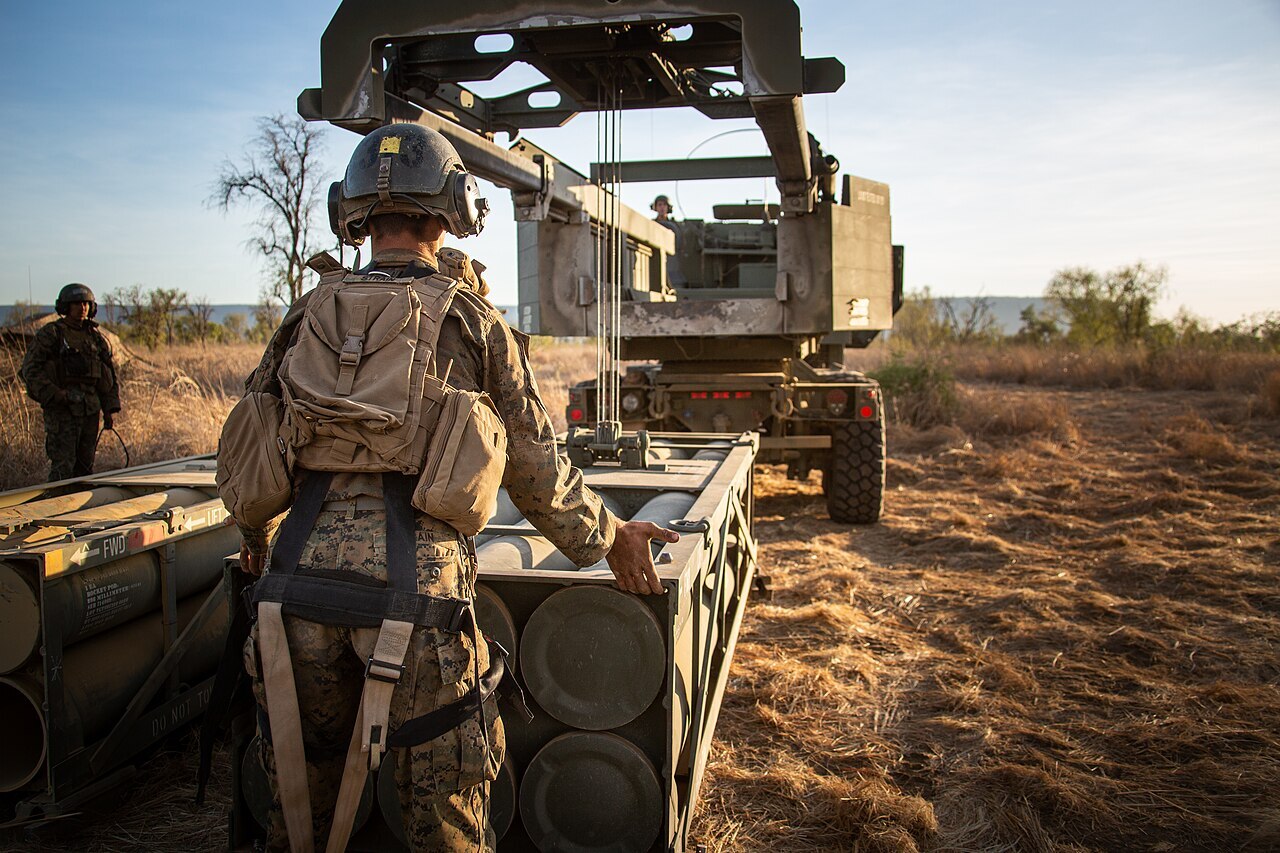
Lockheed Martin and the US Army have redirected a Guided Multiple Launch Rocket System (GMLRS) rocket in flight to destroy a moving target, a first for the programme, according to the company. The test took place at White Sands Missile Range in New Mexico and was reported on October 28.
The rocket was fired from a HIMARS launcher. The target update was then sent to it in flight over the Strigo datalink and Remote Interceptor Guidance-360, known as RIG-360. Lockheed Martin paid for the integration of both systems itself.
GMLRS Rocket Retargeted After Launch
| Item | Detail |
|---|---|
| Company | Lockheed Martin |
| Customer | US Army |
| Location | White Sands Missile Range, New Mexico |
| Launcher | HIMARS |
| Link used | Strigo datalink and RIG-360 |
| Result | Rocket redirected in flight and destroyed a moving target |
| Funding | Integration funded by Lockheed Martin |
| Reported | October 28, 2026 |
Lockheed Martin said the demonstration was aimed at widening GMLRS capability without changing the rocket itself. Instead, it connects sensors, launchers and targeting systems the Army already has into one chain, so that a pre-programmed strike can be adjusted as the battlefield changes.
“By delivering this level of integration between Lockheed Martin products such as GMLRS, RIG-360 and Strigo, we’re giving our warfighters the confidence and capability to succeed in the most complex, real-world scenarios,” said Randy Crites, vice president of Lockheed Martin Advanced Programs.
Why Retargeting After Launch Matters
A GMLRS rocket is normally launched at coordinates fixed before it leaves the pod. That works against a bunker or a command post. It works poorly against a truck or a launcher that moves while the rocket is in the air, a gap that in-flight updates are meant to close.
Lockheed Martin said the capability would let commanders change a strike in response to changing conditions, and that the test supports the Army’s plans for networked precision fires. The company’s statement did not give the range, target type or number of rockets fired. How well the method works against fast, evasive targets is untested in public.
From Captive Carry to Live Fire
The result builds on earlier work. In October 2023 Lockheed Martin reported a captive-carry test in which a RIG-360 prototype flew inside an aircraft replicating a surface-to-surface trajectory and passed target updates to a surrogate GMLRS. A flight test was then planned for 2024. Lockheed Martin describes the White Sands test as a first for the programme.
| Test | What flew | Outcome |
|---|---|---|
| October 2023 | RIG-360 prototype carried on an aircraft, with a surrogate GMLRS | Proof of concept for in-flight target updates |
| October 2026 | GMLRS fired from HIMARS with Strigo and RIG-360 | Rocket redirected in flight and destroyed a moving target |
ER GMLRS and PrSM Could Use the Same Link
Lockheed Martin said the datalink package is directly applicable to Extended Range GMLRS and the Precision Strike Missile, or PrSM. That would carry the approach from the standard rocket to the longer-range weapons the Army is buying for its HIMARS and M270A1 launchers.
| Munition | Launchers | Lockheed Martin statement |
|---|---|---|
| GMLRS | HIMARS, M270A1 | Demonstrated at White Sands |
| ER GMLRS | HIMARS, M270A1 | Datalink package directly applicable |
| PrSM | HIMARS, M270A1 | Datalink package directly applicable |
Lockheed Martin Company Profile
| Item | Detail |
|---|---|
| Headquarters | Bethesda, Maryland |
| Formed | 1995 (Lockheed and Martin Marietta merger) |
| Employees | About 123,000 (2025) |
| Revenue | About $75.05 billion (2025) |
| CEO | James Taiclet |
| Segments | Aeronautics, Missiles and Fire Control, Rotary and Mission Systems, Space |
| Known programmes | F-35, HIMARS, GMLRS, PAC-3, THAAD, Javelin |
A Busy Month for Lockheed Missiles
The test comes days after the Air Force put the AGM-183A ARRW hypersonic missile into production, covered in our report on the $694 million ARRW contract.
GMLRS In-Flight Update FAQ
What did Lockheed Martin demonstrate?
A GMLRS rocket fired from a HIMARS was redirected in flight and destroyed a moving target at White Sands Missile Range.
What is RIG-360?
Remote Interceptor Guidance-360 is the guidance and datalink system, used with the Strigo datalink to pass target updates to the rocket. Lockheed Martin funded its integration.
Is this the first time?
Lockheed Martin says it is a first for the GMLRS programme.
Does it change the rocket?
The company says the approach expands capability without fundamentally changing the munition.
Which other weapons could use it?
Lockheed Martin says the datalink package applies directly to ER GMLRS and PrSM.
- Defence Industry Europe – “Lockheed Martin redirects GMLRS rocket in flight to destroy moving target in U.S. Army test” (October 28, 2026, reporting Lockheed Martin)
- Lockheed Martin – “Lockheed Martin Advances Joint Fires Concept with Captive Carry Test” (press release, October 11, 2023): news.lockheedmartin.com
- Wikipedia – Lockheed Martin (company data)