
What is a Firearm? The Engineering and Physics of Internal Ballistics


 React
React
In defense analysis, terms like “assault rifle,” “pistol,” and “machine gun” are used daily. But stripping away the tactical classifications, what fundamentally defines a firearm from an engineering perspective?
Unlike a bow or a catapult, which uses stored mechanical tension to launch a projectile, a firearm is essentially a single-stroke internal combustion engine. It is a thermodynamic machine designed to harness the extreme pressure of a rapid chemical reaction to propel a projectile down a directional tube at lethal velocities.
To understand how this operates, we must examine the physics of the firing cycle.
The Physics of the Shot: The Cartridge
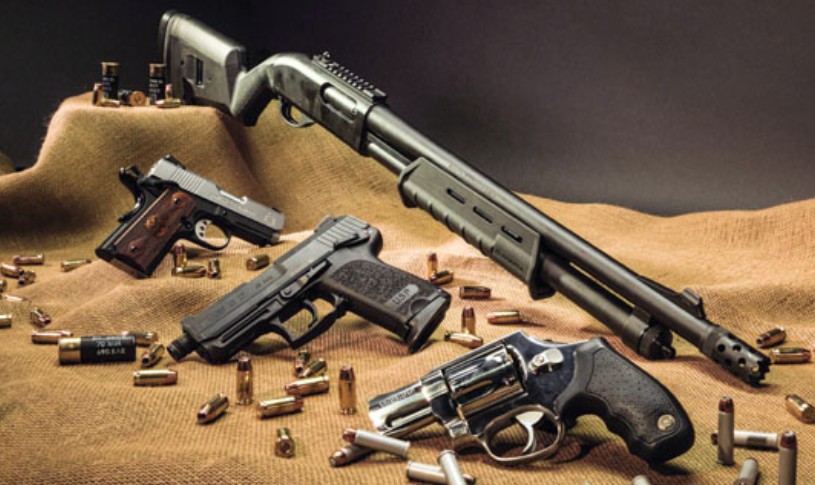
The magic of a modern firearm lies in the self-contained cartridge (often incorrectly called a “bullet”). A standard cartridge consists of four components: the brass casing, the primer, the propellant (smokeless powder), and the projectile (the bullet).
The firing sequence happens in fractions of a millisecond:
-
Ignition: When the operator pulls the trigger, a mechanical hammer or striker is released, violently driving a firing pin into the primer at the base of the cartridge. The primer contains a highly sensitive impact-explosive (like lead styphnate) that sparks instantly.
-
Deflagration: This spark shoots through a “flash hole” into the main casing, igniting the smokeless powder. Crucially, smokeless powder does not detonate; it deflagrates (burns rapidly).
-
Expansion and Expulsion: This rapid burning instantly converts the solid powder into highly pressurized, superheated gas. Because the brass casing seals the rear of the chamber, the expanding gas has only one path of escape: forward. The immense pressure (often exceeding 50,000 psi in modern rifles) violently pushes the projectile out of the casing and down the barrel.
Controlling the Chaos: Barrel Mechanics
Once the projectile is moving, its accuracy is determined by the barrel. Firearms are divided into two main categories based on barrel design:
-
Rifled Barrels (Rifles and Handguns): The inside of the barrel is machined with spiral grooves (rifling). As the bullet is forced down the barrel, it grips these grooves, causing it to spin at hundreds of thousands of RPMs. This spin acts like a gyroscope, stabilizing the bullet in flight and allowing for extreme precision over long distances.
-
Smoothbore Barrels (Shotguns): These barrels have no internal grooves. They are designed to fire a cluster of spherical pellets (buckshot) or a single heavy slug over short ranges, where spin stabilization is either unnecessary or detrimental to the spread pattern.
The Evolution of the Action
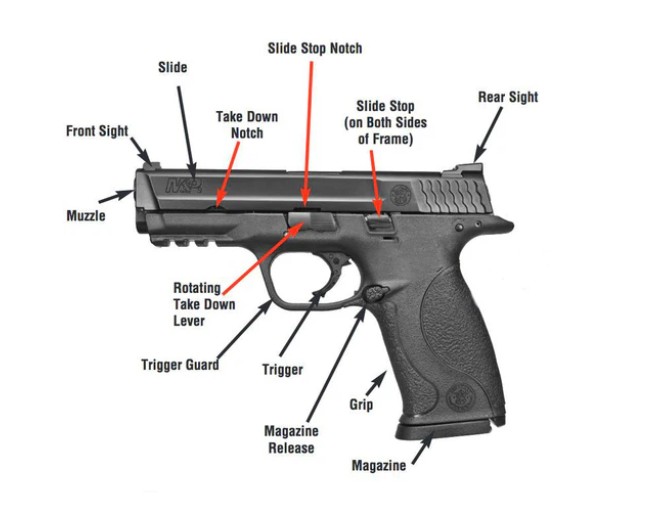
The “action” of a firearm dictates how it loads, fires, and extracts a cartridge. This defines its tactical capability on the battlefield:
-
Manual Action: The user must manually manipulate a mechanism (like a bolt-action sniper rifle or a pump-action shotgun) to eject the spent casing and load the next round. Highly reliable and accurate, but with a slow rate of fire.
-
Semi-Automatic Action: Found in modern pistols (like the Glock 19) and infantry rifles (like the AR-15). It ingeniously bleeds off a small portion of the expanding gas from the fired shot (or uses recoil energy) to automatically push the bolt backward, eject the empty casing, and load a fresh round. One trigger pull equals one shot.
-
Fully Automatic Action: The hallmark of machine guns. As long as the trigger is held down, the weapon’s internal sear remains disengaged, allowing the gas-operated cycle to continuously fire, eject, and load until the magazine is empty.
Ultimately, whether it is a 9mm concealed carry pistol or a .50 caliber heavy machine gun, the fundamental physics remain identical: harnessing a controlled chemical explosion to deliver kinetic energy to a target.
React