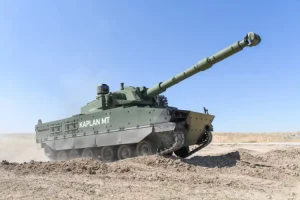

Thermal Imaging in the Military, How Armies Learned to See Heat
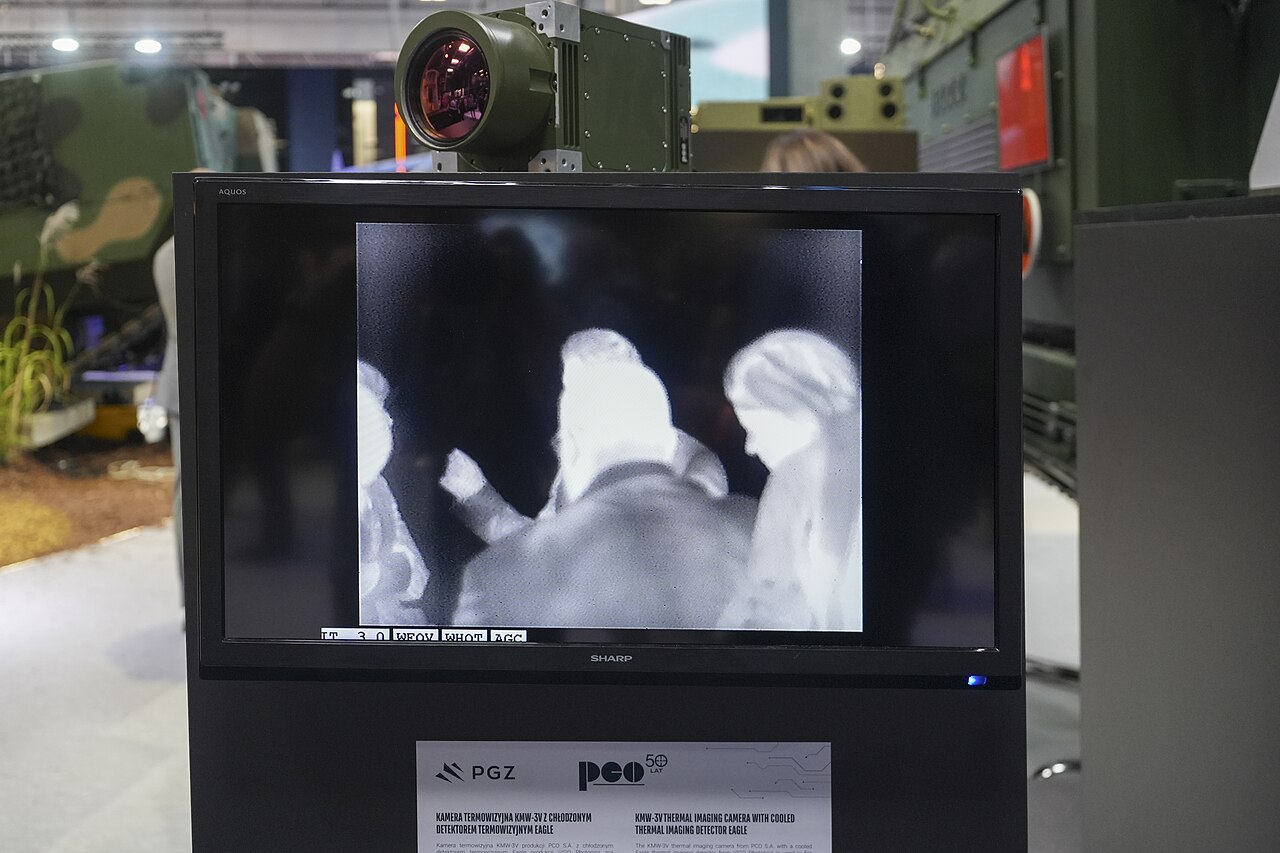
Thermal imaging lets soldiers see the heat every person, engine and generator radiates in the 8–14 micron infrared band, turning night, smoke and camouflage into minor obstacles. From rifle sights to satellite sensors, it has become the military’s default way of finding things, and the war in Ukraine has pushed it from premium equipment to commodity necessity.
How does thermal imaging work
Every object above absolute zero emits infrared radiation, and the hotter it is, the more it emits. A thermal imager focuses that radiation through a germanium lens, because ordinary glass is opaque to long-wave infrared, onto a focal plane array of detector elements. Each element converts incoming radiation into an electrical signal, and processing turns thousands of tiny temperature differences into a picture. Sensitivity is measured as NETD, noise-equivalent temperature difference, with good military sensors resolving differences of a few tens of millikelvin.
Crucially, thermal imaging is passive. Unlike radar or a laser rangefinder it emits nothing, so using it betrays nothing, the same logic that makes IRST sensors attractive on fighters hunting stealth aircraft.
Cooled vs uncooled thermal imagers
| Feature | Cooled (photon) | Uncooled (microbolometer) |
|---|---|---|
| Detector | InSb, MCT or T2SL semiconductors | Vanadium oxide or amorphous silicon |
| Cooling | Cryocooler to around 77 K | None, runs at ambient temperature |
| Sensitivity | Excellent, long detection ranges | Good, shorter ranges |
| Cost and upkeep | Expensive, cooler is a wear item | Cheap, no moving parts |
| Typical use | Tank sights, targeting pods, missile seekers | Rifle scopes, drones, vehicle cameras |
The split defines the market. Cooled sensors see farther and faster but cost tens of thousands of dollars and need minutes to cool down, so they go where range decides outcomes, tank fire control, attack aviation, ship sensors. Uncooled microbolometers switch on instantly, cost hundreds to thousands of dollars, and have proliferated onto rifles and small drones by the hundred thousand.
MWIR vs LWIR, which infrared band
Two atmospheric windows matter. Mid-wave infrared, 3–5 microns, offers crisp contrast on hot targets and suits long, humid sight lines, which is why cooled MWIR dominates naval and airborne sensors. Long-wave infrared, 8–14 microns, matches the peak emission of room-temperature objects such as people, penetrates dust and smoke slightly better, and is where uncooled detectors work, making LWIR the infantry standard. Many high-end systems now carry both, plus fusion with visible or image-intensified channels.
Where the military uses thermal imaging
| Platform | Application |
|---|---|
| Infantry | Weapon sights, handheld observation, fused night vision goggles |
| Armored vehicles | Gunner and commander sights, driver vision enhancers |
| Drones | Gimballed EO/IR balls from quadcopters to MALE UAVs |
| Aircraft | Targeting pods, IRST, missile warning sensors |
| Missiles | Imaging infrared seekers, as on Javelin |
| Ships and air defense | Passive search and track, counter-drone cueing |
The seeker application deserves emphasis, the Javelin locks its imaging infrared seeker onto a tank’s heat signature before launch, which is what makes fire-and-forget possible. At the other end of the scale, wide-area thermal sensors on satellites and balloons watch for the biggest signature of all, rocket exhaust.
Thermal imaging in Ukraine
Ukraine industrialized the technology’s low end. Commercial thermal scopes and drone cameras, many of them Chinese-made microbolometers, flooded both sides, making night assaults without thermal discipline close to suicidal and pushing movement to bad weather and thermal-masking tactics. Operator-reported experience also elevated the countermeasure business, thermal blankets, engine shrouds and decoy heaters, because as our explainer on infrared signature management details, hiding heat is now as important as armor. The lesson procurement offices drew is volume, a $2,000 sight on every rifle beats a $200,000 sight on every tenth vehicle.
Thermal imaging frequently asked questions
What is the difference between thermal imaging and night vision?
Night vision amplifies existing light; thermal imaging reads emitted heat and needs no light at all, working through smoke and total darkness.
Can thermal imaging see through walls?
No. It reads surface temperatures only; a wall shows the wall’s heat, not what is behind it.
How far can military thermal imaging see?
Handheld uncooled sights detect people at one to two kilometers; cooled vehicle and airborne sensors detect vehicles at ten kilometers or more, conditions permitting.
What defeats thermal imaging?
Thermal blankets and multispectral camouflage that trap or scatter heat, terrain masking, rain and heavy fog, and decoys that imitate signatures.
Why do thermal cameras use germanium lenses?
Standard glass blocks long-wave infrared; germanium transmits it, which is also a reason quality thermal optics stay expensive.
- Reference works on electro-optical and infrared systems engineering
- Wikipedia – Thermographic camera and Thermal weapon sight (accessed October 2026)
- Manufacturer literature on cooled and uncooled detector lines
- Defence & Tech reporting on EO/IR systems and Ukraine