FNSS Unveils U-MAV Unmanned Amphibious Assault Vehicle

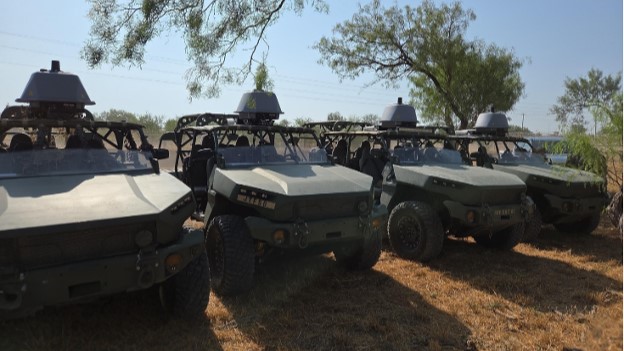
Turkish armoured vehicle manufacturer FNSS has unveiled the U-MAV, an eight-tonne unmanned amphibious vehicle designed to go ashore ahead of manned forces and absorb the risk of the first wave of an amphibious landing.
The vehicle was shown at TEKNOFEST Mavi Vatan 2026, held Aug. 20-23 at the Gölcük Naval Shipyard Command in Kocaeli. FNSS chief executive Selim Baybaş described it as opening “a new era” for the company, adding that “very few companies worldwide can build an unmanned amphibious vehicle of this size and capability.”
What it is
U-MAV — the multi-purpose modular unmanned amphibious vehicle — is a wheeled, eight-tonne platform that can operate autonomously, under remote control, or in a hybrid mode where an operator supervises a largely self-directed vehicle. A 300-horsepower powerpack gives it a power-to-weight ratio of 37.5 horsepower per tonne, a figure closer to a light armoured vehicle than to most unmanned ground systems in this weight class.
It swims at 7 knots and drives at up to 70 kilometres per hour on road. Line-of-sight communications reach 3 kilometres, extendable through a UAV relay — a necessary provision, since an amphibious approach places the vehicle low on the water with the mother ship over the horizon.
FNSS has defined ten mission configurations: fire support, mine clearance, combat engineering, electronic warfare, reconnaissance, deception, counter-drone, navigation and obstacle marking, logistics support, and casualty evacuation. Mission modules are interchangeable in roughly 40 minutes.
The tactical case
The first wave of an amphibious assault is the most dangerous phase of one of the most dangerous operations in warfare. Vehicles emerging from the surf are slow, silhouetted and predictable, moving through water that may be mined and toward a beach that has been surveyed by the defender for exactly this purpose.
U-MAV is designed to be in that position instead of a crewed vehicle. Its stated primary missions — engaging coastal defences, clearing mines and obstacles, marking safe lanes and preparing the beach — are precisely the tasks that historically consume the first echelon. A vehicle with no one inside changes the arithmetic of accepting those losses.
The deception role deserves attention. An unmanned vehicle can be sent ashore at a location the force has no intention of using, drawing fire and revealing defensive positions before the real landing begins. Feints of this kind have always been valuable and always been expensive in lives. Making them cheap makes them usable.
Where it fits in the Turkish fleet
U-MAV is intended to work as part of a manned-unmanned team alongside FNSS’s tracked Marine Assault Vehicle family, the ZAHA, already entering service with the Turkish Naval Forces Command. The concept places the unmanned vehicle in the first echelon with crewed vehicles following once the beach has been screened.
That fits a broader Turkish naval trajectory. The amphibious assault ship TCG Anadolu gave Turkey the capacity to project a landing force, and ZAHA gave it the vehicle to land. What has been missing is a way to reduce the cost of the opening minutes. The Turkish Naval Forces have also invested heavily in uncrewed surface vessels, and U-MAV extends the same logic from the sea onto the beach.
The wider market
Unmanned ground vehicles in the eight-tonne class are not new, but amphibious ones are rare. Most robotic ground systems are either small enough to be carried or heavy tracked platforms that require a landing craft to reach shore. A self-swimming eight-tonne vehicle that can carry a remote weapon station, an electronic warfare payload or a mine plough is a narrow niche, and Baybaş’s claim that few companies can build one is defensible.
Whether that translates into export orders is a separate question. Amphibious assault is a capability few countries maintain, and those that do — the United States, South Korea, Japan, China — have their own industrial bases. The more plausible export markets are states with long, contested coastlines and littoral defence requirements, where the same vehicle can be used defensively for mine clearance, coastal reconnaissance and obstacle marking without any assault mission attached.
Why it matters
FNSS is best known for tracked infantry vehicles and for a licensing model that has put its designs into service in Malaysia, Indonesia, the Philippines, Oman and Saudi Arabia. U-MAV represents a move toward the higher end of the autonomy market, where the barrier is less the hull than the control software, sensor fusion and the reliability of an autonomous system operating in surf.
Nothing about the unveiling establishes that the vehicle works as advertised. Trials in the water, under jamming, against a defended shoreline, will settle that. But the platform answers a real operational problem, its specifications are plausible rather than aspirational, and it arrives from a manufacturer with a record of turning prototypes into fielded vehicles.
Sources
- FNSS Savunma Sistemleri A.Ş. product information and statements by chief executive Selim Baybaş
- Defence Industry Europe, “FNSS launches U-MAV as heavy unmanned amphibious platform for first-wave assault, mine clearance and electronic warfare”
- TEKNOFEST Mavi Vatan 2026, Gölcük Naval Shipyard Command, Kocaeli, Aug. 20-23, 2026