US Armored Vehicles: Bradley, Stryker, AMPV and XM30
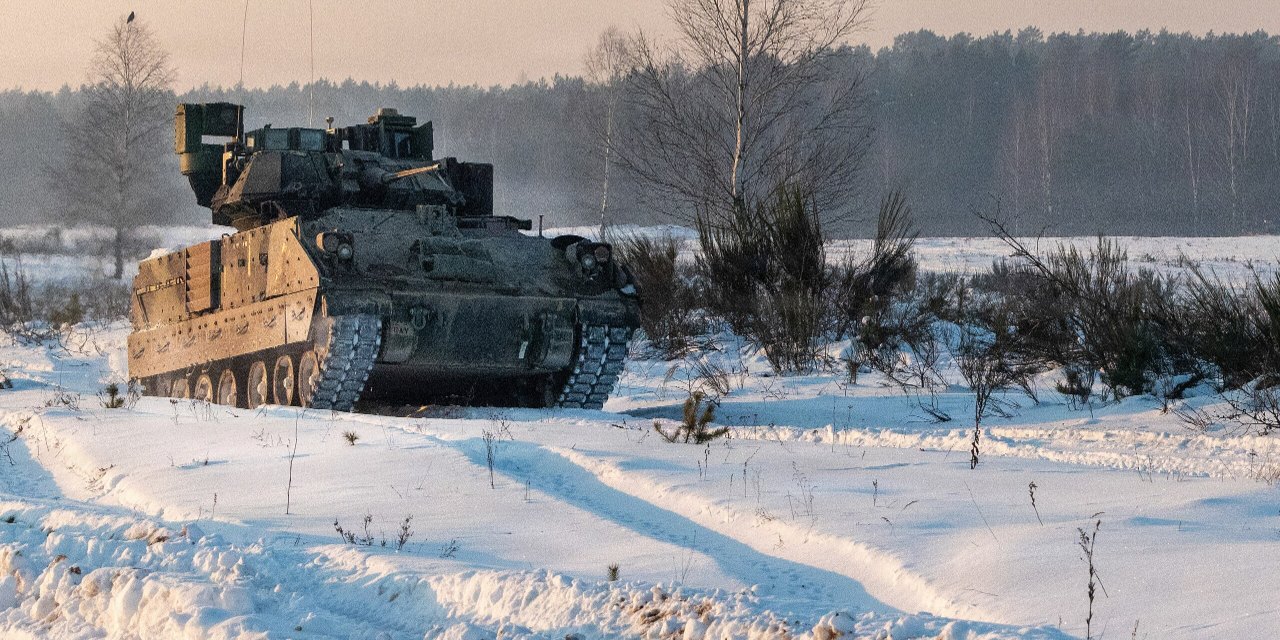
Behind its Abrams tanks the US Army fields two main armored vehicles: the tracked M2 Bradley, which carries infantry into battle alongside the tanks, and the eight-wheeled Stryker, which equips its medium brigades. Around them are the new AMPV, the 1960s-vintage M113 it replaces, and thousands of lighter trucks.
This guide explains what each vehicle is for, how many there are, and why the Bradley’s replacement, the XM30, was put on hold in 2026.
What armored vehicles does the US have?
The Army builds its brigades around one family of vehicles each. Armored brigades have Abrams tanks, Bradleys and tracked support vehicles. Stryker brigades have wheeled vehicles that drive long distances on roads. Infantry brigades are now being re-equipped with light, unarmored trucks to become what the Army calls mobile brigades. The tanks are covered separately in how many tanks the US has.
| Vehicle | Type | Crew and passengers | Main weapon | Approximate number |
|---|---|---|---|---|
| M2 and M3 Bradley | Tracked infantry and cavalry fighting vehicle | 3 crew, 6 soldiers | 25 mm cannon, TOW missiles | About 3,500 active |
| Stryker | 8×8 wheeled armored vehicle | 2 crew, 9 soldiers | Heavy machine gun or 30 mm cannon | About 4,200 |
| AMPV | Tracked support vehicle | 2 crew, 6 passengers | Machine gun | A few hundred delivered |
| M113 | Tracked personnel carrier | 2 crew, 11 soldiers | Machine gun | Several thousand, being retired |
| JLTV | 4×4 protected light vehicle | Up to 4 | Machine gun; missiles on some | More than 12,000 |
| Infantry Squad Vehicle | Light unarmored truck | 9 | None | About 1,100 delivered |
| ACV | Marine 8×8 amphibious vehicle | 3 crew, 13 Marines | Machine gun or 30 mm cannon | About 630 planned |
M2 Bradley: the infantry fighting vehicle
The Bradley has carried American mechanised infantry since 1981. Its 25 mm cannon and TOW anti-tank missiles let it fight armored vehicles as well as deliver six soldiers to the objective. The M3 version carries scouts. The latest M2A4 has a more powerful engine and electrics, and some are being fitted with the Iron Fist active protection system, a technology explained in how active protection works.
More than 300 Bradleys went to Ukraine, where crews praised their protection and their gun. The same war confirmed that the design has no room left to grow: it cannot take more armor, power or electronics without a new hull.
XM30: the Bradley replacement on hold
The XM30 is the latest of several attempts to replace the Bradley, after two earlier programmes were cancelled. Two teams are competing, General Dynamics Land Systems and American Rheinmetall, whose entry is based on the Lynx. The requirement is for a vehicle with a 50 mm cannon in an unmanned turret, a crew of two, hybrid drive and the ability to operate without a crew on board.
The programme passed its main review in June 2025. Then, in February 2026, Army leaders declined to sign the documents that would have moved it into full development, while they reconsidered the approach. The Congressional Research Service says the Army is now assessing several competing designs and has asked for $547 million in fiscal 2027 to buy 19 prototypes. Both teams delivered vehicles at the end of the summer, as we reported in the first Lynx XM30 prototype. Soldiers of the 1st Cavalry Division are to test them alongside the M1E3 tank until March 2027. How the Lynx compares with its rivals is in CV90 vs Lynx vs Redback.
Stryker: the wheeled middle weight
The Stryker entered service in 2002 to give the Army a force lighter than tanks but better protected than infantry on foot. It weighs about 20 tonnes, carries nine soldiers and comes in a dozen versions, from mortar carrier to medical vehicle. Later models have a V-shaped hull against mines, and the Dragoon version carries a 30 mm cannon. The Sgt Stout air defense vehicle is a Stryker too, as described in our guide to US air defense.
About 170 were given to Ukraine. Wheels make the Stryker fast on roads and cheap to run. They also make it poor in deep mud, which is one reason the Army has never treated it as a substitute for the Bradley.
AMPV and the M113
The M113 is the aluminium box on tracks that first went to war in Vietnam. Thousands still serve in armored brigades as ambulances, command posts and mortar carriers, although the Army judged long ago that they were too vulnerable to send forward. The Armored Multi-Purpose Vehicle, built by BAE Systems on a turretless Bradley chassis, is taking over those jobs in five versions.
The Army planned to buy 2,907. Deliveries have been slow and purchases were cut back in the 2025 Transformation Initiative, so the M113 will be around for years yet. The same review cancelled the M10 Booker light tank.
Light vehicles and the Marine Corps ACV
Below the armored vehicles sits a large fleet of trucks. The JLTV was bought to replace the Humvee with something that could survive roadside bombs. In 2025 the Army stopped buying both, arguing that armored trucks are too heavy and too easy for drones to find. The Marine Corps continues with the JLTV. The makers are profiled in our AM General article.
The Army’s preferred light vehicle is now the Infantry Squad Vehicle, an unarmored nine-seat truck based on a commercial pickup and built by GM Defense. It trades protection for speed and can be carried under a Black Hawk. The Marines, for their part, are replacing their 1970s amphibious tractors with the eight-wheeled Amphibious Combat Vehicle, which swims from ship to shore.
Frequently asked questions
What is the main US infantry fighting vehicle?
The M2 Bradley, in service since 1981 and armed with a 25 mm cannon and TOW missiles.
How many Bradleys does the US have?
About 3,500 in active service, with more in storage. More than 300 were sent to Ukraine.
What will replace the Bradley?
The XM30. Two teams have delivered prototypes, but the Army paused the move to full development in February 2026 and no winner has been chosen.
What is the difference between a Bradley and a Stryker?
The Bradley is tracked, heavily armored and armed with a cannon and missiles. The Stryker is wheeled, lighter and usually armed with a machine gun.
Does the US still use the M113?
Yes, in support roles within armored brigades. It is being replaced by the AMPV.
- Congressional Research Service – The Army’s XM-30 Mechanized Infantry Combat Vehicle (September 2026): everycrsreport.com
- Breaking Defense – Is the Army about to shake up the XM30 Bradley replacement? (February 2026): breakingdefense.com
- Wikipedia – List of equipment of the United States Army: en.wikipedia.org
- Wikipedia – Next Generation Combat Vehicle: en.wikipedia.org
- IISS – The Military Balance: iiss.org