Active Protection Systems, How Tanks Shoot Down Incoming Missiles
An active protection system gives a tank milliseconds of self-defense that tons of steel cannot, detecting an incoming missile with radar and destroying or deceiving it before impact, often in under a tenth of a second. After Ukraine’s drones and missiles punished even the heaviest armor, APS moved from expensive option to the defining requirement of every serious armored vehicle program of 2026.
How does an active protection system work
Every APS runs the same loop, sense, decide, act. Small radars, and increasingly electro-optical sensors, stare outward from the turret watching for the signature of an incoming rocket or missile. A computer classifies the threat, computes an intercept point, and triggers an effector, all faster than a human can register the launch.
The engineering challenge is not any single step but doing all of them reliably on a vibrating, muddy, radio-noisy vehicle, while never firing at a passing bird, a friendly round or a dismounted soldier’s silhouette. That discrimination problem, more than the interceptor itself, is what separates fielded systems from brochures.
Hard-kill vs soft-kill APS
| Factor | Hard-kill | Soft-kill |
|---|---|---|
| Method | Physically destroys or disrupts the threat with a counter-munition or fragment blast | Defeats guidance with jammers, obscurants and decoys |
| Works against | RPGs, ATGMs, some tank rounds depending on design | Guided missiles relying on laser, IR or command links |
| Limitations | Ammunition count, reload, danger to nearby infantry | Useless against unguided threats and hit-to-kill ballistics |
| Examples | Arena-M, GL-5, KAPS, StrikeShield | Shtora-1, MUSS, smoke-based systems |
| Typical role | Last-ditch physical shield | First layer that makes the missile miss quietly |
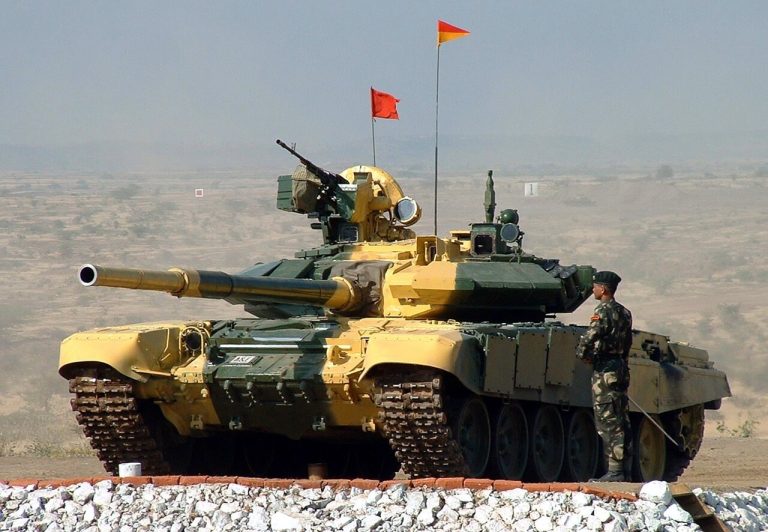
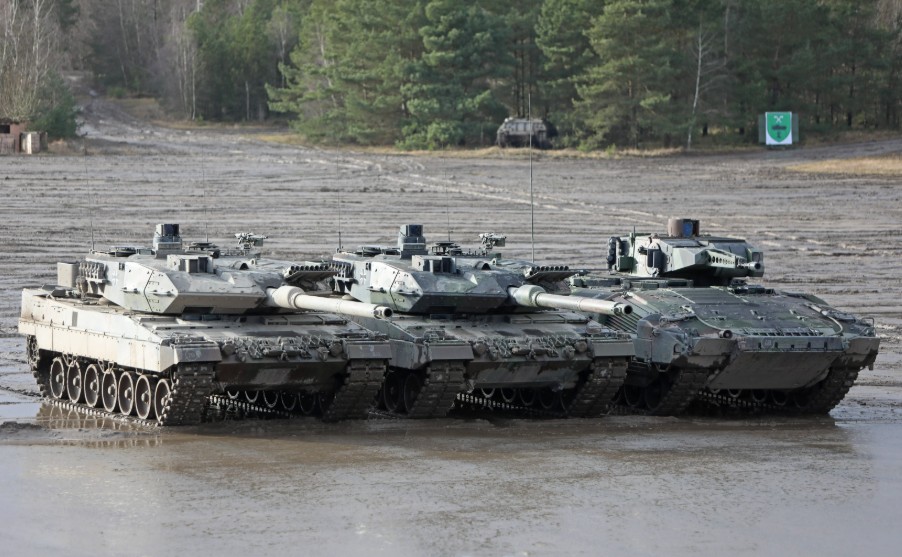
Soft-kill came first at scale, Russia’s Shtora dazzlers on the T-90 and Germany’s MUSS on the Puma IFV among the best known, because deceiving a SACLOS missile is cheaper than shooting one down. Hard-kill delivers the decisive effect, at the price of exploding something meters from your own infantry.
Which active protection systems exist today
The Soviet Union fielded the first operational hard-kill system, Drozd, on naval infantry T-55s in 1983, followed by the Arena family. Today’s Arena-M is offered for T-72B3M and T-90M upgrades, with Russian sources claiming interception of tandem-warhead ATGMs, figures that remain manufacturer claims without independent verification. The T-14 Armata’s Afganit system, also unproven in combat, extends the concept with claims against kinetic rounds.
China’s Norinco markets the GL-5 hard-kill system on its export VT-4 tank and newer domestic designs, with state media crediting it against RPGs and ATGMs, again manufacturer claims. South Korea developed KAPS for the K2 Black Panther and is maturing a follow-on under its K2 and K3 roadmaps, while Rheinmetall’s StrikeShield, a distributed hybrid of sensors and countercharges that doubles as armor modules, won its first major order from Hungary for the Lynx IFV fleet. The US experimented with domestic designs such as Artis’s Iron Curtain before settling interim needs through off-the-shelf procurement; readers should note that hard-kill pioneers headquartered in Israel fall outside this site’s coverage policy, and several Western integration programs draw on that lineage.
The direction of travel is clear in every new vehicle we track, from the concepts in our top 10 main battle tanks ranking to the uncrewed turrets of next-generation programs, APS is becoming a design assumption rather than a retrofit, in the way our Leopard 2 coverage shows successive variants sprouting sensor masts and launcher mounts.
What APS struggles against
Physics sets hard limits. Kinetic-energy tank rounds arrive too fast and too dense for most interceptors, which is why APS marketing focuses on shaped-charge threats. Top-attack profiles compress reaction time and demand elevated coverage many older systems lack. Saturation is brutal arithmetic, a system carrying a handful of counter-munitions meets a swarm of $500 FPV drones, and small, slow, plastic drones are genuinely hard for radars tuned to fast rockets. Add the dismounted-infantry danger zone around every detonation, and APS emerges as one layer in a survival stack, not a force field.
Why Ukraine made APS urgent
Ukraine’s battlefields turned anti-armor fire from an event into an environment, with FPV drones accounting for the majority of vehicle kills by most operator-reported tallies. Neither side fields meaningful numbers of functioning APS, Russian claims about Arena-M deployments remain unverified, so crews answered with cages, nets and electronic jammers, improvised soft-kill at scale. The lesson procurement offices drew across NATO and Asia is that the next vehicle generation must sense and fight back automatically, and APS lines now feature in armor budgets from Warsaw to Seoul.
Active protection systems frequently asked questions
What is an active protection system on a tank?
A sensor-and-effector suite that detects incoming rockets or missiles and defeats them before impact, either by physical interception or by deceiving their guidance.
What was the first active protection system?
The Soviet Drozd, fielded on T-55AD tanks in 1983, followed by the Arena family and later foreign designs.
Can APS stop tank shells?
Generally no. Kinetic-energy rounds are too fast for most fielded systems; some newer designs claim partial capability, but those remain manufacturer claims.
Can APS stop FPV drones?
Only partially. Slow, small drones challenge radars designed for fast rockets, and limited interceptor counts make swarms dangerous; jammers currently do most counter-drone work.
Is APS dangerous to nearby infantry?
Yes, hard-kill interceptions detonate close to the vehicle, so doctrine keeps dismounts clear of defined danger zones.
- Wikipedia – Active protection system (accessed October 2026)
- Manufacturer literature from Rheinmetall, Norinco and Rostec (manufacturer claims noted)
- Open-source analysis of vehicle losses in Ukraine (operator-reported)
- Defence & Tech reporting on armored vehicle programs