Reactive Armor vs Composite Armor, How Tanks Stop Modern Weapons
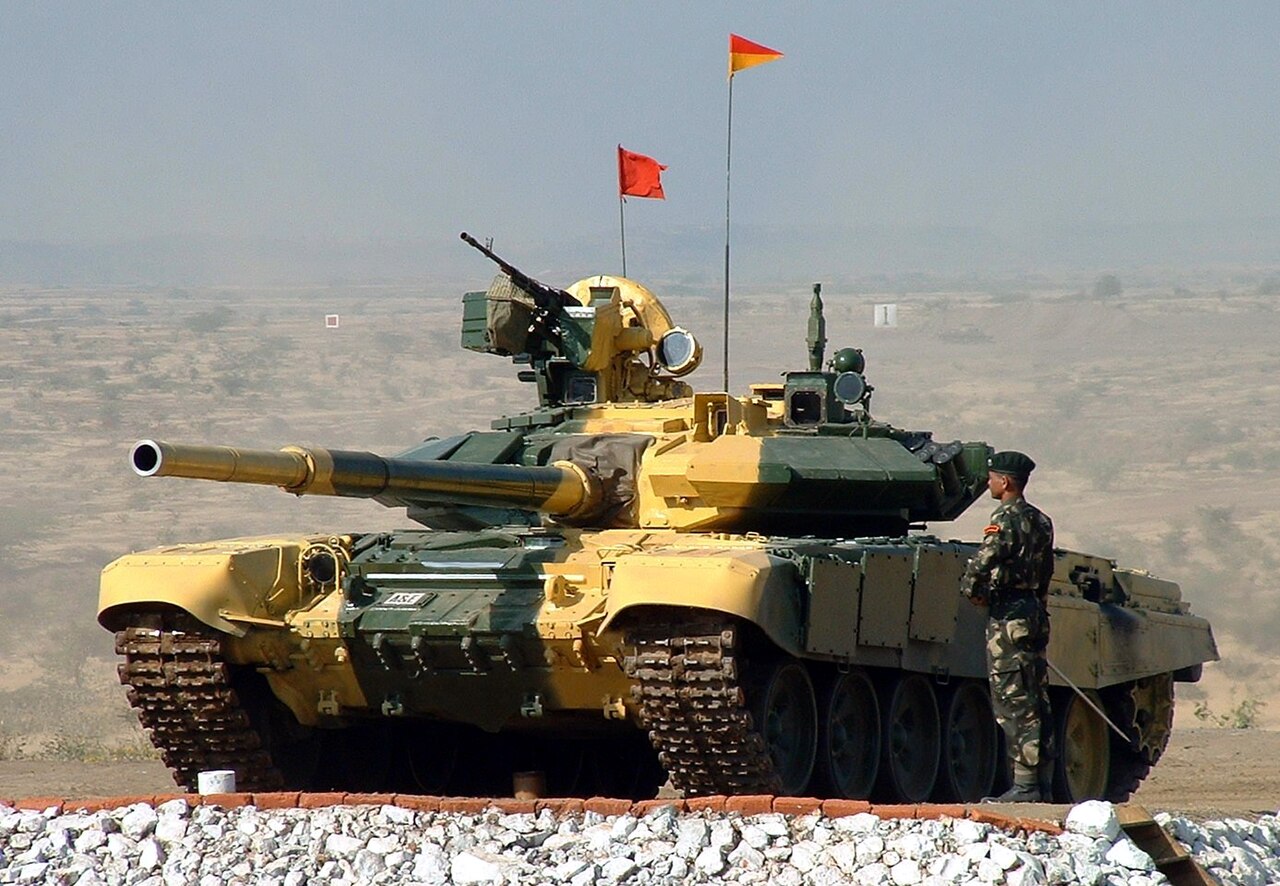
Reactive armor defeats an incoming warhead by exploding outward against it, while composite armor absorbs and disrupts it passively, and every serious tank built since the 1980s relies on at least one of the two. Understanding the difference explains why a modern main battle tank weighs 55 to 70 tons, why Soviet-designed tanks wear bricks, and why both technologies are now being stacked together under cages and interceptors.
How does composite armor work
Composite armor sandwiches layers of different materials, hardened steel, ceramics, glass-reinforced plastics, rubber, and in some designs depleted uranium, so that an incoming penetrator has to fight a new physics problem at every boundary. Ceramic tiles shatter and erode the jet of a shaped charge, spaced layers make long-rod penetrators yaw and snap, and backing plates catch the fragments.
The concept matured in two places at once. Britain’s Burlington research, better known as Chobham armor, went into the M1 Abrams and Challenger, while the Soviet Union fielded its own layered “combination K” arrays in the T-64 as early as the 1960s. Exact recipes remain among the most closely held secrets in the defense world; even export customers of the M1 Abrams receive different armor packages than the US Army.
How does reactive armor work
Explosive reactive armor, or ERA, is a box containing a slab of explosive between two metal plates. When a shaped-charge jet strikes the box, the explosive detonates and drives the plates apart across the jet’s path, cutting, bending and diluting it before it reaches the hull. Each box works exactly once.
The Soviet Union fielded ERA at scale in the mid-1980s, first with Kontakt-1 against shaped charges, then from 1985 with Kontakt-5, a heavier design whose thick flyer plates also degrade armor-piercing long-rod ammunition. Later Russian generations, Relikt and the newest fitted to T-90M, claim better performance against tandem warheads, figures that remain manufacturer claims. Western armies came to ERA more selectively, with kits like the Abrams Reactive Armor Tiles for urban combat, because ERA detonations endanger nearby infantry and equipment.
A related family, non-explosive or NERA, uses rubber sandwiched between plates that bulge rather than detonate, giving a weaker but reusable and safer effect; much of what sits inside modern composite arrays is technically NERA.
Reactive vs composite armor compared
| Factor | Reactive armor (ERA) | Composite armor |
|---|---|---|
| Working principle | Explosive counter-blast disrupts the threat | Layered materials erode and absorb the threat |
| Reusability | Single use per brick | Continues protecting after hits, within limits |
| Weight cost | Low, add-on kits of 1 to 3 tons | Very high, drives tanks past 55 tons |
| Best against | Shaped charges; heavy ERA also degrades long rods | Both shaped charges and kinetic penetrators |
| Weaknesses | Tandem warheads, top attack, danger to nearby infantry | Cost, weight, cannot be retrofitted to light vehicles easily |
| Typical users | Russian-designed tanks, Ukraine, urban kits on Western tanks | All modern Western and most Asian MBTs |
The two are not rivals so much as layers. A T-90M carries composite armor under its Relikt bricks; a Leopard 2 relies on composite arrays but can take add-on modules. Designers choose the mix based on weight budgets, doctrine and how much they trust their base array.
Why tandem warheads changed the game
ERA’s success produced an immediate answer, the tandem warhead. A small precursor charge detonates the reactive brick, clearing the way for the main charge milliseconds later. Nearly every modern anti-tank missile, from Javelin to Kornet, carries one, and top-attack profiles add a second insult by striking roofs where neither ERA coverage nor composite thickness is generous. That arms race is precisely why armor alone stopped being enough, pushing designers toward active protection systems and cage armor as additional layers.
What Ukraine taught about tank armor
The war in Ukraine turned armor theory into daily footage. Shaped-charge FPV drones, striking in volume and from above, have destroyed tanks of every family, and crews on both sides responded by welding on cope cages, slat screens and ERA bricks in improvised patterns. Operator-reported experience suggests the add-ons defeat some drone strikes but cannot compensate for exposed roofs and engine decks against repeated hits.
The lesson most armies have drawn is not that the tank is dead but that passive protection has reached its weight ceiling, a conclusion visible in every finalist of our top 10 main battle tanks ranking, where new designs pair slimmer passive arrays with sensors and interceptors.
Tank armor frequently asked questions
What is the difference between reactive and composite armor?
Composite armor passively absorbs and erodes threats through layered materials, while reactive armor actively detonates outward to disrupt an incoming warhead.
Does reactive armor hurt nearby infantry?
It can. Detonating ERA throws fragments and blast, which is a key reason Western armies restricted it to specific kits and situations.
Can reactive armor stop tank shells?
Heavy ERA such as Kontakt-5 can degrade armor-piercing long-rod penetrators, but it reduces rather than reliably stops them, and modern ammunition is designed to defeat it.
What is Chobham armor made of?
Exact compositions are classified, but it is understood to combine ceramics, metals and elastic layers that shatter and deflect incoming penetrators.
Why do Russian tanks have bricks on them?
Those are explosive reactive armor blocks, Kontakt or Relikt series, compensating for lighter base armor on Soviet-lineage designs.
- Wikipedia – Reactive armour and Composite armour (accessed October 2026)
- Reference works on armored vehicle protection
- Open-source analysis of armor performance in Ukraine (operator-reported)
- Defence & Tech reporting on tank modernization programs