
HAVELSAN Unveils AVISTA, a Self-Funded Answer to Turkiye’s Underwater Sensor Problem
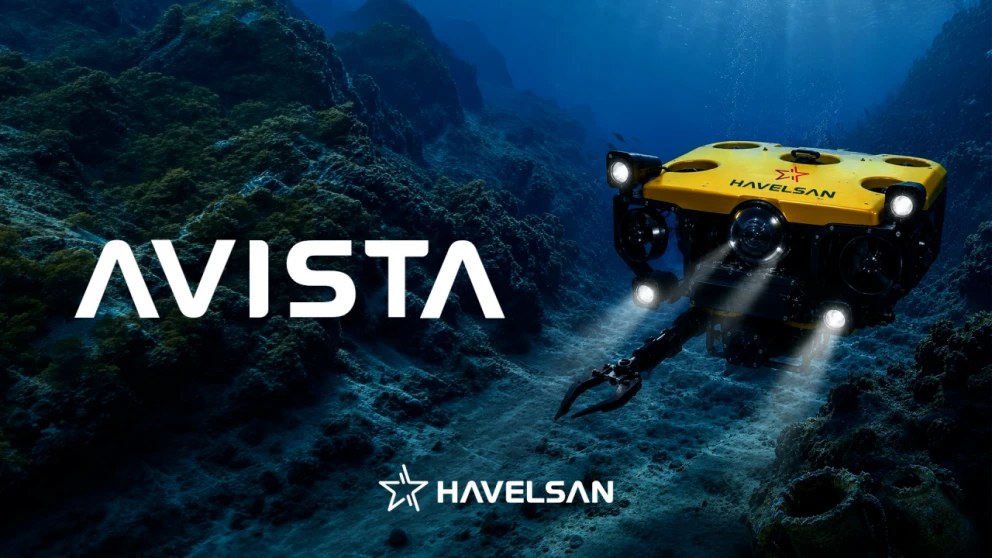
HAVELSAN used TEKNOFEST Blue Homeland 2026 in Golcuk on 28 August to unveil AVISTA, an underwater autonomy project the Turkish state-owned technology firm has funded entirely from its own resources. The reason it did so is as revealing as the technology itself: the company says it moved because underwater sensors have become both expensive and difficult to import.
That is an unusually direct statement of the problem. Sonars, doppler velocity logs, acoustic positioning systems and the inertial units that let a vehicle navigate without satellite fix are among the most tightly controlled items in the maritime domain. For a country building an unmanned naval fleet, dependence on a handful of foreign suppliers for those components is a programme risk, not a procurement inconvenience.
What AVISTA Actually Is
The demonstrator is a remotely operated underwater vehicle with six degrees of freedom — meaning it can translate and rotate freely on all axes, hovering and holding station rather than flying a fixed path like a torpedo-shaped survey AUV. That manoeuvrability is what the intended missions require.
Four capability lines sit on top of the vehicle. The first is an integrated underwater positioning system, addressing the fundamental problem that GNSS does not penetrate seawater; below the surface a vehicle must fix its position acoustically and by dead reckoning. The second is underwater mapping, building three-dimensional models of the seabed and of structures on it. The third is ship hull inspection, a routine task in peacetime and a counter-sabotage task in a crisis. The fourth is underwater navigation corridor planning — computing safe transit routes through a mapped and potentially mined volume of water.
HAVELSAN also states that AVISTA is engineered for a low acoustic signature during extended submerged loitering, which matters for any mission where the vehicle is meant to observe rather than announce itself.
Software First, Hull Second
The architectural decision behind the project is the part worth attention. HAVELSAN describes AVISTA’s algorithms and software architecture as platform-independent, designed to be lifted onto different underwater vehicles rather than welded to this particular ROV. The software is also being built to talk to ADVENT, HAVELSAN’s combat management system, which is already the backbone of Turkish Navy surface combatants.
That is a deliberate inversion of the usual sequence. Rather than building a vehicle and writing control software for it, the company is building the autonomy stack as the product and treating hulls as interchangeable carriers. If it works, capability developed on a small ROV migrates to larger platforms without being rewritten — and, because it speaks ADVENT, an unmanned underwater vehicle becomes a sensor node inside an existing fleet architecture rather than a standalone system requiring its own operator console.
Where It Leads: CAKA
AVISTA is explicitly a technology foundation for CAKA, HAVELSAN’s Submersible Hybrid Unmanned Marine Vehicle project — a craft designed to transit on the surface and submerge for the terminal phase of a mission. The company’s route to that platform runs through its existing unmanned marine work: SANCAR, the armed unmanned surface vessel now in Turkish Navy service, and RAFNAR, a hull design partnership that produced the platforms underpinning several of those programmes.
Sea trials are described as beginning shortly, with HAVELSAN targeting operational readiness for its underwater technology products in 2027. For a self-funded research project unveiled at a public festival, that is an aggressive timeline, and it should be read as an intent rather than a schedule.
The Missions Behind the Programme
HAVELSAN lists four military applications: anti-submarine warfare, anti-surface warfare, mine warfare and seabed warfare. The last of these has moved from a specialist concern to a mainstream one since the Nord Stream and Baltic cable incidents, and Turkiye sits astride a dense concentration of subsea infrastructure — energy interconnectors, fibre routes and the pipelines crossing the Black Sea and eastern Mediterranean.
Mine warfare is the more immediate driver. The Black Sea has been a mine-contaminated body of water since 2022, with drifting ordnance reaching Turkish, Bulgarian and Romanian waters, and the three littoral NATO states established a joint mine countermeasures group in response. Unmanned systems that can survey, classify and eventually neutralise mines without putting a crewed minehunter over the threat are the direction of travel for every navy facing that problem.
The civilian applications HAVELSAN cites — search and rescue, forensic recovery, infrastructure inspection and port security — are not filler. They provide the operational hours and the commercial base that keep an autonomy stack maturing between military deployments.
The Broader Turkish Pattern
AVISTA fits a now-familiar sequence in Turkish defence industry development: identify a component or capability subject to export restriction, fund an indigenous alternative internally, demonstrate it publicly at TEKNOFEST, and fold it into a larger platform programme. The same path produced domestic electro-optical payloads, national combat management systems and the drone families that reshaped Turkiye’s export profile.
Underwater autonomy is a harder problem than aerial autonomy — the environment denies satellite navigation, limits communications to low-bandwidth acoustics, and punishes hardware with pressure and corrosion. Success is not guaranteed by precedent in other domains. But the strategic logic is the same one that has driven Turkish procurement for a decade, and the company has been explicit that supply constraints, not opportunity, put this project on its own books.
Sources
- HAVELSAN, “HAVELSAN to unveil AVISTA, its new underwater autonomy project,” corporate press release — havelsan.com
- Naval News, “HAVELSAN Unveils AVISTA, New Underwater Autonomy Project,” 28 August 2026 — navalnews.com
- TEKNOFEST Blue Homeland 2026, Golcuk, programme materials