
Counter-Drone Lasers in Europe: Operational or Prototype?
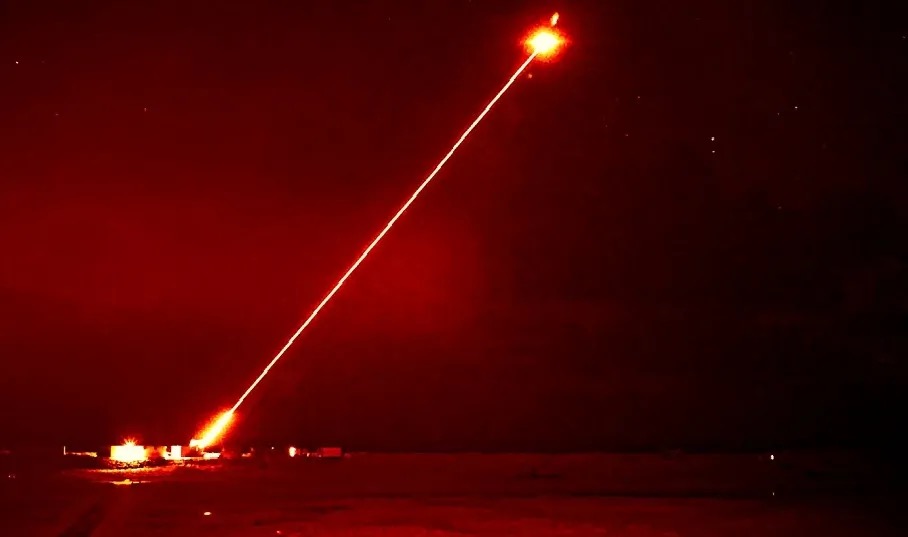
No European armed force operates a counter-drone laser in the full sense today, but two are close. The UK signed a £316 million contract with MBDA in November 2025 to put the 50 kW-class DragonFire on a Royal Navy Type 45 destroyer before the end of 2027, at a stated £10 of electricity per shot. Germany followed on 9 July 2026 with a Rheinmetall and MBDA Deutschland naval laser due in service in 2029. France fields the low-power HELMA-P, the Netherlands has just signed for a 100 kW Apollo, and Israel’s Iron Beam, delivered in December 2025, is the benchmark everyone measures against.
- UK DragonFire: £316 million, 29-month MBDA contract (20 November 2025); QinetiQ laser-source subcontract £67 million (January 2026); first Type 45 fit planned before end-2027; status PROCUREMENT.
- Germany: BAAINBw contract to ARGE HEL (Rheinmetall Waffe Munition and MBDA Deutschland) on 9 July 2026, reported at up to €462 million; demonstrator fired more than 1,000 shots from frigate Sachsen; in-service target 2029.
- France: CILAS HELMA-P protected the Paris 2024 Olympics and the DGA ordered three more in October 2024; a tens-of-kilowatts SYDERAL demonstrator (MBDA, Safran, Thales, Cilas) was ordered in August 2025 for fielding by 2030.
- Netherlands: letter of intent with EOS for the 100 kW Apollo signed 28 September 2026, including a possible Dutch production line.
- Benchmarks: Israel’s Iron Beam handed to the IDF on 28 December 2025 (OPERATIONAL, serial production); US Army awarded AeroVironment $464.8 million on 2 September 2026 for dozens of 30 kW LOCUST X3 systems.
- UK Project PANOPTES (2 September 2026) offers £5 million for laser-armed uncrewed ground vehicles against drone swarms.
Why Europe wants lasers now: the price of a shot
The argument for a counter drone laser starts with arithmetic, not physics. An air-defence missile costs hundreds of thousands of pounds, and the drones Royal Navy destroyers have fired them at in the Red Sea cost a fraction of that. The UK Ministry of Defence says a DragonFire engagement consumes about £10 of electricity, and the Dutch Ministry of Defence used the same logic when it signed with EOS in September 2026: because ammunition supply is not a concern, a laser “can be more effective and cost-efficient than kinetic air defence”. A ship with a laser does not run out of interceptors while it has fuel and cooling.
Here the money tells the story, but only part of it. The £10 covers energy per shot; it excludes purchase price, crew, maintenance and the generators and chillers the weapon depends on. Nobody in Europe has published a unit price for a production laser. The closest public data points are the EOS Apollo order the Netherlands placed in 2025, reported at €71.4 million with deliveries to 2028, and the German naval contract, which Bloomberg put at up to €462 million. Cheap shots sit on expensive hardware.
Magazine depth is the second argument. EOS states that Apollo carries enough onboard energy for more than 200 drone engagements and fires continuously when plugged into external power and cooling. The UK’s Project PANOPTES brief of 2 September 2026 puts the goal plainly: defeat large numbers of low-cost aerial threats “without exhausting munition stockpiles”. That is the demand signal. Whether European industry can meet it by 2030 is the question below, programme by programme.
The United Kingdom: DragonFire from the Hebrides to the Type 45
Britain is the European country that has moved furthest from demonstrator to funded programme, and it has done so by splitting the problem in two. The naval line, DragonFire, has a contract, a ship class and a delivery date. The land line is still a set of trials with smaller budgets and a longer road, which is the honest way to read the two H3 sections that follow.
The reason the UK is ahead is not a technical breakthrough but continuity: the same MBDA, Leonardo and QinetiQ team has worked on the beam director, the laser source and the tracking since the first Dstl contract in 2017, so the money that arrived after the 2025 Strategic Defence Review had a mature prototype to buy.
DragonFire at sea
DragonFire is the most advanced counter-drone laser programme in Europe by contract value and by schedule. MBDA UK leads, QinetiQ builds the laser source and Leonardo UK supplies the beam director and tracking optics; the demonstrator has fired on MOD ranges since late 2021. It is a 50 kW-class weapon using coherent beam combining, which merges several fibre-laser modules into one beam. It fired its first high-power shot against an aerial target in January 2024, ran six weeks of trials against Class 1 drones at the MOD Hebrides range between March and May 2025, and in October 2025 tracked and engaged larger targets flying at up to 650 km/h, the UK’s first above-the-horizon laser engagement.
The procurement decision followed within weeks. On 20 November 2025 DE&S announced a £316 million, 29-month contract with MBDA for a “Minimum Deployable Capability”, with the first Type 45 integration planned before the end of 2027, about five years earlier than the original plan. In January 2026 MBDA passed £67 million to QinetiQ for the laser source, work supporting about 120 QinetiQ jobs and more than 100 UK suppliers, half of them SMEs. Janes has reported a Royal Navy plan to fit four Type 45s over time, but the contract covers the first production-standard systems only and the MOD has not named the first ship.
The picture is less tidy on the engineering side. At the NATO Industrial Advisory Group plenary in Portsmouth on 24 June 2026, where Leonardo displayed the beam director, the three companies told Breaking Defense that their priority was fitting the existing design to the Type 45 and protecting it against ingress, not shrinking it. That is the honest status: PROCUREMENT, with sea qualification ahead. The Strategic Defence Review of June 2025 named DragonFire as the model for “novel directed energy weapons”, and Defense News reported close to £1 billion earmarked for directed energy this Parliament. Partner profiles: MBDA, QinetiQ and Leonardo.
Land lasers: Wolfhound and Project PANOPTES
The British Army is a step behind. Under the Land Laser Directed Energy Weapon demonstrator, Raytheon UK put its 15 kW High-Energy Laser Weapon System on a Wolfhound 6×6 with NP Aerospace, and in October 2024 gunners of 16 Regiment Royal Artillery destroyed mini-drones with it at Radnor Range in Wales, the first British soldiers to fire a high-energy laser from an armoured vehicle. It remains a DEMONSTRATOR with no production order.
What changed in 2026 is the framing. UK Defence Innovation launched Project PANOPTES on 2 September 2026, a two-phase competition with £5 million for Phase 1 and outline bids due 23 September. The MOD wants an autonomous, vehicle-mounted counter-UAS capability, names laser directed energy weapons as a technology of interest and asks for integration with future uncrewed ground vehicles. The threat driving it is the saturation attack described in Drone Swarms in Europe: Countries, Companies and Programmes; the Army’s answer is to put the effector on a robot that carries its own power.
Germany, France, Italy and the Netherlands: the continental programmes
On the continent the pattern is the opposite of Britain’s. Germany tested at sea first and is only now converting the result into a procurement contract, France fielded a small system for a specific event before deciding what a fleet weapon should look like, and Italy and the Netherlands are buying into other people’s designs rather than starting their own.
What unites the four is timing. Every one of these programmes has a service date between 2028 and 2030, which means that for the rest of this decade European counter-drone defence will lean on guns and missiles, with lasers arriving as a supplement rather than a replacement.
Germany: from Sachsen’s container to a 2029 fleet weapon
Germany ran Europe’s longest sea trial of a laser weapon. Rheinmetall and MBDA Deutschland, working as ARGE HEL, put a containerised demonstrator on the F124 frigate Sachsen in 2022 and kept it aboard for more than a year: 28,000 nautical miles in the North Sea, Baltic and Mediterranean and more than 1,000 engagements against air, surface and land targets, including in poor weather. The companies presented the results at WTD 91 in Meppen in March 2026.
The Bundestag budget committee cleared the project on 8 July 2026 and BAAINBw signed the development contract the next day. Rheinmetall calls the value “mid three-digit million euro”; Bloomberg put the ceiling at €462 million. The contract covers the full chain from detection to engagement, with series production “primarily in Germany” and service entry in 2029 on frigate-sized ships. The production power class is unpublished. Maturity: PROCUREMENT, built on a SEA TEST demonstrator. Background on the prime is in our Rheinmetall company profile.
France: HELMA-P in service, SYDERAL for 2030
France is the only European country that has deployed a laser on a real security mission. CILAS, owned by MBDA and Safran, built HELMA-P as a low-power, kilowatt-class counter-drone laser, and deployed prototypes to protect the Paris 2024 Olympics. On 18 October 2024 the DGA ordered three more for the Air and Space Force, Army and Navy, which makes HELMA-P the only European laser at LIMITED DEPLOYMENT. In November 2025 India’s Axiscades signed an MoU to integrate it on Indian vehicles, the first export track for a European counter-drone laser.
HELMA-P is a point-defence tool against small drones at about a kilometre; France wants more. On 22 August 2025 the DGA notified the SYDERAL demonstrator to MBDA, Safran Electronics & Defense, Thales and Cilas: a “several tens of kilowatts” system using beam combining and adaptive optics against tactical drones, rockets and mortar rounds, with fielding targeted at 2030. The DGA had already put €10 million into Lumibird and Cilas in 2024 for domestic laser sources, a signal about where it sees supply risk. SYDERAL is a DEMONSTRATOR contract, not a purchase.
Italy and the Netherlands
Italy is earliest in the cycle. MBDA Italia and Leonardo signed a memorandum of understanding on 5 December 2024 for a naval laser fire unit in two classes: a “light” unit for existing ships under MBDA, and a “high-end” unit for new ships under Leonardo, which also builds DragonFire’s beam director. Neither company has published funding or a test date, so the label is CONCEPT to LAB.
The Netherlands has moved faster than any other continental buyer. After trials of the Australian EOS Apollo, a 100 kW containerised laser against Group 1 to 3 drones, State Secretary Derk Boswijk signed a letter of intent with EOS on 28 September 2026 covering production and deployment, a possible Dutch factory, a Dutch-led European supply chain and an intention to buy “a number” of systems if the work succeeds. We covered the signing in Netherlands and EOS sign Apollo laser letter of intent. The Defense Post reports a €71.4 million Apollo order placed in 2025 with deliveries to 2028; the Dutch ministry itself gave no quantities. Status: FIELD TRIAL moving toward PROCUREMENT.
The benchmarks outside Europe: Israel, the United States and Türkiye
Israel is the yardstick because it has done what Europe is planning. On 28 December 2025, at Rafael’s headquarters in northern Israel, the Ministry of Defense handed the first Iron Beam to the Israeli Air Force, with Elbit Systems supplying the laser source and “numerous additional systems already in production”. Rafael says it intercepted rockets, mortars and drones in testing at “negligible marginal cost”. Israeli officials had said in May 2025 that lower-power lasers had already downed scores of drones in combat. Iron Beam is OPERATIONAL and in SERIAL PRODUCTION, with one stated limitation: heavy cloud and low visibility degrade it. The power class is unpublished.
The United States is the industrial reference. The Army sent four 50 kW DE M-SHORAD prototypes on Strykers to Central Command and found optics failed too often; as Lt Gen Robert Rasch put it, the Army cannot count on clean rooms in combat. Its answer, the Enduring High Energy Laser, went to AeroVironment on 2 September 2026: $464.8 million for dozens of 30 kW LOCUST X3 systems on JLTVs and pallets, the first US production contract for a laser weapon, backed by a $30 million plant in Albuquerque. The lesson for Europe: 30 kW, modular and repairable beat 50 kW and exquisite.
Türkiye belongs here as an early fielder rather than an exporter of proven lasers. ASELSAN’s GÖKBERK puts a laser, radar, thermal camera and the İHTAR jammer on one 6×6 vehicle; in March 2025 it detected, tracked and destroyed FPV drones in trials, and chief executive Ahmet Akyol said ASELSAN could supply it to Türkiye and “allied countries” now, within the Steel Dome layered air defence plan. Roketsan’s ALKA pairs a laser with electronic attack, but neither company has published an operator list or a confirmed export, so both sit at FIELD TRIAL on public evidence. Türkiye’s better-documented counter-drone layer is the gun: ASELSAN’s KORKUT 35 fired at drones in front of delegations from 12 countries at Karapınar on 26 September 2026, and it is that combination of gun, missile and laser that most European army buyers are now specifying.
Where each programme stands: the maturity map
The table uses the same labels for every programme. Power classes appear only where a government or manufacturer has stated them; “n/p” means not published.
| System (country) | Companies | Power / platform | Status | Latest milestone |
|---|---|---|---|---|
| DragonFire (UK) | MBDA UK, QinetiQ, Leonardo UK | 50 kW-class; Type 45 destroyer | PROCUREMENT | £316m contract Nov 2025; £67m QinetiQ Jan 2026; first ship by end-2027 |
| Land LDEW / HELWS (UK) | Raytheon UK, NP Aerospace | 15 kW; Wolfhound 6×6 | DEMONSTRATOR | Army live fire Oct 2024; PANOPTES £5m call Sep 2026 |
| Naval laser HLWS (Germany) | Rheinmetall, MBDA Deutschland (ARGE HEL) | n/p; container on frigate | PROCUREMENT (development) | BAAINBw contract 9 Jul 2026; 1,000+ shots from Sachsen; service 2029 |
| HELMA-P (France) | CILAS (MBDA/Safran) | kW-class; fixed/vehicle/ship | LIMITED DEPLOYMENT | Paris 2024 Olympics; 3 more ordered Oct 2024; India MoU Nov 2025 |
| SYDERAL (France) | MBDA, Safran, Thales, Cilas | “several tens of kW”; land | DEMONSTRATOR (contract) | DGA order 22 Aug 2025; fielding aim 2030 |
| Naval fire unit (Italy) | MBDA Italia, Leonardo | light and high-end; ships | CONCEPT / LAB | MoU 5 Dec 2024 |
| Apollo (Netherlands) | EOS (Australia) | 100 kW; 20 ft container | FIELD TRIAL → PROCUREMENT | LoI 28 Sep 2026; 2025 order reported €71.4m |
| Iron Beam (Israel) | Rafael, Elbit Systems | n/p (high power); fixed | OPERATIONAL / SERIAL PRODUCTION | Delivered to IAF 28 Dec 2025 |
| LOCUST X3 / E-HEL (USA) | AeroVironment (BlueHalo) | 30 kW; JLTV, pallet | PROCUREMENT / SERIAL PRODUCTION | $464.8m award 2 Sep 2026 |
| GÖKBERK (Türkiye) | ASELSAN | n/p; 6×6 vehicle | FIELD TRIAL | FPV drone trials Mar 2025 |
Two patterns stand out. First, every European programme that has reached a contract is naval: the ship supplies the power, cooling water and stable mount a laser needs, and the Red Sea gave navies the argument. Land systems, which must carry their own generator and chiller, are demonstrators everywhere except Israel and, since September, the United States. Second, the same companies fill the rows. MBDA is prime or partner in the UK, Germany, France and Italy; Leonardo supplies beam directors in two countries; Rheinmetall and QinetiQ each hold one national position. Europe has more programmes than independent laser suppliers.
That frames what a buyer actually receives in 2027 to 2029: a 50 to 100 kW-class effector against Class 1 and 2 drones at line-of-sight ranges, cued by radar and an electro-optical tracker, with performance that falls in rain, fog and heavy cloud. No European contract claims capability against cruise missiles or fast jets. Against ballistic or hypersonic missiles, lasers are not part of any European plan.
Procurement outlook 2026 to 2030 and the industrial bottlenecks
Europe’s funded pipeline is short. The UK has £316 million committed for DragonFire at sea, a follow-on for further Type 45s expected but unsigned, and £5 million of PANOPTES seed money for land robots. Germany has up to €462 million for a naval weapon in 2029. France has three HELMA-P in delivery and SYDERAL pointed at 2030. The Netherlands has a letter of intent and a reported €71.4 million first order. Italy has a memorandum. That is all of it as of September 2026: two development-to-production contracts, one low-power fleet in single digits, and paperwork. Nobody has ordered lasers for an army brigade, which is why Drone Swarms in Europe: Countries, Companies and Programmes remains a missile-and-gun problem for European land forces through the decade.
That is where the industrial bottleneck starts. Every European high-power system combines many kilowatt-class fibre-laser modules into one beam, and few firms build defence-grade sources in volume: QinetiQ in the UK, Rheinmetall and MBDA Deutschland in Germany, Lumibird and Cilas in France, Elbit in Israel. The DGA’s direct funding of Lumibird and Cilas in 2024, the Dutch insistence on a “Dutch-led European supply chain” for Apollo and Germany’s “primarily in Germany” production clause point to the same worry: fibre sources, pump diodes and beam-director optics are a concentrated supply base. The US Army’s finding that optics were its highest-failure component, and Breaking Defense’s June 2026 report that QinetiQ is still working out how to manufacture the beam at scale, show the bottleneck is production engineering, not physics.
The second constraint is integration. A laser is only as useful as the radar and electro-optical chain that hands it a track, and that sensor-fusion software is where the AI content of counter-drone defence lives; we look at that layer in How AI Is Changing Electronic Warfare in Europe: Cognitive EW and at the firms building it in Europe’s Defence AI Companies: Who Is Building What in 2026. Buyers should expect the laser to arrive as one effector inside a layered kit beside guns such as Skyranger and KORKUT and short-range missiles. The realistic European timeline: the Royal Navy with the first shipborne laser in 2027 if sea qualification holds, the German Navy in 2029, SYDERAL and Italy’s fire unit after 2030, and land forces buying in numbers only once PANOPTES or a US E-HEL derivative proves a vehicle laser can be maintained by soldiers rather than scientists.
Frequently asked questions
Which European countries have laser weapons?
None has a high-power laser weapon in operational service as of September 2026. France operates the low-power CILAS HELMA-P counter-drone laser in limited numbers, used at the Paris 2024 Olympics. The UK (DragonFire, first Type 45 fit by end-2027) and Germany (Rheinmetall and MBDA naval laser, 2029) have signed production-oriented contracts. The Netherlands signed a letter of intent for the EOS Apollo in September 2026. Israel’s Iron Beam is the only operational high-power system among Europe’s partners.
How much does a DragonFire laser shot cost?
The UK Ministry of Defence states that a DragonFire engagement uses about £10 of electricity, compared with hundreds of thousands of pounds for an air-defence missile. That figure covers energy only. It excludes the purchase price of the system, which sits inside a £316 million contract signed with MBDA in November 2025, as well as maintenance, crew and the ship’s power and cooling infrastructure.
What is the range and power of DragonFire?
The MOD and MBDA describe DragonFire as a 50 kW-class laser using coherent beam combining. The MOD has not published an official engagement range; it has said the weapon can hit a £1 coin at one kilometre and, in October 2025 trials at the Hebrides range, tracked and engaged drones flying at up to 650 km/h in the UK’s first above-the-horizon laser engagement.
When will the Royal Navy get DragonFire on the Type 45?
DE&S announced on 20 November 2025 a 29-month contract for a “Minimum Deployable Capability”, with the first Type 45 destroyer integration planned before the end of 2027, about five years earlier than the original plan. The MOD has not named the first ship, and Janes reports a longer-term plan to fit four Type 45s.
Is Germany buying a laser weapon?
Yes. On 9 July 2026 the BAAINBw procurement office contracted Rheinmetall Waffe Munition and MBDA Deutschland (ARGE HEL) to develop a high-energy laser weapon system for German Navy frigates, with service entry planned for 2029. Bloomberg reported the approved ceiling at €462 million. The contract follows more than a year of sea trials of a containerised demonstrator on the frigate Sachsen, which fired over 1,000 shots.
Sources
- UK Defence Equipment & Support: Boost for Armed Forces as new laser weapon takes down high-speed drones (November 2025)
- Defense News: UK Royal Navy to equip MBDA’s drone-frying lasers by 2027 (November 2025)
- Janes: MBDA to deliver DragonFire LDEW for RN Type 45 destroyers (November 2025)
- Defence Connect: QinetiQ secures DragonFire contract for directed energy weapon source (January 2026)
- Breaking Defense: UK industry team looks to miniaturize DragonFire laser for Type 45 destroyer debut (June 2026)
- UK Government: The Strategic Defence Review 2025 (June 2025)
- European Security & Defence: British Army personnel conduct live-firing with Raytheon UK’s laser weapon demonstrator (December 2024)
- Airforce Technology: UK MoD launches Project PANOPTES to counter mass drone threats (September 2026)
- Rheinmetall: BAAINBw commissions Rheinmetall and MBDA to develop a laser weapon system for the German Navy (July 2026)
- Bloomberg: Rheinmetall wins German laser deal after frigate fiasco (July 2026)
- DGA (Ministère des Armées): La DGA commande un démonstrateur de laser de forte puissance destiné à la lutte anti-drones (September 2025)
- CILAS: 3 more HELMA-P for the French armed forces (October 2024)
- The Defense Post: Axiscades to bring France’s Helma-P laser counter-drone system to India (November 2025)
- MBDA: MBDA to develop additional laser capability with Leonardo (December 2024)
- Defence Connect: EOS, Netherlands sign letter of intent for Apollo laser production, deployment (September 2026)
- The Defense Post: Netherlands, EOS agree to further develop 100-kW Apollo counter-drone laser (September 2026)
- Israel Ministry of Defense: Israel MOD and Rafael deliver first operational high-power laser system Iron Beam to the IDF (December 2025)
- Breaking Defense: Israel’s new laser system goes active (December 2025)
- The Times of Israel: Defense Ministry hands IDF first combat-ready Iron Beam laser interception system (December 2025)
- AeroVironment: AV’s LOCUST selected for nearly $500 million Army counter-UAS contract for E-HEL program (September 2026)
- Defense News: Army readies to launch 2026 competition for counter-drone laser weapon (August 2025)
- Airforce Technology: Aselsan tests Gökberk laser system against FPV drone threats (March 2025)