
Decision Day at the Critical Summit. Trump’s Remarks During His Visit to China

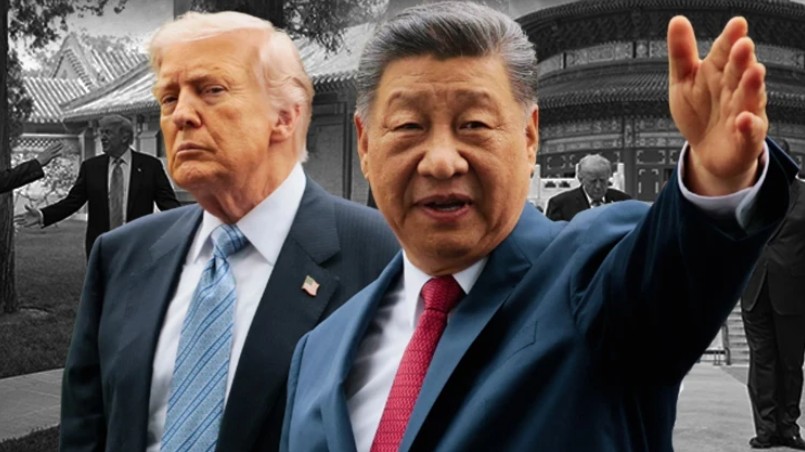

The high-stakes Beijing Summit between Donald Trump and Xi Jinping reached its critical second day as both leaders attempted to balance personal rapport with deep-seated strategic rivalries. While Trump lavished praise on the Chinese leader’s strength, the underlying tensions over Taiwan, the Strait of Hormuz, and Artificial Intelligence (AI) continue to define the new era of “strategic stability” between the two superpowers.
The final day of the two-day summit in Beijing concluded with a historic walk through the Zhongnanhai Garden, followed by private talks between President Donald Trump and President Xi Jinping. The atmosphere, described by Trump as “extraordinarily positive,” marks a significant attempt to de-escalate global tensions following the kinetic military exchanges in the Middle East earlier this year.

The Personal Factor: “A Tremendous Leader”
True to his diplomatic style, President Trump utilized high-level praise as a tool for negotiation. Speaking to reporters before the official sessions, Trump described his relationship with Xi as “very strong,” echoing comments he made to Fox News where he called Xi a “tremendous, powerful, and very solid leader.”
“He is 100% focused,” Trump remarked, noting Xi’s physical presence and leadership style as unique on the world stage. For Beijing, this personal hospitality was reciprocal; President Xi noted he chose the historic Zhongnanhai Palace specifically to return the hospitality shown to him at Trump’s Mar-a-Lago estate in 2017.
Defense & Security: The Hormuz and Iran Knot
Despite the cordiality, the defense agenda was heavy. Trump confirmed that both leaders share a common stance on preventing Iran from obtaining nuclear weapons.
-
The Strait of Hormuz: Trump emphasized the need for maritime security, stating, “We want the straits open. Situation there is a little crazy, a little bit delice. It shouldn’t be that way.”
-
Military Supply Chains: Trump claimed Xi promised that China would not provide “military equipment” to Tehran, though no concrete commitment was made regarding China’s continued import of Iranian oil—a major point of friction for Washington.

Taiwan: The Non-Negotiable Red Line
The summit’s most friction-filled moment occurred over Taiwan. President Xi delivered a stern warning, stating that the Taiwan issue is the “most important” matter and, if mishandled, could lead to a direct military confrontation between the US and China.
While Trump deflected Taiwan-specific questions by calling China a “beautiful country,” US Secretary of State Marco Rubio was more direct. Rubio told NBC that any forced change to the status quo in the Taiwan Strait would be “bad for both countries,” reinforcing Washington’s commitment to regional stability.
The AI War: A New Dialogue Mechanism
The technological front of the summit saw a major announcement regarding Artificial Intelligence. US Treasury Secretary Scott Bessent announced a new dialogue mechanism between the two “AI superpowers.”
“The reason we can have healthy conversations with the Chinese on AI is because we are ahead,” Bessent noted, suggesting that Washington’s current lead in AI technology provides the necessary leverage for these strategic talks. The summit also saw high-profile business figures like Elon Musk and Goldman Sachs CEO David Solomon in attendance, highlighting the intersection of corporate interests and national security.
In conclusion; While the Beijing Summit successfully established a framework for “strategic stability” and saw Xi Jinping accept an invitation to visit Washington in September, the fundamental disagreements on Taiwan and Iran suggest that the US-China relationship remains a fragile balance of power rather than a true alliance.