Honeywell Aerospace Defense Business, Products and Revenue
Honeywell Aerospace is one of the biggest defense suppliers most people never count, a business with roughly $15.4 billion in 2024 aerospace revenue whose turbines drive the M1 Abrams tank and whose boxes fly on nearly every Western military aircraft. With parent Honeywell splitting itself into three companies, the Phoenix-based aerospace arm is about to stand alone for the first time.
Honeywell Aerospace at a glance
| Item | Detail |
|---|---|
| Unit | Honeywell Aerospace Technologies |
| Parent | Honeywell International Inc., headquartered in Charlotte, North Carolina |
| Aerospace base | Phoenix, Arizona |
| Revenue | Roughly $15.4 billion in 2024, about a third of it defense and space |
| Defense lines | Engines and APUs, navigation, avionics, power and thermal systems, wheels and brakes |
| Flagship military products | AGT1500 tank turbine, T55 helicopter engine, F124 turbofan, 331 APU family, embedded GPS/INS |
| Status | Planned spin-off as an independent aerospace company, targeted for 2026 |
The aerospace lineage runs through some of the most storied names in American aviation. Today’s business is the accumulation of Garrett AiResearch, Bendix, Sperry Aerospace and Lycoming’s turbine lines, welded together by the 1999 merger of Honeywell and AlliedSignal, which kept the Honeywell name. That history explains the sprawling catalogue, few companies inherited more cockpit, engine and accessory franchises than this one.
What does Honeywell make for the military
Honeywell is a systems house rather than a platform builder. Its defense catalogue spans propulsion, the T55 engines that have powered the CH-47 Chinook for six decades and the F124 turbofans in jet trainers, auxiliary power units from the 331 family found on airliners and military transports alike, embedded GPS/INS navigators that guide aircraft and precision weapons, TALIN inertial systems for artillery and armored vehicles, satellite communications, air data computers, environmental control, and wheels and brakes for fighters. If it spins, cools, navigates or powers something on a military aircraft, Honeywell probably bids on it.
Space adds another layer. Honeywell avionics and guidance hardware have flown on crewed spacecraft and satellites for decades, and the company supplies inertial references and processors for missile-defense and space-surveillance programs it rarely advertises.
The engine that drives the Abrams
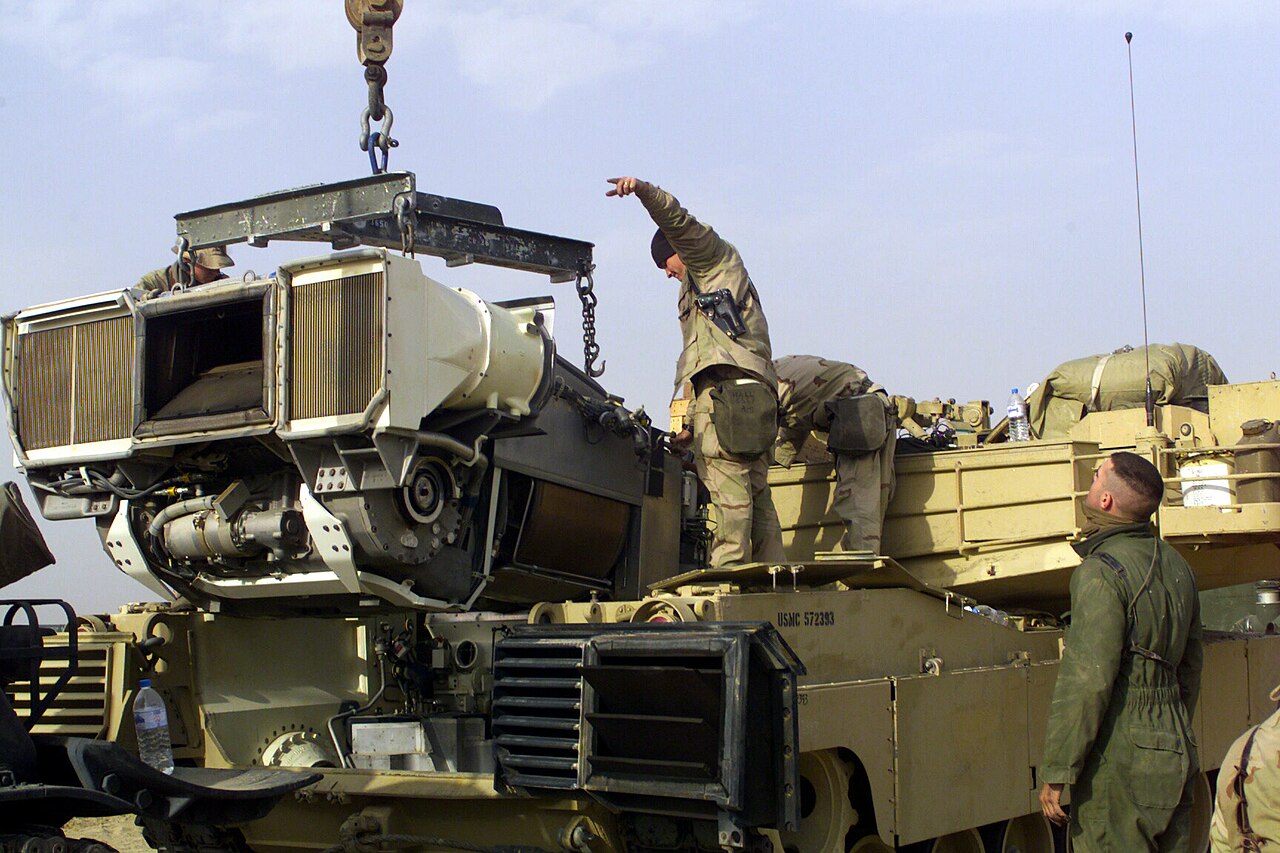
The company’s most distinctive defense franchise never leaves the ground. Every M1 Abrams runs on the AGT1500, the 1,500 hp gas turbine that gives the tank its trademark whine and jet-like acceleration. Honeywell inherited the line through its merger history and today remanufactures and supports thousands of the turbines for the US Army and Abrams export fleets from Poland to Australia. The Army’s planned hybrid AbramsX-style successor engine is a live threat to that franchise, and Honeywell has pitched updated turbine and hybrid options to keep it.
Honeywell on the F-35 and fighter fleets
On the F-35, Honeywell supplies the power and thermal management system, the machinery that starts the engine, generates onboard power and swallows the enormous heat load of the jet’s electronics, one of the program’s most critical subsystems as upgrades push cooling demand ever higher. Honeywell hardware also rides on the F-15, F-16, C-17 and most Western helicopters, and its navigation units sit inside guided weapons across the US inventory. The business profits from fleets flying, not just from new aircraft, which makes its defense revenue unusually resilient.
The Honeywell breakup and what it means
Under pressure from activist investors, Honeywell announced that it will split into three public companies, automation, aerospace and advanced materials, with the aerospace separation targeted for 2026. A standalone Honeywell Aerospace would instantly rank among the world’s largest pure aerospace suppliers, comparable in scale to the biggest names in the global defense rankings’ supplier tier. The bet is that focus, and a currency to buy other aerospace assets, beats conglomerate breadth, the same logic that transformed GE Aerospace after its own breakup.
Honeywell Aerospace frequently asked questions
Is Honeywell a defense company?
Partly. Roughly a third of its aerospace unit’s $15.4 billion 2024 revenue comes from defense and space, alongside a large commercial aviation business.
What engine does Honeywell make for the M1 Abrams?
The AGT1500, a 1,500 hp gas turbine; Honeywell remanufactures and supports the fleet’s engines for the US Army and export operators.
What does Honeywell supply on the F-35?
The power and thermal management system, which starts the engine, generates power and cools the jet’s electronics.
Is Honeywell Aerospace becoming a separate company?
Yes. Honeywell plans to split into three companies, with the aerospace spin-off targeted for completion in 2026.
Where is Honeywell Aerospace based?
The aerospace business is run from Phoenix, Arizona; parent Honeywell International is headquartered in Charlotte, North Carolina.
- Public company data and 2024 segment disclosures
- Wikipedia – Honeywell Aerospace (accessed October 2026)
- US Army and program-office statements on Abrams propulsion
- Defence & Tech reporting on the aerospace supplier tier