Counter-Battery Radar Explained, How Armies Find Enemy Guns
Counter-battery radar is the technology that turns an enemy’s own shells against him, tracking a round in flight and calculating the gun’s position within seconds of the first shot. In Ukraine’s artillery war, where thousands of tubes duel daily, these radars decide who shoots second, and whether the first shooter survives long enough to fire again.
What is counter-battery radar
A counter-battery (or weapon-locating) radar watches slices of sky over the front line for artillery shells, mortar bombs and rockets in flight. When it catches one climbing, it measures a segment of the trajectory and runs the ballistics backwards to the firing position and forwards to the impact point. The firing coordinates go to friendly guns or rocket launchers for counter-fire, the impact prediction can warn troops in the target area. The concept dates to World War II sound-ranging, but modern AESA radar made it fast, multi-target and mobile.
How does counter-battery radar work
The radar sweeps an electronic fence a few degrees above the horizon across its sector. A shell crossing that fence returns a tiny echo, modern sets detect objects with radar cross-sections far smaller than a drone, and the beam revisits it several times a second. From even a short observed arc, a Kalman-filtered ballistic model extrapolates the full parabola. Electronically scanned arrays track dozens or hundreds of rounds at once and sort shell from rocket from mortar bomb automatically, then push grid coordinates into the fire-control network, so a HIMARS or howitzer battery can fire back before the enemy guns finish their mission. Gallium-nitride transmitters, the same GaN technology spreading through air defense, have extended detection ranges and cut power demands in the newest sets.
Main counter-battery radar systems
| System | Origin | Notes |
|---|---|---|
| AN/TPQ-53 | USA (Lockheed Martin) | US Army standard, AESA, roughly 60 km against rockets, on a 5-ton truck |
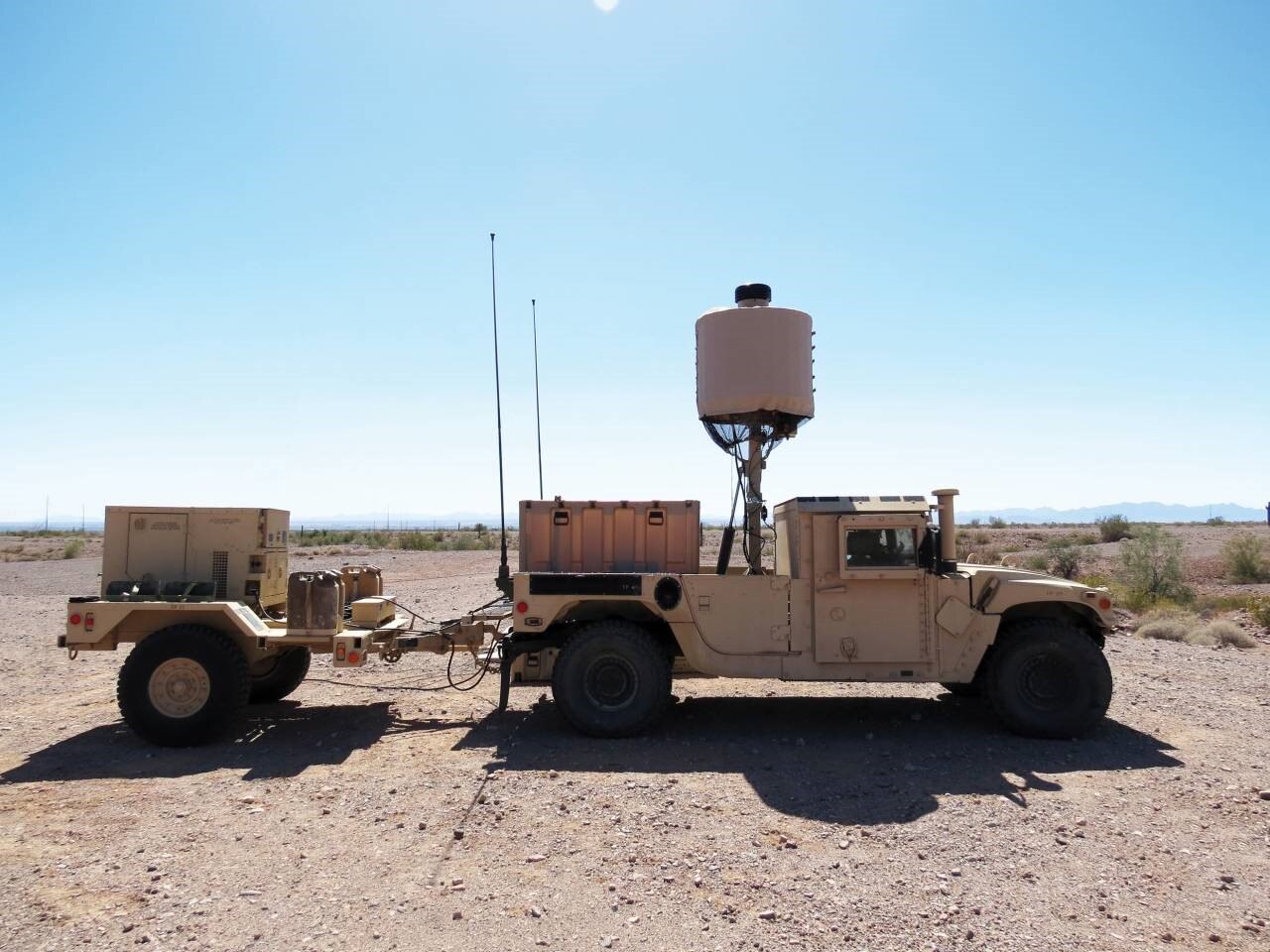
| AN/TPQ-50 | USA (SRC) | Lightweight 360-degree set for mortars and rockets, HMMWV or tripod mounted |
| AN/TPQ-36/37 Firefinder | USA | Cold War-era passively scanned pair, widely exported, many donated to Ukraine |
| ARTHUR | Sweden (Saab) | Long-serving NATO weapon-locating radar, used by multiple donors to Ukraine |
| COBRA | Germany/France (consortium) | High-end AESA counter-battery radar of several NATO armies |
| Zoopark-1M | Russia | Russia’s principal counter-battery set, a priority target in Ukraine |
| SLC-2 family | China | Chinese AESA weapon-locating radar, exported alongside Norinco artillery |
Counter-battery radar in Ukraine
Ukraine turned counter-battery work from a staff procedure into a minute-by-minute contest. Western radars, TPQ-36s, TPQ-50s, ARTHURs, Zoopark hunting became explicit mission sets, and operator-reported accounts describe Russian batteries relocating within two to five minutes of firing to beat the response. Both sides learned the same hard lesson, the radar that locates guns is itself a priority target, found by drones and anti-radiation seekers the moment it radiates. Crews now emit in short scheduled windows, displace constantly and hand data off by network so no single radar owns a sector for long. Reconnaissance drones have absorbed part of the role too, but radar remains the only sensor that works through cloud, night and the whole width of a front simultaneously.
Limitations and how gunners fight back
The radar’s weakness is that it must transmit, and transmission is a beacon. Anti-radiation missiles, loitering munitions and jamming all follow the emissions, which is why doctrine treats these radars as consumables to disperse and shelter rather than assets to park. On the shooting side, gunners answer with shoot-and-scoot tactics, firing fewer rounds per position, with low-trajectory shots that shrink the radar’s observation window, and with rocket salvos meant to saturate the tracker. The duel has no permanent winner, each improvement in locating speed forces faster displacement, and the side whose sensors-to-shooters loop runs tighter simply loses fewer guns.
Counter-battery radar frequently asked questions
How does a counter-battery radar find a gun?
It tracks a shell in flight and runs the ballistic trajectory backwards to the firing point, usually within seconds of the shot.
How far can counter-battery radar detect?
Modern AESA sets like the AN/TPQ-53 are credited with roughly 60 km against rockets and less against low-flying shells, per manufacturer statements.
Can counter-battery radar be jammed or destroyed?
Yes. Its emissions can be jammed and traced, and radars are priority targets for anti-radiation missiles and loitering munitions.
What counter-battery radars does Ukraine use?
Donated AN/TPQ-36, AN/TPQ-50 and ARTHUR sets among others, alongside domestic radars and drone-based spotting.
What is shoot-and-scoot?
Firing a few rounds and relocating immediately, the standard artillery tactic for surviving enemy weapon-locating radar.
- Manufacturer product literature for TPQ-53, TPQ-50, ARTHUR and COBRA
- Wikipedia – Counter-battery radar (accessed October 2026)
- Reporting on artillery duels and radar attrition in Ukraine (operator-reported figures noted)
- Defence & Tech reporting on artillery modernization