Su-35S Specs, Radar, Weapons and Combat Record in Ukraine

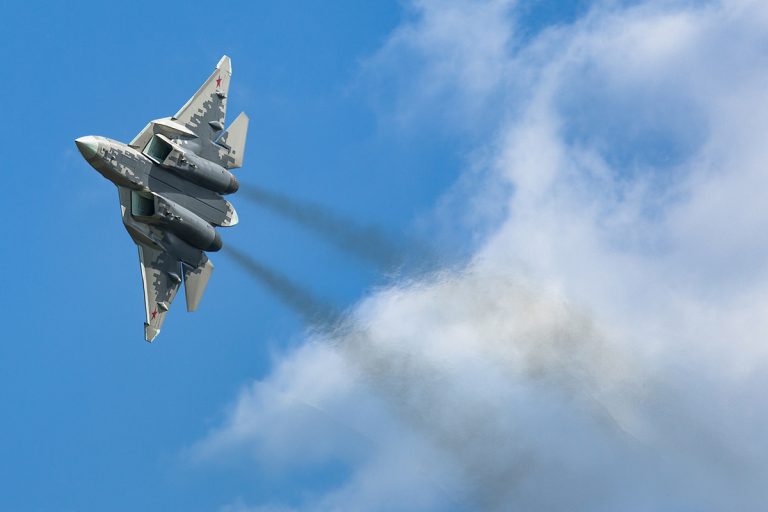
The Sukhoi Su-35S is Russia’s most capable fourth-generation-plus fighter in large-scale service, a thrust-vectoring Flanker with a claimed top speed of Mach 2.25 and an 8,000 kg weapon load. Introduced into Russian service in 2014, it has become the workhorse of the Russian Aerospace Forces in the Ukraine war, and its performance figures below are manufacturer claims unless stated otherwise.
Su-35S specs
| Parameter | Value (manufacturer claims unless noted) |
|---|---|
| Role | Single-seat multirole air superiority fighter |
| Length / wingspan | About 21.9 m / about 15.3 m |
| Max takeoff weight | About 34,500 kg |
| Engines | 2 x Saturn 117S (AL-41F1S) with 3D thrust vectoring, each roughly 14,500 kgf with afterburner |
| Max speed | About Mach 2.25 at altitude |
| Range | About 3,600 km on internal fuel, longer with external tanks |
| Service ceiling | About 18,000 m |
| Gun | 1 x 30mm GSh-30-1 cannon with about 150 rounds |
| Weapon stations | 12 hardpoints, about 8,000 kg of external stores |
| Radar | N035 Irbis-E passive electronically scanned array |
| Self-protection | Khibiny-M electronic warfare pods and L-265 suite |
How was the Su-35S developed
The Su-35S is not a new airframe but a deep redesign of the Soviet-era Su-27 Flanker. Sukhoi flew the first modern prototype, then known as the Su-35BM, in February 2008, adding a new cockpit, more powerful engines, a stronger structure with a 6,000-hour life claim and the big Irbis-E radar. Serial production at the Komsomolsk-on-Amur plant produced the first aircraft for the Russian Aerospace Forces in 2014.
The project has long been described as a bridge. It gave Russia a modern multirole fighter while the stealthy Su-57 remained in limited production, and it kept the Flanker line alive for export. Roughly 100 or more aircraft are estimated to have been built for Russian use, though the precise count is not officially published.
Su-35S radar and weapons
The Irbis-E is a passive electronically scanned array, meaning it steers its beam with phase shifters but uses a single high-power transmitter rather than hundreds of small modules. Russian sources claim it can detect large aircraft at about 400 km and track up to 30 air targets while engaging eight, figures that have not been independently verified. The design trades the flexibility of modern AESA sets for raw power, a difference we explain in our guide to how AESA radar works.
The aircraft also carries the OLS-35 infrared search-and-track sensor, which can cue weapons without emitting radar, a role described in our explainer on IRST systems. Air-to-air armament ranges from the short-range R-73 through the active-radar R-77 family to the very-long-range R-37M, and the jet drops glide bombs and fires Kh-31, Kh-35 and Kh-59 missiles. The thrust-vectoring nozzles give exceptional low-speed agility, though that matters less in an era of beyond-visual-range fighting.
Su-35S operators and exports
| Operator | Status | Notes |
|---|---|---|
| Russia | In service since 2014 | Main operator, estimated at roughly 100 or more aircraft |
| China | 24 delivered | Bought under a contract announced in 2015; deliveries completed by 2018, widely reported |
| Egypt | Reported order | Reports of an order for about two dozen jets; deliveries have not been officially confirmed |
| Algeria | Reported buyer | Media reports of deliveries; treat as unconfirmed |
| Indonesia | Canceled | A 2018 deal for 11 aircraft was dropped after US sanctions pressure |
Export success has been thin. China was the first foreign buyer with 24 jets, while other announced deals have been delayed or unverified, partly because of sanctions risk. The Su-35S also competes for the same buyers as the Su-57E, and for how the two Russian fighters stack up against Western options see our comparison of the F-35 and Su-57.
Su-35S in Ukraine
The Su-35S has been heavily used since February 2022, mainly flying from Russian territory to fire glide bombs and long-range missiles and to escort other aircraft. Russian forces have also used it to fire R-37M missiles at long range against Ukrainian aircraft, according to Russian and Ukrainian reporting.
Ukrainian officials have claimed several Su-35S shoot-downs by air defense and aircraft, and these claims are operator-reported. Open-source trackers have documented fewer confirmed losses than Ukraine has asserted, and some losses are attributed to Russian friendly fire. Taken together, the record shows a capable aircraft that has been kept at a distance from dense Ukrainian air defenses, rather than one that has dominated the skies.
Su-35S frequently asked questions
How fast is the Su-35S?
Russia claims about Mach 2.25 at altitude. This is a manufacturer claim and has not been independently verified.
Is the Su-35S a fifth-generation fighter?
No. It is generally classed as fourth-generation-plus, with thrust vectoring and advanced avionics but no stealth shaping.
What is the difference between the Su-35S and Su-57?
The Su-57 is a stealth design with internal weapon bays and an AESA radar; the Su-35S is a non-stealthy upgraded Flanker.
Who flies the Su-35S?
Russia is the main operator, China received 24 aircraft, and Egypt and Algeria are reported buyers with unconfirmed deliveries.
Has the Su-35S been shot down in Ukraine?
Ukraine has claimed several kills, which are operator-reported, and open-source reporting confirms some losses, including some from friendly fire.
- Wikipedia – Sukhoi Su-35 (accessed October 2026)
- Russian state media and United Aircraft Corporation statements (manufacturer claims)
- Ukrainian General Staff statements (operator-reported)
- Open-source loss documentation and Defence & Tech reporting