Tatra Trucks, the Czech Backbone Chassis Behind Europe’s Wheeled Howitzers
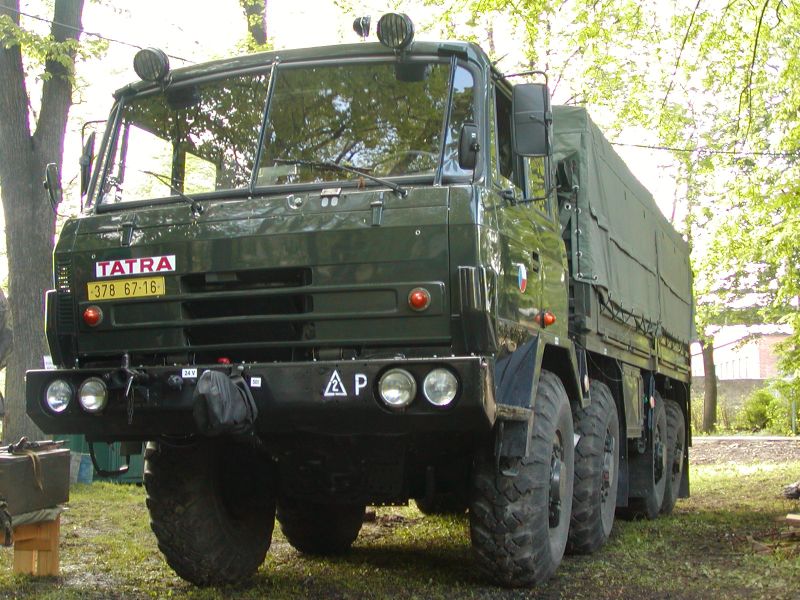
Tatra Trucks is the Czech heavy-truck maker whose backbone-tube chassis and swing half-axles have carried artillery, rocket launchers and radars for armies on four continents, and whose trucks won the Dakar Rally trucks class repeatedly. Based in Kopřivnice since 1850, the company is one of the oldest continuously operating vehicle makers in the world, and its military 8×8 chassis sit under some of the most sought-after wheeled howitzers in Europe.
Tatra Trucks at a glance
| Item | Detail |
|---|---|
| Legal name | Tatra Trucks a.s. |
| Headquarters | Kopřivnice, Moravian-Silesian Region, Czech Republic |
| Origin | 1850, as a coachbuilder founded by Ignác Šustala; Tatra brand adopted in 1919 |
| Core products | Heavy off-road trucks in 4×4 to 12×12 layouts; military variants, the Tatra 815-7 and 817 families |
| Civilian line | Tatra Phoenix, a Tatra chassis with a DAF cab and a Paccar water-cooled engine |
| Defense focus | Wheeled artillery carriers, rocket launchers, recovery, bridging and air defense chassis |
| Drivetrain news | Hybrid, battery-electric and fuel-cell Force e-Drive vehicles introduced in 2023-2026 |
Why Tatra trucks have a backbone chassis
The design that defines Tatra was set in 1923, when engineer Hans Ledwinka put a rigid central backbone tube under the Tatra 11 car and hung the rear wheels on swinging semi-axles. The same idea scaled up into trucks. Instead of a ladder frame flexing over rough ground, a torsionally stiff tube carries the drivetrain, and every wheel keeps independent travel.
For an army, that matters in mud, sand and rock. A backbone truck keeps more wheels on the ground and tolerates twisting loads that would crack a conventional frame, which is why Tatra 8×8 and 10×10 chassis are popular as platforms for heavy weapons that recoil hard. The marque proved the point in rally raids, where Tatra driver Karel Loprais won the Dakar trucks class six times.
Tatra military trucks and what they carry
| System | Role | Tatra link |
|---|---|---|
| Tatra 815-7 family | General cargo, fuel, recovery, engineer support | Modular 4×4 to 10×10 military chassis range |
| Tatra 817 | Heavy military truck generation | Primary military line per public descriptions |
| Morana 155mm howitzer | Wheeled self-propelled artillery | 8×8 Tatra carrier; see our report on the deal with Latvia |
| DANA family | 152mm wheeled howitzer | Tatra 815 8×8 chassis, used by Czech forces |
| CAESAR 8×8 (Czech order) | 155mm truck-mounted howitzer | Tatra chassis used for the Czech variant |
| Pinaka launchers (India) | Multi-barrel rocket launcher carrier | Tatra-derived chassis built under license in India |
The pattern is consistent. Customers pick a weapon, then look for the carrier that keeps it mobile, and Tatra’s 8×8 frequently wins that second decision. The Czech Army mounts its DANA howitzer on a Tatra 8×8, France’s KNDS has offered a Tatra-based CAESAR to Prague, and Slovak and Latvian programs lean on the same carrier family. In India, Tatra-derived trucks carry the Pinaka rocket launcher, built locally under license.
Who owns Tatra Trucks
Tatra Trucks a.s. is a privately held Czech company. Nationalized in 1945 and run as a state enterprise during the communist era, it stopped building passenger cars in 1999 to focus on trucks, then passed through a series of private owners after the turn of the century. Detailed shareholder information is not widely published, and readers should treat secondary reports about current stakes with caution.
What is clear is the industrial logic. Tatra concentrates on the expensive, low-volume end of the truck market, where the defense customer pays for capability rather than price per ton. A plan to exceed 2,000 trucks in 2023 shows that scale, a fraction of what mass-market truck makers produce, and it explains why the company works with partners for cabs and some engines on its civilian Phoenix line.
Tatra and the artillery boom
European rearmament has turned an old niche into a growth market. Wheeled howitzers promise tracked-level firepower at a fraction of the logistics burden, and each one needs a chassis strong enough to absorb a 155mm recoil. As we noted in our look at the Morana howitzer deal for Latvia, the carrier is increasingly part of the headline when those contracts are announced.
The challenge is capacity. Hand-assembled backbone chassis cannot be scaled like a car line, and long procurement cycles mean Tatra must decide years ahead how much to invest. Demand from artillery programs and the wider 155mm production race gives it confidence, while the Force e-Drive hybrid and fuel-cell prototypes are an attempt to offer silent-watch and lower-signature options to militaries that want them.
Tatra Trucks frequently asked questions
Where are Tatra trucks made?
In Kopřivnice in the Czech Republic, where the company has built vehicles since 1850.
What is a Tatra backbone chassis?
A central rigid tube carrying the drivetrain, with independently suspended half-axles, instead of a conventional ladder frame. It gives extreme off-road articulation.
Which armies use Tatra trucks?
The Czech and Slovak armies are core users, and Tatra-derived vehicles serve in India and many other countries as cargo trucks and weapon carriers.
Does Tatra still make cars?
No. Passenger car production ended in 1999, and the company now builds trucks only.
Are Tatra trucks electric?
Tatra has introduced hybrid, battery-electric and fuel-cell Force e-Drive variants between 2023 and 2026, mostly for specialist and pilot applications.
- Wikipedia – Tatra (company) (accessed October 2026)
- Public company information and Czech defense procurement announcements
- Reference works on Dakar Rally truck results
- Defence & Tech reporting on wheeled artillery programs