Lynx KF41 Specs, Variants, Orders and the XM30 Race
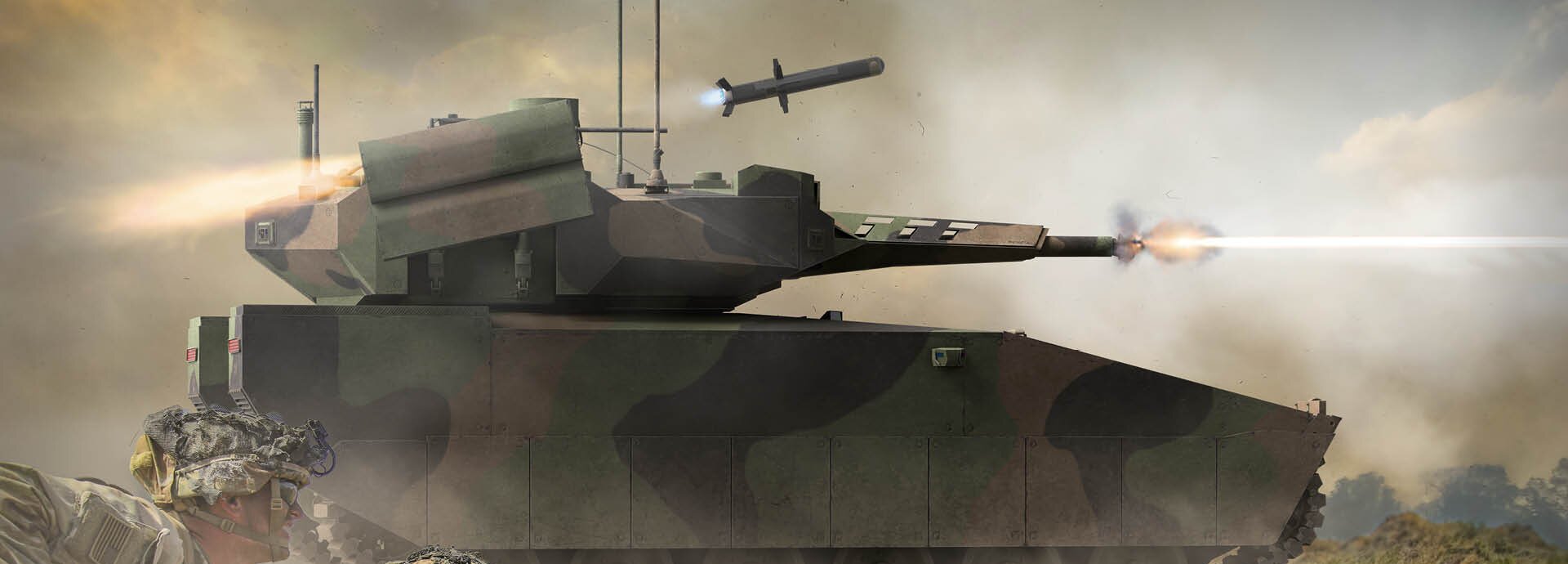
The Lynx KF41 is Rheinmetall’s clean-sheet infantry fighting vehicle, a roughly 44-tonne design with a 30 or 35mm Lance turret, room for three crew and eight dismounts, and a chassis rated to grow toward 50 tonnes. Unveiled in 2018, it has gone from trade-show model to a production program spanning Hungary, Ukraine, Italy and the finals of the US Army’s Bradley replacement.
What is the Lynx KF41
Rheinmetall built the Lynx as a private venture after watching the Puma, its joint-venture IFV with KNDS, price itself out of export markets. The design philosophy is modularity taken seriously: a common drive module up front, a mission compartment behind it that can be reconfigured between roles, and armor fitted in packages the customer picks against threat and weight budgets. The smaller KF31 demonstrator came first in 2016; the stretched KF41, shown in 2018, is the version everyone buys.
Lynx KF41 specifications
| Item | Figure |
|---|---|
| Crew and dismounts | 3 crew + 8 infantry |
| Combat weight | Roughly 44 tonnes in IFV configuration; chassis growth toward 50 tonnes |
| Main armament | Lance 2.0 turret with 30mm or 35mm Wotan autocannon, airburst-capable |
| Secondary | 7.62mm coaxial MG; twin anti-tank missile launcher option; loitering-munition integration shown |
| Engine | Liebherr diesel, roughly 1,140 hp, with Renk transmission |
| Speed | About 70 km/h on road, manufacturer figure |
| Protection | Modular passive packages plus optional StrikeShield hybrid active protection |
| Electronics | Open digital architecture; Hungarian vehicles integrate a battle management system built locally |
Lynx KF41 variants
The mission-module concept exists to multiply variants cheaply. Beyond the baseline IFV, Rheinmetall has shown or contracted command post, armored recovery, ambulance, driver training and mortar-carrier configurations, plus an air defense version mounting the Skyranger 30 turret, a combination Hungary has pursued to protect its own mechanized brigades against drones. A 120mm gun-armed fire support concept, the Lynx 120, targets the light-tank niche. Because every variant shares the drive module, a customer’s fleet logistics collapse to one spare-parts chain, the argument Rheinmetall presses hardest against older rivals.
Who has ordered the Lynx
| Customer | Status |
|---|---|
| Hungary | 218 vehicles ordered 2020; first deliveries 2023; joint plant at Zalaegerszeg building most of them |
| Ukraine | Initial vehicles delivered from 2024 with local assembly announced as part of Rheinmetall’s Ukrainian ventures |
| Italy | Selected 2023–24 as the basis of the Army’s A2CS armored family; a program discussed at up to roughly 1,000 vehicles pending funding |
| United States | Lynx-derived XM30 design, via American Rheinmetall with partners, in the final two of the Bradley-replacement competition |
| Others | Greece and several European and Gulf states have evaluated or negotiated; Australia chose the rival Redback in 2023 |
Hungary was the bet that made the program real: Budapest did not just buy vehicles, it bought a factory, and Zalaegerszeg now anchors Lynx production outside Germany. Italy’s selection potentially dwarfs everything else, and the vehicle’s main European rival remains the BAE Systems-built CV90, which keeps winning the Nordic-flavored competitions.
Lynx in Ukraine and the XM30 race
Ukraine operates a small but growing Lynx fleet, with the first vehicles handed over in late 2024 and assembly work building up inside the country; combat feedback so far is limited and operator-reported. The sharper test is American. The XM30 program pits a Lynx-derived design against General Dynamics for the contract to replace thousands of Bradleys, with prototypes due for Army evaluation in the late 2020s. Winning would make the Lynx family the standard Western IFV of the 2030s; losing still leaves a European production base deeper than any rival’s except the CV90’s.
Lynx KF41 frequently asked questions
Who makes the Lynx KF41?
Rheinmetall, with production in Unterlüss, Germany and Zalaegerszeg, Hungary, plus announced assembly in Ukraine and a US derivative for the XM30 program.
How many dismounts does the Lynx carry?
Eight, plus a crew of three, among the highest capacities of any current Western IFV.
What gun does the Lynx use?
The Lance 2.0 turret with Rheinmetall’s 30mm or 35mm Wotan autocannon firing programmable airburst ammunition, plus optional anti-tank missiles.
Which countries operate the Lynx?
Hungary is the launch operator with 218 on order; Ukraine fields initial vehicles; Italy has selected it; the US is evaluating a derivative as the XM30.
Is the Lynx combat proven?
Only marginally, early Ukrainian use with limited, operator-reported feedback. Its rivals’ Ukraine records remain deeper.
- Rheinmetall product literature and program announcements (manufacturer claims noted)
- Hungarian, Italian and US program reporting on Lynx and XM30
- Wikipedia – Lynx (Rheinmetall) (accessed October 2026)
- Defence & Tech reporting on IFV competitions