Russia’s Armored Vehicles: BMP, BTR and BMD Explained
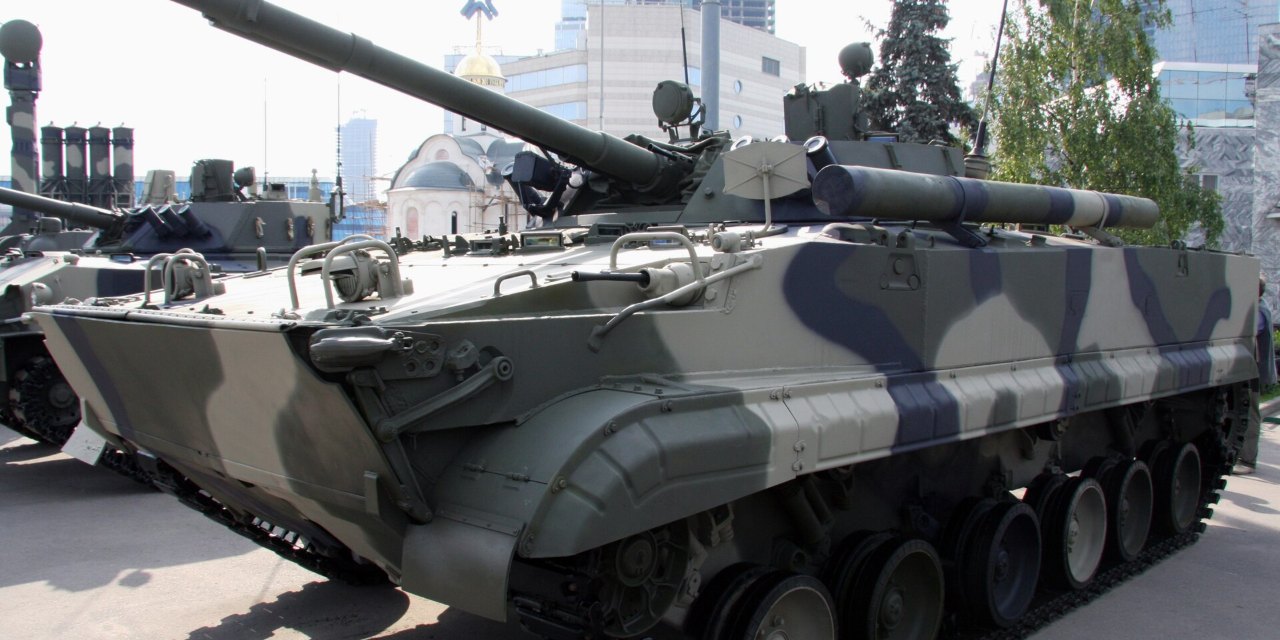
Russia fields one of the world’s largest fleets of infantry fighting vehicles and armored personnel carriers, built around three families: tracked BMPs, wheeled BTRs and air-droppable BMDs. Almost four years of war in Ukraine have burned through that fleet faster than factories can replace it, and the mix of vehicles at the front in late 2026 looks very different from the one that crossed the border in 2022.
This guide explains what each family does, how many vehicles Russia has lost, what its plants are building now and why motorcycles and buggies have started to appear where armored columns used to be.
BMP, BTR and BMD: what the names mean
Russian armored vehicles follow a naming logic inherited from the Soviet Army. A BMP (boyevaya mashina pekhoty, or infantry fighting vehicle) is a tracked vehicle that carries a rifle squad and fights alongside it with a cannon and anti-tank missiles. A BTR (bronetransporter) is a wheeled 8×8 carrier that is cheaper, faster on roads and more lightly protected. A BMD (boyevaya mashina desanta) is a light tracked vehicle built for the Airborne Forces, small enough to be dropped by parachute from an Il-76.
A fourth vehicle matters just as much in practice: the MT-LB, a 1970s tracked tractor designed to tow guns, which Russia has pressed into service as a front-line carrier. Together these types move the motor rifle brigades described in our guide to the size of Russia’s army and work alongside the tanks covered in how many tanks Russia has.
| Family | Role | Running gear | Main types in service |
|---|---|---|---|
| BMP | Infantry fighting vehicle | Tracked | BMP-1, BMP-2, BMP-3 |
| BTR | Armored personnel carrier | Wheeled 8×8 | BTR-80, BTR-82A |
| BMD | Airborne combat vehicle | Tracked, air-droppable | BMD-2, BMD-4M |
| MT-LB | Multi-purpose tractor used as a carrier | Tracked | MT-LB, MT-LBu |
BMP-1, BMP-2 and BMP-3: the tracked core
The BMP-1 of 1966 was the world’s first mass-produced infantry fighting vehicle, armed with a 73 mm low-pressure gun. The BMP-2, introduced in 1980, replaced that gun with a 30 mm 2A42 automatic cannon that remains effective against light armor, infantry and low-flying aircraft. Both weigh about 13–14 tonnes, and both have thin armor that protects against small arms and shell splinters, not against modern anti-tank weapons.
The BMP-3 is the most capable type in service. It weighs 18.7 tonnes and combines a 100 mm 2A70 gun-launcher, a coaxial 30 mm 2A72 cannon and three machine guns, with a crew of three and seven passengers. Its full specification is in our BMP-3 guide. Older hulls are also being modernized: the BMP-2M receives the Berezhok turret with Kornet missiles, and the BMP-1AM Basurmanin gets the 30 mm turret of the BTR-82A.
| Type | Entered service | Combat weight | Main gun | Crew + troops |
|---|---|---|---|---|
| BMP-1 | 1966 | ~13 t | 73 mm 2A28 | 3 + 8 |
| BMP-2 | 1980 | ~14 t | 30 mm 2A42 | 3 + 7 |
| BMP-3 | 1987 | 18.7 t | 100 mm 2A70 + 30 mm 2A72 | 3 + 7 |
BTR-82A and the airborne BMD-4M
The BTR-82A is the standard wheeled carrier. Built at the Arzamas Machine-Building Plant, it weighs about 15 tonnes, carries a crew of three and seven troops, and mounts a stabilized 30 mm 2A72 cannon in place of the 14.5 mm machine gun of the older BTR-80. Its weak points are well known: thin armor, limited mine protection and side doors that force troops to dismount into fire, which is why Russian soldiers so often ride on the roof. A redesigned BTR-22 with a rear exit was shown in 2023 but has not replaced it in volume.
The Airborne Forces use the BMD-4M, which packs the BMP-3’s 100 mm and 30 mm armament into a vehicle of roughly 14 tonnes, alongside the BTR-MDM Rakushka carrier and the older BMD-2. Air-droppable armor has to be light, and in Ukraine paratroop units have fought as regular infantry, where that lightness has cost them heavily.
How many armored vehicles has Russia lost in Ukraine?
Russia does not publish equipment losses, so the best figures come from open-source researchers who count photographed wrecks. Analyst Jakub Janovsky, who works with the Oryx project, estimated in January 2026 that Russia had permanently lost about 9,240 infantry fighting vehicles and armored personnel carriers in 47 months of war, roughly 2,400 a year. Oryx’s wider tally of visually confirmed Russian equipment losses of all types has since passed 24,000 items. Both are minimums, because not every wreck is filmed.
| Vehicle | Estimated losses |
|---|---|
| BMP-1 and BMP-2 | ~3,600 |
| MT-LB | ~2,150 |
| BTR-82 family | ~1,900 |
| BMP-3 | ~890 |
| BMD family | ~700 |
First-person-view drones now account for most of these losses. A vehicle that takes weeks to build can be stopped by a drone that costs a few hundred dollars, the same arithmetic that has reshaped tank warfare; see how active protection systems work for the countermeasures armies are turning to.
Production versus attrition
Two production lines carry most of the load. Kurganmashzavod, part of Rostec, builds the BMP-3 and BMD-4M; Arzamas builds the BTR-82A. Janovsky puts combined output at about 900 vehicles a year, roughly 400 BMP-3s and 500 BTR-82s. A Russian trade outlet, citing foreign analysts, suggested in July 2026 that BMP-3 output may have reached 50–60 a month, far above the 168 vehicles delivered across 2020 and 2021 together. Neither figure can be verified, because Russia treats production data as secret.
The gap between roughly 900 built and 2,400 lost each year has been filled from Soviet-era storage. About 6,000 vehicles, mostly BMP-1s and MT-LBs, have been pulled out of depots and refurbished, and satellite imagery suggests the usable part of that reserve is close to exhausted. A December 2025 study by Delwin Strategy estimated that Russia’s total armored fleet was still slightly larger than in 2022, at about 20,900 vehicles, but with fewer infantry fighting vehicles and 38% more basic carriers. The fleet has held its size by getting older and simpler.
| Indicator | Estimate | Source |
|---|---|---|
| New BMP-3s per year | ~400 (possibly more in 2026) | Janovsky; Russian media |
| New BTR-82s per year | ~500 | Janovsky |
| IFVs and APCs lost per year | ~2,400 | Janovsky / Oryx |
| Vehicles taken from storage since 2022 | ~6,000 | Janovsky |
| Total armored fleet, end of 2025 | ~20,900 | Delwin Strategy |
Kurganets, Bumerang and the motorcycle problem
The vehicles meant to replace all of this were unveiled at the 2015 Victory Day parade: the tracked Kurganets-25, the wheeled Bumerang and the heavy T-15 built on the Armata chassis. More than a decade later none is in serial service. Cost, sanctions on electronics and the priority given to simple, proven designs have kept them at the trial stage, much like the T-14 Armata tank.
What has changed instead is how vehicles are used. Crews weld on cages, rubber screens and jammers; some hulls are turned into improvised, shed-like assault carriers. Since 2024 Russian assault groups have increasingly attacked on motorcycles, quad bikes and light buggies, or on foot in small teams, because a column of armored vehicles is spotted and hit by drones long before it reaches the line. The Institute for the Study of War has tracked this shift throughout 2025 and 2026. Armor is still needed to exploit a breakthrough, but fire support from Russia’s artillery and glide bombs now does much of the work it once did.
Frequently asked questions
What is the difference between a BMP and a BTR?
A BMP is a tracked infantry fighting vehicle with a cannon and anti-tank missiles, designed to fight alongside tanks. A BTR is a wheeled 8×8 armored personnel carrier that is cheaper and faster on roads but more lightly armed and protected. Both carry a squad of about seven soldiers.
What is Russia’s best infantry fighting vehicle?
The BMP-3. It weighs 18.7 tonnes, carries a 100 mm gun-launcher and a 30 mm cannon, and is in production at Kurganmashzavod. Newer designs such as the Kurganets-25 and T-15 have not entered serial service.
How many armored vehicles has Russia lost in Ukraine?
Open-source analyst Jakub Janovsky estimated about 9,240 infantry fighting vehicles and armored personnel carriers lost between February 2022 and January 2026. The figure is based on visually documented wrecks, so the real total is likely higher.
How many BMP-3s does Russia build each year?
Independent estimates put output at around 400 a year, and some 2026 reports suggest 50–60 a month. Russia does not publish production data, so these numbers cannot be confirmed.
Why do Russian troops attack on motorcycles?
Drones spot and destroy armored columns well before they reach Ukrainian positions. Small, fast vehicles are harder to hit and cheap to replace, and they also make up for a shortage of modern infantry fighting vehicles.
- Oryx – Attack on Europe: documenting Russian equipment losses: oryxspioenkop.com
- Euromaidan Press – Russian IFV and APC losses and replacement, January 2026: euromaidanpress.com
- Delwin Strategy – Analysis: Russian armored vehicle fleet, 2022–2025: delwinstrategy.substack.com
- Institute for the Study of War – Russian Offensive Campaign Assessments: understandingwar.org
- IISS – The Military Balance 2026: iiss.org