FMS vs DCS Arms Sales Explained, How US Weapons Exports Work
Foreign Military Sales (FMS) and Direct Commercial Sales (DCS) are the two legal channels for US weapons exports, and in fiscal 2024 they authorized roughly $318 billion of transfers between them. The difference is who holds the contract: in FMS the US government buys on the customer’s behalf, while in DCS the foreign buyer deals with the manufacturer directly.
What is Foreign Military Sales
FMS is a government-to-government program run under the Arms Export Control Act. The Defense Security Cooperation Agency, part of the Pentagon, manages cases, while the State Department sets policy and approves them. The US government signs a Letter of Offer and Acceptance with the buyer, then contracts with industry on the buyer’s behalf, usually alongside orders for US forces.
The customer pays into a US Treasury trust fund, and the government charges an administrative fee, typically a few percent of the case value. In return it provides contracting expertise, quality oversight, pooled pricing and, often, training and sustainment support. That package is why major platforms such as the F-35 and the Patriot system are sold almost entirely through FMS.
What are Direct Commercial Sales
DCS lets a foreign government or company negotiate directly with a US manufacturer. The State Department’s Directorate of Defense Trade Controls must still license the export under the International Traffic in Arms Regulations, so DCS is not a loophole. It is a different commercial route with the same legal oversight of what can leave the country.
DCS tends to suit buyers who want customized configurations, direct supplier relationships or faster negotiation on smaller items, such as components, spare parts, small arms, avionics and subsystems. The trade-off is that the buyer carries more contracting risk and does not get the US government’s contract oversight.
FMS vs DCS differences
| Feature | Foreign Military Sales | Direct Commercial Sales |
|---|---|---|
| Contract parties | US government and foreign government | Manufacturer and foreign buyer |
| Legal basis | Arms Export Control Act, Section 36(b) notifications | AECA and ITAR licensing, Section 36(c) notifications |
| Oversight | Defense Security Cooperation Agency and State Department | State Department licensing, with no US government contract role |
| Pricing | Government-negotiated, plus an administrative fee | Negotiated privately by the buyer |
| Typical items | Major platforms, missiles, long-term support | Components, small arms, subsystems, customized builds |
| Customer support | US government manages delivery and follow-on | Buyer manages suppliers and logistics |
| Financing | Eligible for Foreign Military Financing | Generally not |
How does an FMS case work
A sale usually follows a fixed path. The buyer submits a Letter of Request, the US government responds with pricing and availability data, and an LOA is drafted. For larger cases Congress is notified first, and lawmakers get a review period before the LOA can be signed.
Thresholds depend on the buyer. For most countries, congressional notification starts at $14 million for major defense equipment, $50 million for other articles and services, and $200 million for design and construction services. For NATO members and a handful of close partners the thresholds rise to $25 million, $100 million and $300 million, and the review window is shorter at 15 days rather than 30.
| Step | What happens |
|---|---|
| 1 | Buyer submits a Letter of Request |
| 2 | US government provides pricing and availability data |
| 3 | Congressional notification for cases above thresholds |
| 4 | Letter of Offer and Acceptance signed and funded |
| 5 | US government contracts with industry; delivery and support follow |
Which weapons go through which channel
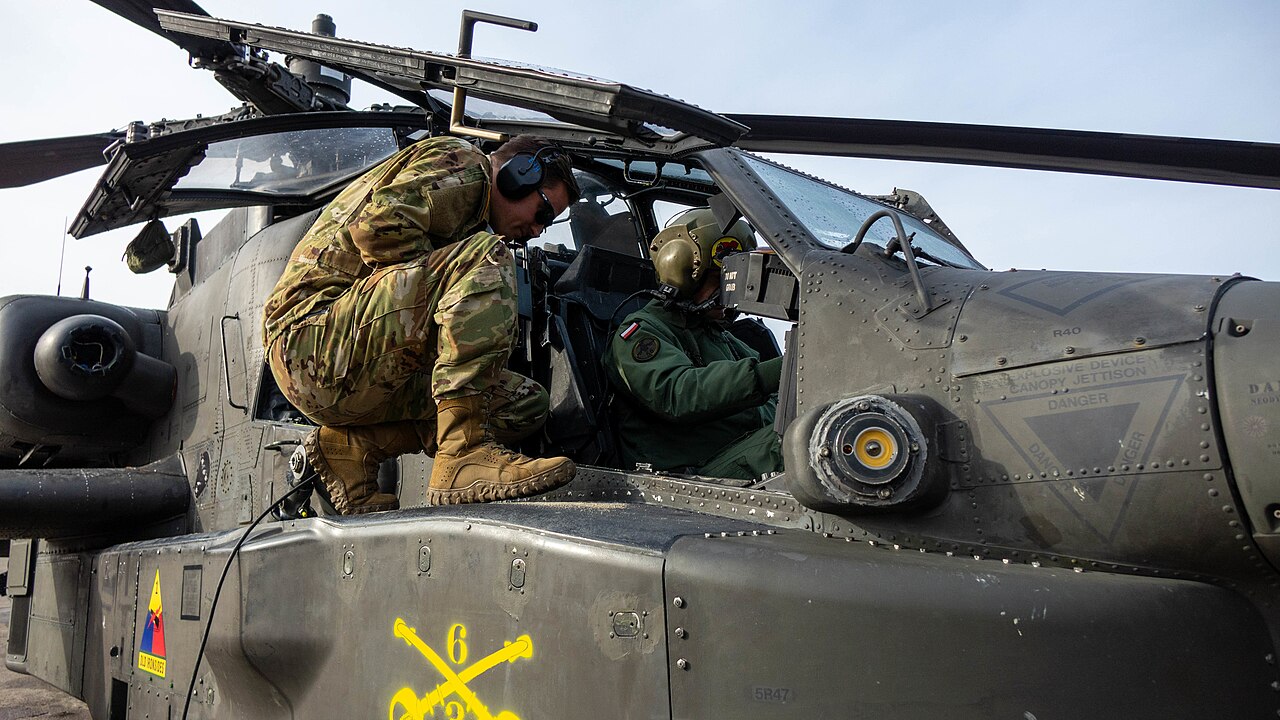
Large, politically sensitive systems almost always move through FMS. Poland’s order for 96 AH-64E Apache helicopters was handled as an FMS case, with the US Army managing the contract. By contrast, a wide range of ammunition, electronics and small arms ships under DCS licenses. The State Department’s annual totals show DCS authorizations regularly exceeding FMS, but authorizations are not deliveries, and DCS licenses are often approved for amounts buyers never fully use.
Other exporters run similar dual systems, and buyers often combine channels: an FMS case for the aircraft, DCS licenses for mission equipment from third-party suppliers. President Trump’s April 2025 executive order on reforming foreign defense sales pushed the agencies to speed both channels up, reflecting buyer frustration with long waits.
FMS vs DCS frequently asked questions
What is the main difference between FMS and DCS?
In FMS the US government contracts with industry on the buyer’s behalf. In DCS the foreign buyer contracts directly with the manufacturer under a State Department license.
Is FMS cheaper than DCS?
Not necessarily. FMS adds an administrative fee but can bring pooled pricing; DCS can be cheaper for customized or smaller items. It depends on the program.
Does Congress review both FMS and DCS?
Yes. Both channels have notification thresholds under the Arms Export Control Act, with lower dollar limits for non-NATO buyers.
Which channel is larger?
DCS authorizations have exceeded FMS in recent State Department figures, but FMS covers most major platforms.
Can a country use both channels at once?
Yes. Many programs combine an FMS case for the main platform with DCS licenses for supporting equipment.
- US State Department, Bureau of Political-Military Affairs fiscal year arms transfer data
- Defense Security Cooperation Agency, Security Assistance Management Manual
- Wikipedia – Foreign Military Sales (accessed October 2026)
- Defence & Tech reporting on US arms exports