Türkiye, Qatar, Pakistan, Indonesia Sign Badr Defense Pact
Lead
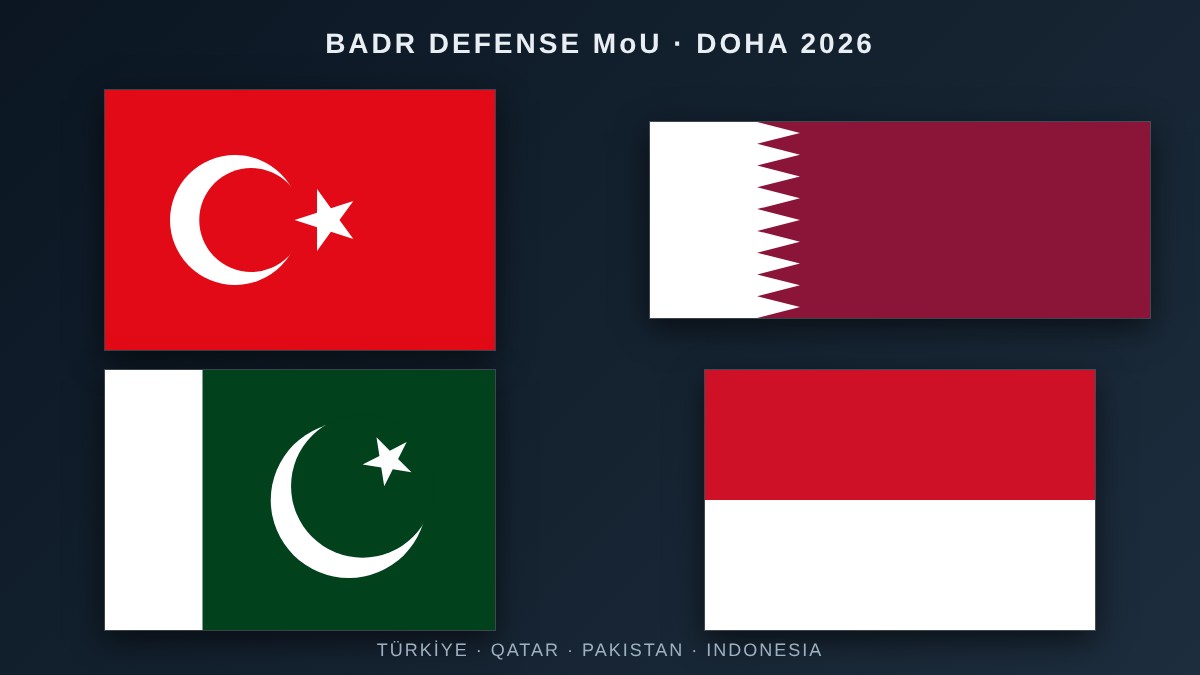
Türkiye, Qatar, Pakistan and Indonesia signed a defense-industrial cooperation memorandum in Doha on October 21, 2026, agreeing to work jointly on military production, technical training and research and development. The agreement, named the “Badr” memorandum of understanding after the full moon, brings together four middle powers with complementary defense-industrial profiles and comes as Gulf states look to diversify their security partnerships following Iran-linked regional tensions and Houthi missile and drone attacks on Saudi Arabia.
What Happened
Qatar’s Ministry of Defense, Indonesia’s Ministry of Defense, Pakistan’s Ministry of Defense and Türkiye’s Ministry of National Defence signed the Badr MoU in Doha, according to the official Qatar News Agency (QNA). Pakistan’s Defense Industrial Production Organization and the Presidency of Defense Industries under Türkiye’s Presidency (SSB) were also party to the accord.
Reuters and regional outlets identified the individual signatories as Turkish National Defence Minister Yaşar Güler, Qatar’s Deputy Prime Minister and Minister of State for Defence Affairs Sheikh Saud bin Abdulrahman bin Hasan Al Thani, Indonesian Deputy Defence Minister Yusuf Jauhari and Pakistani Defence Minister Khawaja Muhammad Asif. Türkiye’s SSB chief Haluk Görgün and Pakistan’s federal minister for defense production, Muhammad Reza Hayat Haraj, also attended the ceremony.
According to QNA, the MoU is intended to “foster cooperation in the field of defense manufacturing,” strengthen the four countries’ defense capabilities, and promote “collaboration in technical defense training, as well as in research and development areas.” Al Jazeera, citing unnamed analysts, reported the scope also extends to joint production, technology transfers and more closely integrated supply chains, though Breaking Defense noted the published text of the MoU itself was light on specifics, with no financial terms or binding commitments disclosed.
QNA reported that the pact is open to additional signatories, subject to criteria the four founding members agree on. Pakistani officials have said other countries could eventually join.
The Framework and Its Background
The Badr MoU is formally separate from, but closely linked to, the Mecca Joint Defence Agreement signed by Saudi Arabia, Pakistan and Türkiye on August 7, 2026, which contains a mutual-defense clause modeled on NATO’s Article 5 and runs to 16 articles covering defense-industry cooperation, intelligence sharing, logistics and joint training (see Pakistan, Saudi, Türkiye Chiefs Vow to Activate Makkah Pact). Türkiye’s government submitted that pact to parliament for ratification on October 20, one day before the Badr signing, and a parliamentary committee is expected to review it before a full assembly vote. Reuters reported the agreement bars withdrawal for ten years, after which members would need to give three months’ notice.
Qatar and Türkiye had already signed a bilateral defense-industry MoU in October 2025, and Ankara maintains separate defense-manufacturing relationships with each of the other three Badr signatories individually. The four-way format formalizes and expands on those existing bilateral channels rather than starting from a blank page.
Track Record: What These Countries Already Build Together
The signatories bring a documented history of joint defense production, which gives the new framework more substance than a typical political memorandum:
- Türkiye–Pakistan: Under the 2018 PN MILGEM program with Turkish state firm ASFAT, two Ada-class corvettes were built at Istanbul Naval Shipyard and two at Karachi Shipyard and Engineering Works, with technology transfer and design intellectual property included in the roughly $1.5 billion deal. PNS Babur was launched in Istanbul in August 2021, PNS Badr in Karachi in May 2022, PNS Khaibar in Istanbul in November 2022, and PNS Tariq — the first frigate of the class designed jointly by Pakistan’s own Maritime Technologies Complex — was launched in Karachi in August 2023.
- Türkiye–Indonesia: Turkish firm FNSS and Indonesia’s state-owned PT Pindad co-developed the Kaplan MT (Harimau) medium tank under a 2015 government-to-government agreement with shared design intellectual property. A 2019 serial-production contract covered 18 tanks, with ten hulls built in Türkiye and eight assembled in Indonesia; the first batch of ten was delivered in March 2022, marking Türkiye’s first tank export.
- Qatar–Türkiye: A bilateral defense-industry MoU was signed in October 2025, ahead of the four-way Badr agreement.
Who Brings What
Analysts cited by Al Jazeera framed the four countries as complementary rather than redundant. Türkiye contributes systems integration and a mature defense-industrial base spanning firms such as Baykar, Turkish Aerospace and Aselsan. Pakistan and Indonesia bring manufacturing capacity, a skilled industrial workforce and large domestic markets through state enterprises including Pakistan Ordnance Factories, Heavy Industries Taxila and the Pakistan Aeronautical Complex’s JF-17 Block III program, and Indonesia’s PT PAL — which is separately modernizing a frigate with Italy’s Fincantieri (see Fincantieri and PT PAL Team Up to Modernize Indonesia’s KRI Sriwijaya) — PT Pindad and PT Dirgantara Indonesia. Türkiye’s own industrial base is anchored by firms such as Turkish Aerospace. Qatar, which hosts the US Al Udeid Air Base and has historically been a buyer rather than a producer, supplies investment capital and procurement demand.
Why It Matters
The agreement lands amid the prolonged US-Israel-Iran confrontation and its spillover into the Gulf, including Houthi missile and drone attacks that forced a temporary closure of Riyadh’s King Khalid International Airport in late October 2026 (see also Houthi-Saudi War: Where Things Stand in October 2026). Analysts told Al Jazeera that regional states are seeking to diversify their defense partnerships and reduce dependence on Washington — citing reported US weapons-delivery strains — without abandoning their existing alliances. Pakistan, Türkiye, Egypt, France and the United Kingdom have all pledged various forms of support to help defend Saudi Arabia since the Houthi escalation began.
For a publication tracking defense developments outside the US-Europe axis, the Badr MoU is notable less for its immediate military effect — which remains undefined — than for what it signals: four non-Western-aligned middle powers with growing indigenous defense industries formalizing a production bloc that spans the Gulf, South Asia and Southeast Asia.
What Happens Next
No implementation timeline, budget or specific program has been announced under the Badr framework itself. As a memorandum of understanding rather than a treaty, it likely does not require parliamentary ratification in any of the four states, unlike the Mecca Joint Defence Agreement now before Türkiye’s parliament. Follow-on announcements — joint ventures, technology-sharing agreements or new platform programs building on the MILGEM and Kaplan/Harimau precedents — would be the next concrete signal of how the framework is being operationalized.
FAQ
What is the Badr MoU?
It is a defense-industrial cooperation memorandum signed by Türkiye, Qatar, Pakistan and Indonesia in Doha on October 21, 2026, covering defense manufacturing, technical training and research and development. The name references the full moon, signaling the four countries’ complementary capabilities.
Is the Badr MoU a mutual-defense pact like NATO’s Article 5?
No. That description applies to the separate Mecca Joint Defence Agreement between Saudi Arabia, Pakistan and Türkiye, signed in August 2026. The Badr MoU is focused on industrial cooperation, not mutual military defense commitments.
Does the Badr MoU include specific weapons deals or funding?
No financial terms, programs or binding commitments have been published. Breaking Defense and other outlets described the publicly released text as light on specifics.
Can other countries join the Badr framework?
According to Qatar News Agency, the pact is open to additional members, subject to criteria to be agreed upon by the four founding signatories.
Do these four countries already cooperate on defense production?
Yes. Türkiye and Pakistan jointly built four MILGEM-class corvettes between 2018 and 2023, and Türkiye and Indonesia co-developed and co-produced the Kaplan MT/Harimau medium tank between 2015 and 2022.
Sources
- Qatar News Agency (QNA), “Qatar, Indonesia, Pakistan and Türkiye Sign Badr MoU to Promote Defense Industries Cooperation,” October 21, 2026 — official announcement with signatory institutions and MoU language.
- Al Jazeera, “How Qatar, Türkiye, Pakistan and Indonesia Are Deepening Defence Ties,” October 21, 2026 — analyst context, scope details and existing joint-production history.
- Breaking Defense, “Türkiye, Qatar, Indonesia, Pakistan Ink Defense Cooperation MoU,” October 21, 2026 — noted the MoU’s limited public detail and Mecca Pact context.
- Reuters (via Hurriyet Daily News and other wire subscribers), “Türkiye, Qatar, Indonesia, Pakistan Sign Defense Accord,” October 21, 2026 — named individual signatories.
- Reuters (via Al-Monitor and other wire subscribers), “Türkiye Submits Saudi-Pakistan Defence Pact to Parliament for Ratification, Sources Say,” October 20, 2026 — Mecca Joint Defence Agreement ratification status and terms.