Riyadh Airport Reopens as Houthis Call It a Military Target and Coalition Downs Missile and Drones
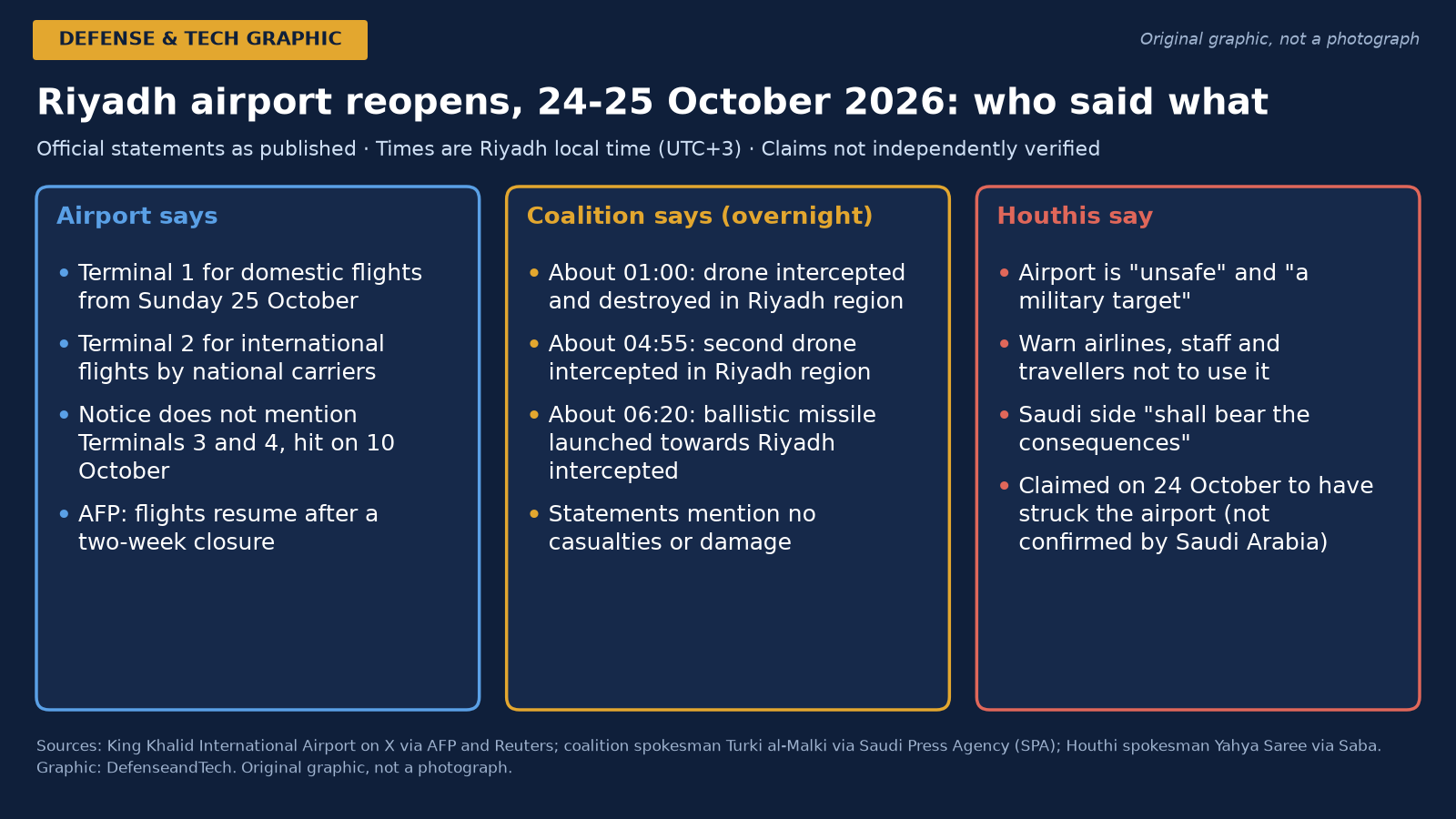
King Khalid International Airport in Riyadh began handling flights again on Sunday, 25 October 2026, through Terminals 1 and 2, two weeks after a deadly Houthi missile strike shut it down. Within hours of the reopening notice, Yemen’s Houthis warned airlines and passengers that the airport remained “a military target”, and the Saudi-led coalition said its air defences destroyed a ballistic missile and two drones heading for the Riyadh area overnight.
- Airport: Terminal 1 for domestic flights and Terminal 2 for international flights by national carriers from 25 October
- Coalition: two drones over the Riyadh region and a ballistic missile aimed at Riyadh intercepted overnight
- The official statements mentioned no casualties or damage
- Houthis: the airport is “unsafe” and “a military target”; airlines and travellers warned
- The 10 October missile strike on the airport killed 13 people, according to Saudi figures cited by Arab News
What the airport announced
In a notice posted on its X account on Saturday evening, the airport said Terminal 1 “will be designated for domestic flights and Terminal 2 for international flights operated by national carriers” from Sunday. It asked passengers with confirmed bookings to check the status of their flights with their airlines before travelling (Arab News, KKIA on X). The notice did not mention Terminals 3 and 4, the complex hit on 10 October, and did not say when foreign airlines would return.
AFP reported that flight-tracking data showed an aircraft taking off from Riyadh for Jeddah early on Sunday (AFP via Gulf News).
Missile and drones over Riyadh overnight
The Saudi Press Agency (SPA) carried three statements from coalition spokesman Maj Gen Turki al-Malki during the night. At about 01:00 and again shortly before 05:00 local time, it reported that a drone had been intercepted and destroyed in the Riyadh region. At about 06:20, the spokesman said air defences had intercepted and destroyed a ballistic missile launched by the Houthis towards Riyadh (SPA, SPA, SPA).
Saudi Civil Defence issued a danger alert in Riyadh and declared minutes later that the danger had passed, Middle East Eye reported (MEE). None of the official statements mentioned casualties or damage. The coalition did not say which air defence systems were used, and the Houthis had not commented on these specific launches by the time of writing.
The Houthi warning
Shortly after midnight, Houthi military spokesman Yahya Saree issued a statement through the Houthi-run Saba news agency. “The Yemeni Armed Forces reiterate their warning to all international, regional, and local airlines, as well as staff and travelers, against traveling through Khalid Airport in Riyadh, as it is unsafe and serves as a military target for us,” he said. Saree added that the Saudi authorities “shall bear the consequences of any operations at the airport” and that it “will never be safe” (Saba).
Background
King Khalid International is the main air gateway to the Saudi capital and has been one of the Houthis’ most frequent targets in the current escalation. On 10 October a ballistic missile hit the airport. Arab News, citing Saudi figures, put the toll at 13 dead and more than 300 wounded; Reuters has reported 12 deaths. The airport stayed closed until this weekend. A timeline of the conflict since September is in our Houthi-Saudi war overview.
For Saudi air defences, the night followed a familiar pattern: slower drones and a ballistic missile aimed at the same city within a few hours. Reopening Riyadh airport under that threat is a test both of the interception network and of airlines’ willingness to fly into Riyadh.
Previous developments
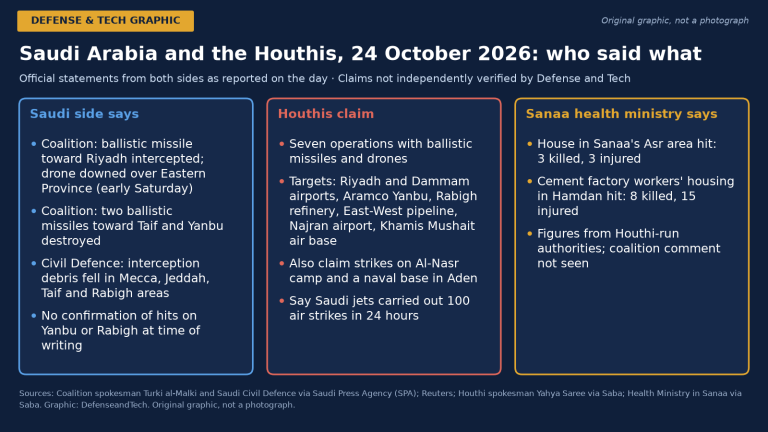
On Saturday, 24 October, the Houthis said they had carried out seven operations, including a strike on King Khalid International Airport “in two phases” and attacks on Aramco in Yanbu and the Rabigh refinery. Saudi Arabia did not confirm any hits; the coalition reported intercepts over Riyadh, Taif and Yanbu (our report). Late on Saturday, Saree rejected Saudi statements that missile debris had fallen in the Mecca and Medina regions, calling them a “great and immense fabrication” and saying that Houthi operations target “oil facilities and military bases” (Saba). In Cairo, the House of Representatives is due to resume on Monday, 26 October, its session on President Abdel Fattah al-Sisi’s request for authorisation to help defend Saudi Arabia (Egypt vote report).
Sources: King Khalid International Airport (X); Arab News; AFP via Gulf News; Saudi Press Agency (coalition statements, 25 October 2026); Middle East Eye; Saba (Yahya Saree). Claims by both sides have not been independently verified. This story will be updated.