
How Laser-Guided Weapons Work, From Paveway to APKWS
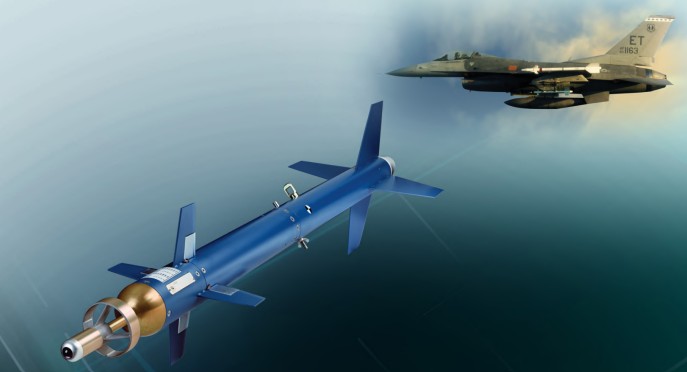
Laser-guided weapons steer themselves onto a spot of laser light no wider than a dinner plate, and they have been doing it in combat since 1972, when Paveway bombs dropped Vietnam’s Thanh Hoa bridge after some 870 unguided sorties had failed. Half a century on, the same principle guides everything from Hellfire missiles to 70mm rockets, and its strengths and blind spots still shape how air forces fight.
How does laser guidance work
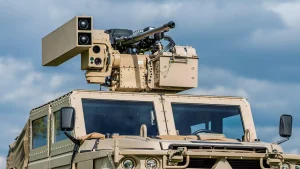
A laser-guided weapon needs two things, a designator and a seeker. The designator, carried by an aircraft targeting pod, a drone, or a soldier with a tripod-mounted unit, fires rapid infrared pulses at the target. The pulses are coded, a pulse-repetition-frequency pattern agreed before the shot, so the seeker locks only onto its own designator’s reflections and ignores every other laser on a crowded battlefield.
The reflected energy scatters off the target in a cone called the laser basket. Any seeker inside that basket can ride the reflection down. That separation of designator and shooter is the system’s quiet genius, one aircraft can lase while another releases, or a special-forces team can mark a target for a bomb dropped from an aircraft its crew never sees.
Semi-active laser homing explained
Nearly all laser-guided weapons use semi-active laser homing, SALH. The seeker is a passive receiver, typically four photodiode quadrants behind a filter tuned to the designator’s 1,064-nanometer wavelength. If the reflected spot drifts off-center, one quadrant sees more energy than the others and the guidance section commands fins to correct until the signal balances. It is a beautifully simple closed loop, no emitter on the weapon, no datalink, no jammable radio.
| Element | Role | Example |
|---|---|---|
| Designator | Paints target with coded IR pulses | Targeting pods, ground laser target designators, UAV sensor balls |
| Seeker | Passive quadrant detector homes on reflection | Paveway nose section, Hellfire SAL seeker |
| Code | PRF setting pairs weapon with designator | Set before launch; prevents cross-lock |
| Laser basket | Cone of usable reflected energy | Weapon must fly into it before impact |
Which weapons use laser guidance
| Weapon | Class | Notes |
|---|---|---|
| Paveway II/III/IV | Guided bombs | The original family; Paveway IV adds GPS dual-mode |
| AGM-114 Hellfire / JAGM | Missiles | Helicopter and drone standard; JAGM adds radar dual-mode |
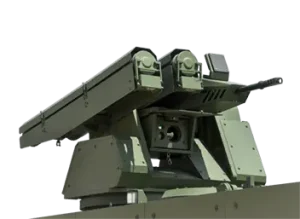
| APKWS II | Guided 70mm rockets | Guidance kit turns unguided rockets into precision weapons |
| MAM-L / MAM-T | Small smart munitions | Roketsan munitions carried by Turkish drones |
| Krasnopol / Copperhead | Artillery shells | 152mm/155mm laser-homing projectiles |
| GBU-54 LJDAM | Dual-mode bomb | JDAM tail kit plus laser seeker for moving targets |
The technology scaled down as optics got cheap. Roketsan’s MAM-L gave the Bayraktar TB2 its signature punch, and guided 70mm rockets now give helicopters and light aircraft a precision magazine at a fraction of missile cost. Heavier platforms like the Bayraktar Akinci carry whole families of laser-homing munitions. Not every precision weapon works this way, the FGM-148 Javelin uses an imaging infrared seeker precisely to avoid needing anyone to keep lasing.
Laser-guided weapons limitations
The physics that makes laser guidance precise also limits it. Cloud, fog, heavy rain, dust and smoke absorb or scatter the beam, Desert Storm crews learned that oil-fire smoke could defeat a Paveway. The designator must hold the spot until impact, which ties up a sensor and can expose the operator. Laser warning receivers on modern armored vehicles detect designation and trigger smoke dispensers within seconds. And the seeker only sees what the laser touches, a target that breaks line of sight behind a building is gone.
Laser plus GPS, the dual-mode answer
The modern consensus is to stop choosing. Dual-mode weapons such as the GBU-54 Laser JDAM and Paveway IV fly on GPS-aided inertial guidance through weather and jamming, then use the laser seeker for terminal precision or moving targets. In Ukraine, where GPS jamming is dense, that layered approach has proven its worth, operator-reported accounts describe satellite-guided weapons degrading under jamming while laser and inertial modes kept working. The laser spot, coded and fleeting, remains stubbornly hard to spoof.
Laser-guided weapons frequently asked questions
How accurate are laser-guided weapons?
Typically within a meter of the laser spot under good conditions, which is why they remain the standard for moving targets and danger-close support.
Can weather stop a laser-guided bomb?
Yes. Cloud, fog, smoke and dust scatter the beam; this is the main reason dual-mode laser-plus-GPS weapons now dominate new production.
What was the first laser-guided bomb used in combat?
Paveway-series bombs in Vietnam, most famously in the 1972 strikes that finally destroyed the Thanh Hoa bridge.
What is the difference between laser guidance and GPS guidance?
Laser weapons home on reflected light and can hit moving targets but need continuous designation; GPS weapons hit surveyed coordinates in any weather but only stationary ones.
Can a laser-guided missile be jammed?
The coded seeker is very hard to spoof, but smoke screens, laser warning receivers and breaking line of sight are all effective countermeasures.
- US Air Force and Army historical accounts of Paveway employment
- Manufacturer product literature for Paveway, Hellfire, APKWS and MAM families
- Wikipedia – Laser-guided bomb (accessed October 2026)
- Defence & Tech reporting on precision-guided munitions