E-2D Advanced Hawkeye Specs, Radar, Cost and Operators
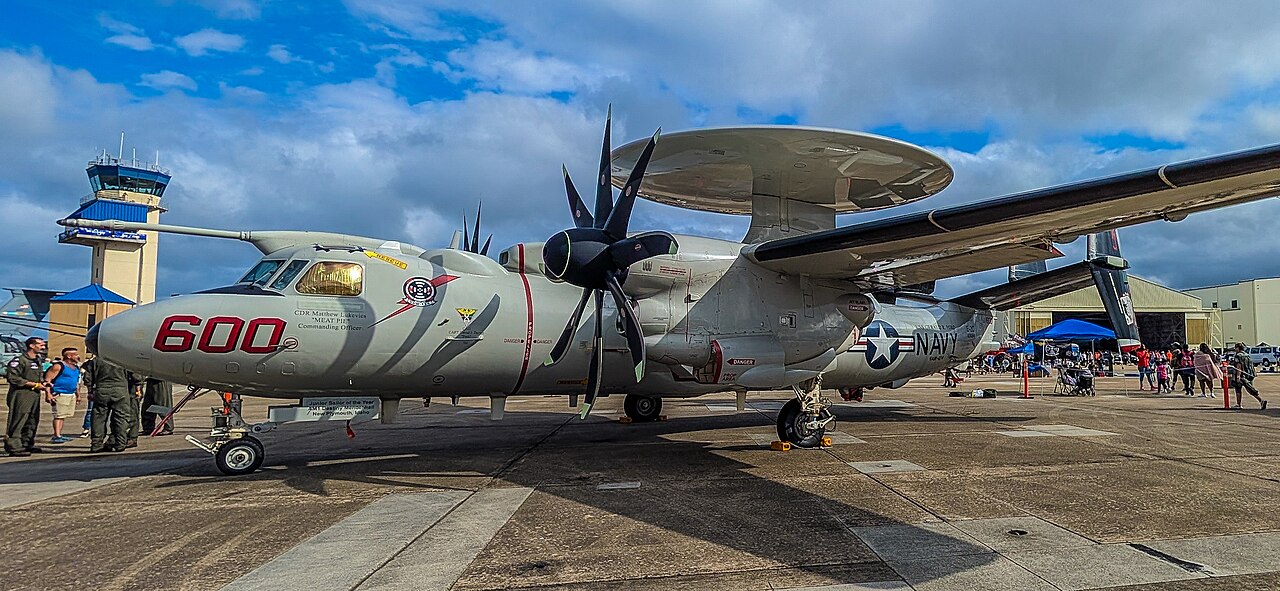
The E-2D Advanced Hawkeye is the US Navy’s carrier-based airborne early warning aircraft, a twin-turboprop radar picket whose AN/APY-9 radar can track targets out to several hundred kilometers while operating from a carrier deck. It gives a carrier strike group its long-range eyes, and it links every ship and fighter around it into one picture.
What is the E-2D Advanced Hawkeye
The E-2D is the fourth major generation of Northrop Grumman’s Hawkeye line, which first flew in 1960 and entered Navy service in the 1960s. The Advanced Hawkeye kept the distinctive 24-foot rotodome and the four-fin tail of earlier models but replaced almost everything inside them: new radar, new computers, new cockpit and a far more capable mission suite.
Its job is to see low-flying cruise missiles and aircraft that a ship’s own radar, limited by the horizon, would detect too late. A Hawkeye flying at altitude extends that horizon dramatically, then passes the data to destroyers running the Aegis combat system so that missiles can be launched against threats the ship itself never detected. The aircraft first flew in 2007 and reached initial operational capability in 2014.
E-2D specifications
| Parameter | Value |
|---|---|
| Manufacturer | Northrop Grumman |
| Role | Carrier-based airborne early warning and command and control |
| Crew | 5 (2 pilots, 3 mission systems operators) |
| Length / wingspan | About 17.6 m / 24.6 m (57 ft 9 in / 80 ft 7 in) |
| Max takeoff weight | About 26,000 kg (57,000 lb) |
| Engines | 2 x Rolls-Royce T56-A-427A turboprops, about 5,100 shp each |
| Max speed | Roughly 650 km/h (about 350 knots) |
| Service ceiling | About 10,000 m (around 33,000 ft) |
| Endurance | More than 6 hours unrefueled; aerial refueling capable |
| Radar | AN/APY-9 UHF electronically scanned array, rotating with the rotodome |
| Unit cost | Roughly $200 million per aircraft, rounded program figure |
How the E-2D radar works
The AN/APY-9 operates in the UHF band, which has a long wavelength. That matters for stealth: shaping techniques designed to defeat higher-frequency fire-control radars are less effective at UHF, so the Hawkeye is among the few sensors that can still detect low-observable aircraft at useful range. The radar rotates mechanically inside the dome while also steering its beam electronically, a hybrid approach often called mechanical and electronic scanning (see how AESA radar works for the electronic-steering principle).
A distinctive feature of the E-2D is Cooperative Engagement Capability, or CEC. Data from the Hawkeye goes to other ships and aircraft in near real time, so a missile fired by one ship can be guided using the radar picture from another platform. Naval Integrated Fire Control-Counter Air, known as NIFC-CA, relies on that chain. The aircraft can also be used as a flying command post, directing fighters and sharing tracks over Link 16.
Inside the cabin, three operators manage radar displays, electronic support measures and communications. The E-2D also has a glass cockpit, and Northrop Grumman has described a design in which the copilot can help with mission tasks. Newer aircraft also carry an aerial refueling probe, extending endurance on long barrier patrols.
E-2D variants and operators
| Operator / variant | Type | Notes |
|---|---|---|
| US Navy | E-2D | Primary operator with dozens of aircraft at sea and ashore |
| France (Marine Nationale) | E-2C Hawkeye | Operates older E-2C aircraft from the carrier Charles de Gaulle; E-2D has been discussed |
| Japan (JASDF) | E-2D | Ordered the Advanced Hawkeye to replace E-2C aircraft |
| Egypt, Taiwan, Mexico, Singapore | E-2C / E-2T | Older models in export service |
| US Navy Reserve and test units | E-2D AHE | Adds aerial refueling and updated mission computers |
The E-2D fleet has been continuously upgraded. The Advanced Hawkeye (AHE) standard added a new mission computer and in-flight refueling, while the Navy has also worked on Link 16 improvements and better electronic support measures. Japan’s purchase of the E-2D is the most significant export sale of the modern version so far.
No Hawkeye has fought in an air-to-air engagement, but Hawkeyes have supported combat operations from the Gulf War to recent Red Sea deployments, directing fighters and tracking incoming threats. Their presence on deployment is a signal in itself, since losing them would blind a carrier group beyond the horizon.
E-2D vs E-7 Wedgetail and other AEW aircraft
The E-2D is smaller than land-based AEW&C aircraft such as the Boeing E-7 Wedgetail or the Saab GlobalEye. Those jets have more space, more operators and longer endurance, but they cannot land on a carrier. The Hawkeye’s carrier capability is its decisive advantage, and it is why the Navy has stayed with a turboprop airframe that dates back decades. Looking ahead, collaborative combat aircraft may eventually carry relay sensors, but no unmanned system yet replaces a Hawkeye’s radar and crew.
E-2D frequently asked questions
What does the E-2D Advanced Hawkeye do?
It detects aircraft and missiles at long range and directs fighters and ships from above a carrier strike group.
How much does an E-2D cost?
Roughly $200 million per aircraft in rounded program reporting.
Who flies the E-2D?
The US Navy, and Japan has ordered the type. Other countries fly older E-2C Hawkeyes.
Can the E-2D detect stealth aircraft?
Its UHF radar is better suited to it than most radars, though detection ranges against specific stealth aircraft are not public.
What replaces the E-2D?
Nothing has been announced. Drones are studied for supporting roles.
- US Navy and Northrop Grumman E-2D product literature
- SIPRI Arms Transfers Database
- Wikipedia – Northrop Grumman E-2 Hawkeye (accessed October 2026)
- Defence & Tech reporting on carrier aviation