Agni-V: Range, MIRV Warheads and India’s Longest-Range Missile
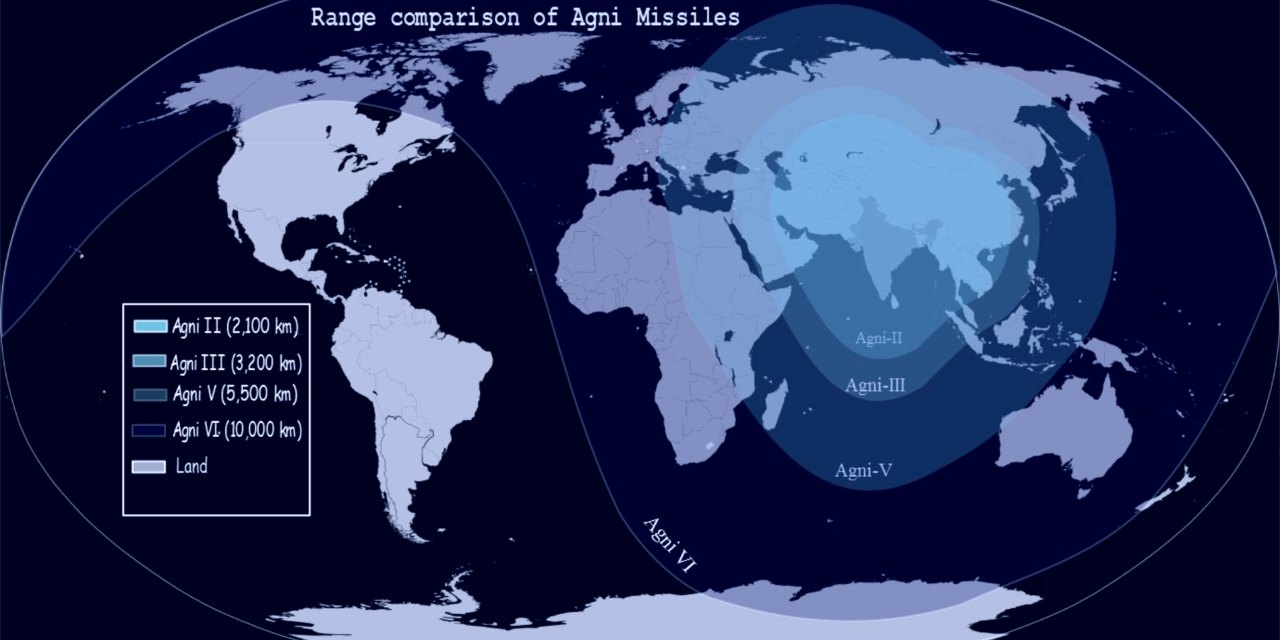
The Agni-V is India’s longest-range ballistic missile and the cornerstone of its nuclear deterrent against China. Officially it has a range of more than 5,000 kilometres, enough to reach every major Chinese city from India. In March 2024 India tested it with multiple independently targetable re-entry vehicles (MIRVs), in a mission called Divyastra, and a second MIRV test followed on 8 May 2026. It is carried in a sealed canister on a road-mobile launcher, so it can be hidden, moved and fired quickly.
This guide explains what the Agni-V is, how far it can reach and why its MIRV capability matters.
What is the Agni-V?
The Agni-V is a three-stage, solid-fuel ballistic missile developed by DRDO. It first flew in April 2012 and was inducted into the tri-service Strategic Forces Command after a user trial in 2018. Unlike earlier Agni missiles, it is stored and launched from a sealed canister, which protects it and allows it to be kept mated with its warhead, cutting the time needed to launch. It is about 17.5 metres long and weighs about 50 tonnes.
| Item | Detail |
|---|---|
| Developer | DRDO |
| Type | Three-stage solid-fuel ballistic missile |
| Range | 5,000 km+ (official) |
| Launch | Road-mobile canister launcher |
| Warheads | Single warhead or MIRV (tested 2024 and 2026) |
| First test | April 2012 |
| Operator | Strategic Forces Command |
| Successor | Agni-VI (reported, in development) |
How far can it reach?
India describes the Agni-V’s range as “more than 5,000 kilometres”, which from northern or central India covers all of China, including Beijing, Shanghai and Harbin. Some Chinese and Western analysts believe its true range could be greater, perhaps 7,000 to 8,000 kilometres with a lighter payload, but India has deliberately avoided describing it as an intercontinental missile. The rest of India’s missile arsenal is set out in our guide to Indian missiles.
Mission Divyastra and the MIRV tests
On 11 March 2024 India tested an Agni-V carrying several warheads that could be released to separate targets, a capability known as MIRV. Only a handful of countries, including the United States, Russia, China, Britain and France, had demonstrated it before. A second MIRV test followed on 8 May 2026 from Dr APJ Abdul Kalam Island off Odisha. MIRVs make a missile force much harder to defend against, because each missile can attack several targets and overwhelm missile defences. How MIRVs work is explained in our article on MIRV and MaRV warheads.
Agni-V and India’s deterrent
India’s nuclear doctrine promises massive retaliation after any nuclear attack, so it needs weapons that can survive a first strike and still reach the attacker. The Agni-V provides the long-range land-based part of that deterrent, alongside nuclear-capable aircraft and Arihant-class submarines, as described in our guide to India’s nuclear weapons. Reports say a longer-range Agni-VI and a conventional “bunker-buster” variant of the Agni-V are in development.
How does it compare?
China’s DF-41 and DF-31 intercontinental missiles have ranges of more than 11,000 kilometres and can reach the United States, as described in our guide to China’s nuclear weapons. The Agni-V is designed for a narrower purpose: to hold China’s major cities at risk. Pakistan has no missile of comparable range.
Frequently asked questions
What is the range of Agni-V?
India officially describes it as more than 5,000 kilometres, enough to reach all of China.
Is Agni-V an ICBM?
It is often called one, but India does not describe it as an intercontinental missile; its official range is at the lower end of that class.
Has Agni-V been tested with MIRVs?
Yes, in March 2024 (Mission Divyastra) and again on 8 May 2026.
Can Agni-V carry nuclear weapons?
Yes. It is a nuclear-capable missile operated by India’s Strategic Forces Command.
Who developed Agni-V?
India’s Defence Research and Development Organisation (DRDO).
What comes after Agni-V?
Reports say a longer-range Agni-VI is in development, along with a conventional bunker-busting version of the Agni-V.
- Overt Defense – India successfully tests advanced Agni missile with MIRV system (May 2026): overtdefense.com
- Army Recognition – India tests second Advanced Agni-5 MIRV missile (2026): armyrecognition.com
- Wikipedia – Agni-V (summary of public reporting): en.wikipedia.org
- Air Power Asia – Indian missiles pushing ahead with precision and reach (August 2026): airpowerasia.com