How Strong Is Saudi Arabia’s Military in 2026? Budget, Air Force, Missile Defense and Vision 2030
Saudi Arabia has one of the largest defense budgets in the world but ranks only 25th in the Global Firepower 2026 index. That gap tells the story of the Saudi military: rich in modern Western equipment, but still building the experience, industry and organization to match its spending. Under Vision 2030, Riyadh wants to change that by producing far more of its own weapons.
- Global Firepower 2026 rank: 25th
- Military spending (SIPRI, 2025): $83.2 billion (8th in the world)
- Active personnel: about 250,000 (incl. National Guard)
- Air defense: Patriot and THAAD
- Vision 2030 goal: 50% local military spending
Budget: eighth in the world
SIPRI estimates Saudi Arabia spent $83.2 billion on its military in 2025, the eighth-highest total globally and one of the highest shares of GDP among major economies. For decades most of that money went to imports from the United States, the UK and France.
People
The Saudi armed forces have around 250,000 active personnel, split between the regular forces under the Ministry of Defense and the Saudi Arabian National Guard, which protects the royal family and key sites.
Air Force: one of the most modern in the region
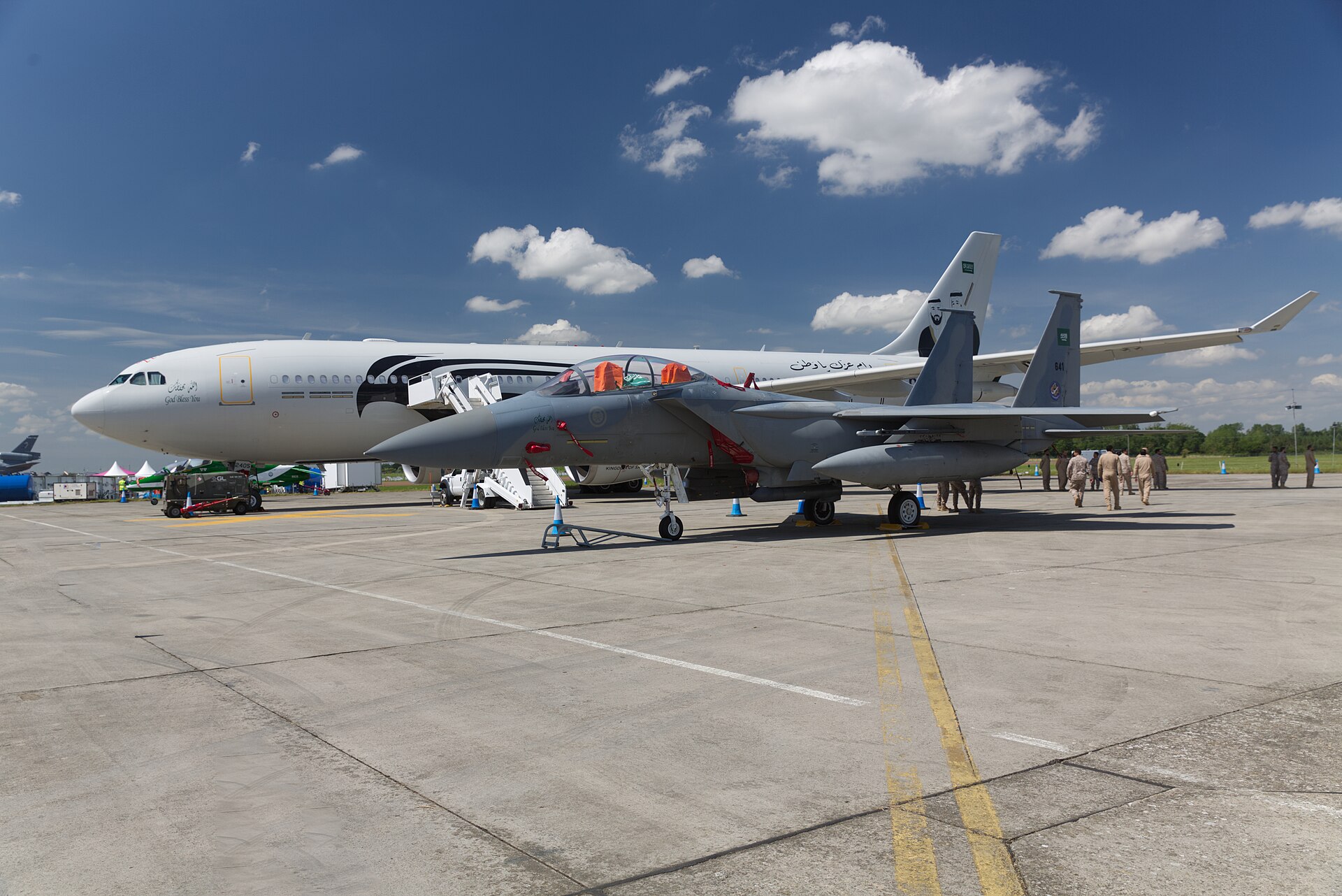
The Royal Saudi Air Force flies F-15SA and F-15C/D Eagles, Eurofighter Typhoons and Tornados, supported by A330 MRTT tankers and E-3 AWACS. Riyadh has long sought the F-35, and in late 2025 Washington signaled it would move ahead with a sale as part of a broader strategic defense agreement.
Missile defense
Facing Houthi missiles and drones from Yemen and the threat from Iran, Saudi Arabia operates multiple Patriot batteries and has added the US THAAD system for high-altitude ballistic missile defense. Its air defenses were tested repeatedly during the Yemen war and again during the regional fighting of 2026.
Land and naval forces
The Army fields M1A2S Abrams tanks, Bradley and LAV vehicles and Caesar artillery, while the Navy is modernizing with Spanish-built Avante corvettes and US-designed multi-mission surface combatants. Saudi forces gained combat experience, and suffered setbacks, during the long war in Yemen that began in 2015.
Vision 2030: building weapons at home
Riyadh’s goal is to localize 50% of military spending by 2030, through the General Authority for Military Industries (GAMI) and the state-owned Saudi Arabian Military Industries (SAMI). Deals with American, European, Korean, Chinese and Turkish firms increasingly include local production, from armored vehicles and ammunition to drones.
New alliances
In 2025 Saudi Arabia signed a mutual defense agreement with Pakistan and a strategic defense agreement with the United States, while deepening industrial ties with Türkiye and South Korea, a sign of a more diversified security strategy.
Verdict
Saudi Arabia has the money and modern hardware of a major military power, especially in the air and in missile defense. Its challenge is turning that spending into an effective, self-reliant force, which is exactly what Vision 2030 aims to do.
Featured image: Ronnie Macdonald from Chelmsford, United Kingdom / CC BY 2.0, via Wikimedia Commons