E-130J Phoenix II: US Navy Receives First Aircraft for New TACAMO Nuclear Communications Fleet
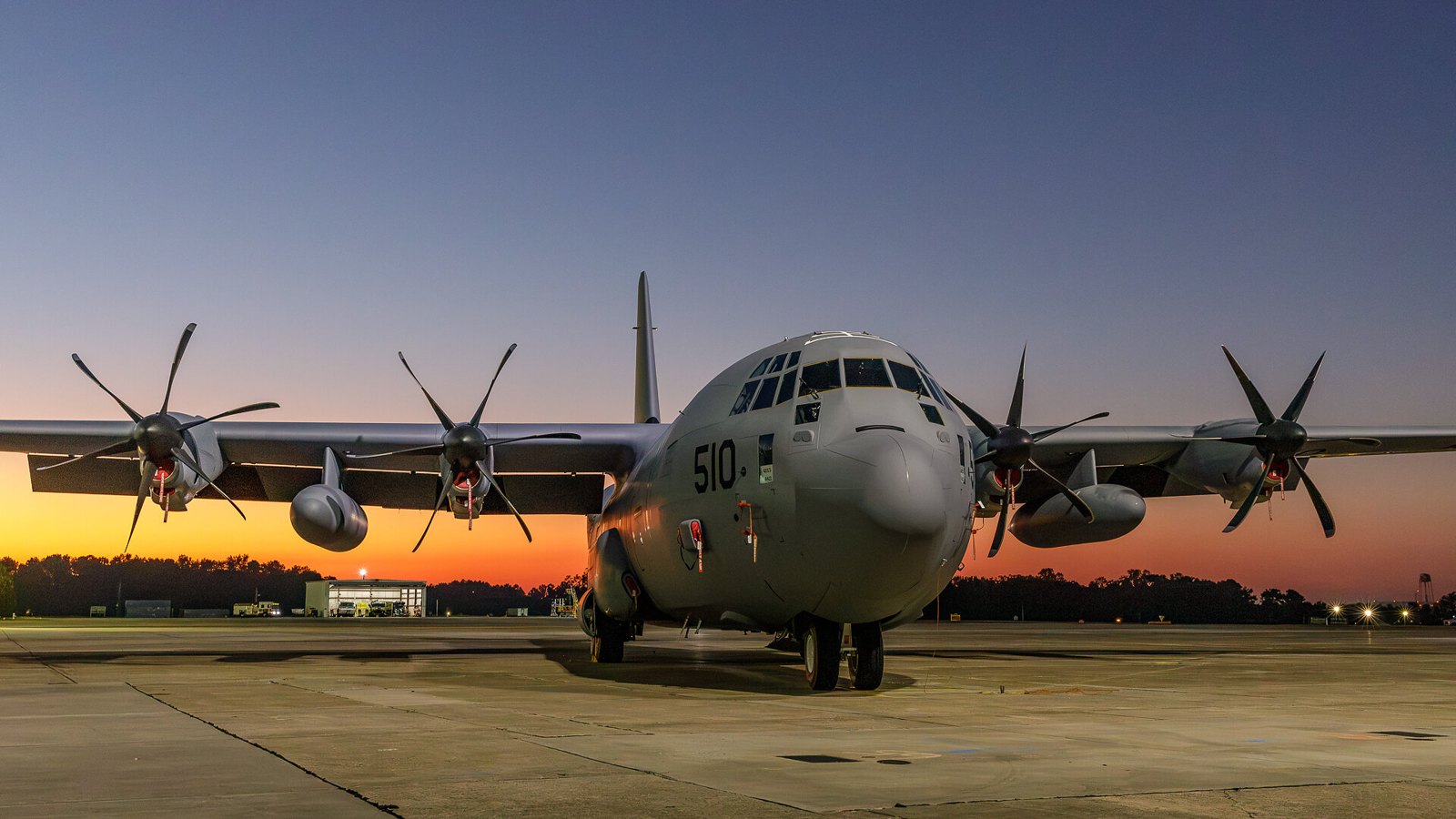
The US Navy has taken delivery of the first aircraft for its E-130J Phoenix II fleet, the planned successor to the E-6B Mercury in the TACAMO nuclear communications role. Lockheed Martin handed over a newly built C-130J-30 Super Hercules at its Marietta, Georgia, plant on 15 October 2026. The airframe now goes to Northrop Grumman for mission-system integration and testing. It is not yet an operational TACAMO aircraft.
Last updated: 17 October 2026
- What: first C-130J-30 airframe for the E-130J Phoenix II program, accepted by the US Navy
- When and where: 15 October 2026, Lockheed Martin, Marietta, Georgia
- Status: delivered as a green airframe; mission systems, ground tests and developmental flight tests still to come
- Batch: first of three C-130J-30s the Navy bought in September 2024
- Integrator: Northrop Grumman; Collins Aerospace supplies the very low frequency (VLF) system
- Replaces: E-6B Mercury in the TACAMO role
What happened in Marietta?
According to the Navy’s Airborne Strategic Command, Control and Communications Program Office (PMA-271), the service accepted the aircraft at a ceremony at Lockheed Martin’s production site. The jet is the stretched C-130J-30 variant and the first of an initial batch of three that the Navy bought in September 2024. Lockheed presented a plaque and a ceremonial key to Capt. Roger Davis, the PMA-271 program manager, who passed the key to Capt. David Gardner, commodore of Strategic Communications Wing 1 at Tinker Air Force Base, Oklahoma. That wing will fly and maintain the new fleet.
“Today’s delivery from the historic Marietta line represents far more than a new airframe; it marks the foundation of our future strategic deterrence posture,” Davis said. Lockheed Martin said the aircraft will be transferred to Northrop Grumman, where the industry team will complete the conversion. Aviation Week, The War Zone and The Aviationist reported the handover independently on 16 October.
What is TACAMO?
TACAMO stands for “Take Charge and Move Out”. It is the Navy’s airborne link between the US president, the secretary of war and US Strategic Command on one side, and the nuclear forces on the other, above all the ballistic missile submarines on patrol. The aircraft receive, verify and retransmit emergency action messages. To reach a submarine underwater they transmit in the very low frequency band through a very long trailing wire antenna, a method TWZ describes in detail. The point of putting this in an aircraft is survivability: the link must still work if ground stations are destroyed.
The program name looks back to the Cold War. The Navy flew the TACAMO mission with the EC-130Q Hercules from 1963 to 1993, according to Lockheed Martin, before the Boeing 707-based E-6 took over.
E-6B Mercury and E-130J compared
| Item | E-6B Mercury (current) | E-130J Phoenix II (planned) |
|---|---|---|
| Base airframe | Boeing 707 derivative | Lockheed Martin C-130J-30 |
| Engines | Four turbofans | Four turboprops |
| Missions | TACAMO and the Looking Glass airborne command post | TACAMO only |
| Fleet | 16 in service | 31 planned (6 pre-production, 25 production), per a Navy acquisition report cited by TWZ |
| Status | Operational | First airframe delivered for conversion; not yet operational |
The Navy has said the E-130J will relieve the E-6B of the TACAMO mission (NAVAIR). The Looking Glass role, which can launch land-based ICBMs from the air, is not part of the E-130J design. The Aviationist notes this drew questions in Congress and that the Air Force is studying how to replace it.
Who builds it and what does it cost?
In December 2024 NAVAIR awarded Northrop Grumman a cost-plus-incentive-fee contract worth $3,459,276,000 to integrate the TACAMO mission systems, including Collins Aerospace’s VLF system, into government-furnished C-130J-30s. The award covers three engineering development models, with options for up to three system demonstration test articles and up to six aircraft in the first production lot. Lockheed Martin and Collins are directed subcontractors. That figure is the integration contract, not the price of a finished aircraft, and it should not be divided into a unit cost.
Risks flagged so far
The airframe is smaller than the E-6B. According to The Aviationist, which cites the Government Accountability Office, fitting the mission equipment within the C-130J-30’s space, weight, power and cooling limits has become a real program risk, and the Navy moved its low-rate initial production decision back by about a year. TWZ adds an operational trade-off: a turboprop will not reach station as fast or fly as high as a 707-class jet, but it can use far more runways, including short and austere strips, which makes the fleet harder to target on the ground.
Why the C-130J?
The C-130J Super Hercules is still in production, which eases spares, training and support compared with the out-of-production 707. Lockheed says the global C-130J fleet exceeds 570 aircraft and the type is certified for 20 mission sets. The Navy’s choice adds a strategic role to an aircraft best known as a tactical airlifter.
The same airframe family is also entering service in Türkiye. The Turkish Ministry of National Defence said on 1 October 2026 that the first two of 12 ex-Royal Air Force C-130Js it is buying from Britain are planned to arrive in December, after maintenance in the UK, Türkiye Today reported.
Where it fits in US nuclear modernisation
NAVAIR lists the E-130J alongside the Columbia-class submarine, the B-21 Raider bomber and the Sentinel ICBM as part of the wider US nuclear modernisation effort. For the bigger picture, see our guides to how many nuclear weapons the US has and US strategic bombers.
FAQ
What is the E-130J Phoenix II?
A C-130J-30 Super Hercules converted by Northrop Grumman for the US Navy’s TACAMO mission, which relays nuclear command messages to ballistic missile submarines. It will replace the E-6B Mercury in that role.
When was the first E-130J delivered?
The first C-130J-30 airframe was accepted on 15 October 2026 in Marietta, Georgia. It still has to be converted and tested before it becomes an operational E-130J.
How many E-130Js will the Navy buy?
The initial contract covers three development aircraft with options for more. TWZ and The Aviationist, citing a Navy acquisition report, put the planned total at 31 aircraft.
Who will fly the E-130J?
Strategic Communications Wing 1 at Tinker Air Force Base, Oklahoma, the unit that flies the E-6B today.
Sources
- US Department of War / US Navy PMA-271: Navy Accepts Next-Generation Aircraft to Modernize Strategic Communications (16 Oct 2026)
- Lockheed Martin: U.S. Navy receives C-130J-30 Super Hercules to become future TACAMO platform, E-130J Phoenix II (16 Oct 2026)
- NAVAIR: Navy awards $3.5B contract to Northrop Grumman to develop successor to E-6B Mercury aircraft (18 Dec 2024)
- Aviation Week: U.S. Navy Accepts First Nuclear Command C-130J (16 Oct 2026)
- The War Zone: First C-130J for Navy’s New E-130J Phoenix II Fleet Delivered (16 Oct 2026)
- The Aviationist: U.S. Navy Receives First C-130J-30 for TACAMO Program (16 Oct 2026)
- Türkiye Today: Türkiye to receive first 2 ex-RAF C-130J aircraft in December (1 Oct 2026)