
IRIS-T SLM, the German Air Shield With a Stellar Ukraine Record
IRIS-T SLM went from a little-known German project to the most talked-about medium-range air defense system in Europe in a single year, after Ukrainian crews reported shooting down nearly everything it aimed at. Built by Diehl Defence around a repurposed air-to-air missile, the system now has a queue of European buyers and a production line straining to keep up.
What is IRIS-T SLM
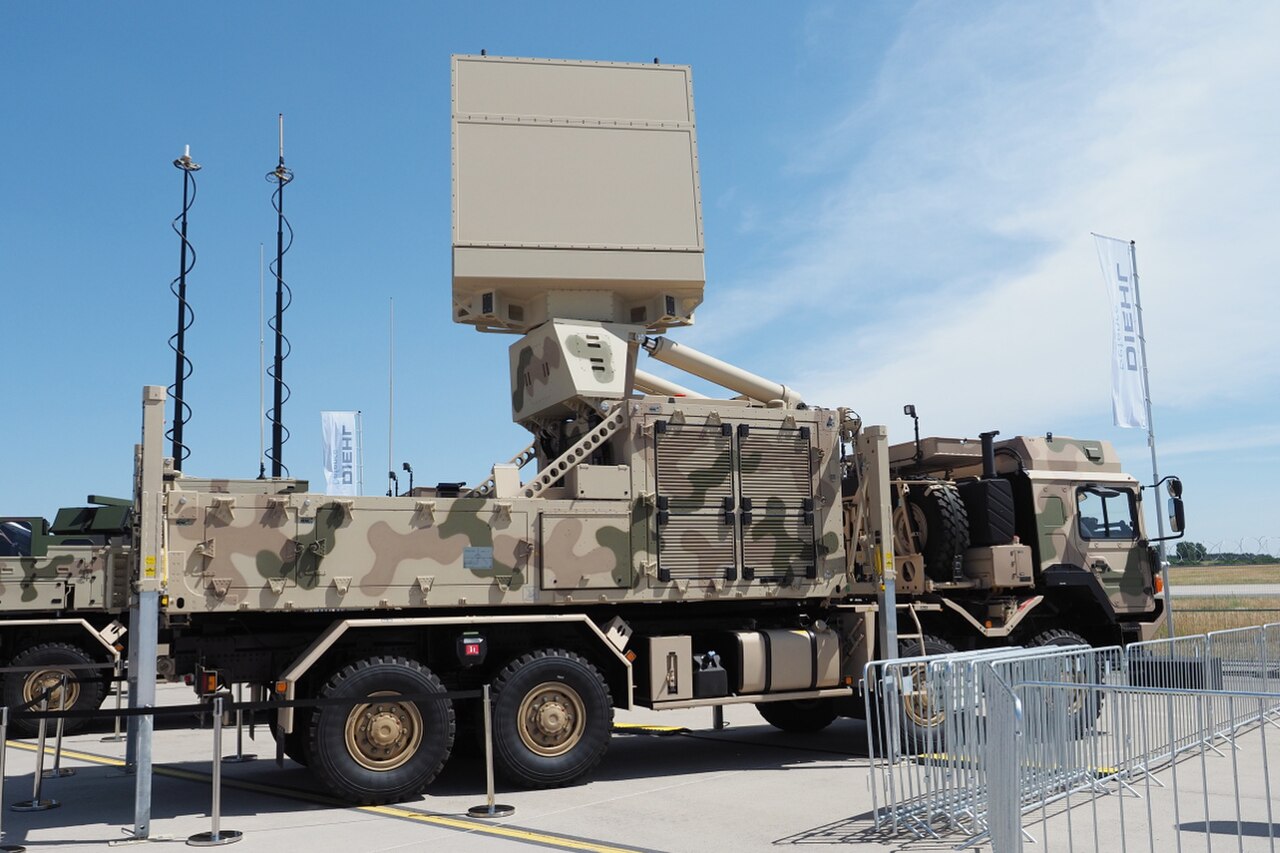
IRIS-T SLM is the ground-launched, medium-range member of Diehl’s IRIS-T family, pairing vertically launched infrared-guided missiles with Hensoldt’s TRML-4D AESA radar and a fire-control network. It fills the layer between short-range guns and Patriot-class systems, the same niche as NASAMS, its closest competitor and the system it is most often compared against.
From air-to-air missile to air shield
The missile began as the IRIS-T air-to-air weapon, a European program led by Germany with partners in Italy, Sweden, Greece, Norway and Spain, fielded on Typhoons, Gripens and F-16s with a 25-kilometer reach and thrust-vectoring agility. Diehl’s ground variants kept the seeker and airframe: SLS fires the unmodified missile to about 12 kilometers, while SLM adds a booster-length body for 40 kilometers, and the SLX in development stretches toward 80 with a dual-mode seeker. Reusing a missile already in European inventories cut cost and time, the same trick NASAMS played with the AMRAAM.
IRIS-T SLM specifications
| Variant | Range | Altitude | Status |
|---|---|---|---|
| IRIS-T SLS | About 12 km | About 8 km | Fielded, short-range layer |
| IRIS-T SLM | About 40 km | About 20 km | In service, combat proven |
| IRIS-T SLX | About 80 km | About 30 km | In development |
The Ukraine record
Germany delivered the first SLM battery to Ukraine in October 2022, the type’s combat debut, and Ukrainian operators have since credited it with hit rates above 90 percent against cruise missiles and Shahed-type drones, figures that are operator-reported but consistent across two years of engagements defending Kyiv and the power grid. The system’s infrared terminal guidance is hard to jam electronically, and its vertical launch gives 360-degree coverage, two traits crews single out. Batteries and munitions have kept flowing through packages alongside US-cleared interceptor deals.
Inside a battery, radar, launchers, network
A typical SLM battery pairs Hensoldt’s TRML-4D, a GaN AESA radar that tracks roughly 1,500 targets to 250 kilometers, with a Diehl fire-control center and several eight-cell vertical launchers, linked by radio so elements can disperse kilometers apart. Vertical launch matters more than it sounds: there is no minimum-engagement sector and no slewing delay, so a single battery handles attacks from all azimuths simultaneously, the scenario Russian mixed drone-and-missile salvos are designed to create. The missile itself ignores chaff and most jamming because its imaging-infrared seeker homes on shape and heat, with the counterpoint that heavy rain and fog degrade IR more than radar, the trade every buyer weighs against AMRAAM-based batteries.
Who is buying, Sky Shield and beyond
Combat validation turned into a European order wave, much of it under the German-led Sky Shield Initiative: Germany’s own forces, plus buyers including Austria, Latvia, Estonia, Slovenia, Switzerland and Norway in various stages, joining earlier export users like Egypt and Saudi Arabia in the wider family. Diehl has expanded production capacity repeatedly since 2022, and delivery slots, not demand, now set the market’s pace, the same bottleneck story running through our air defense top ten, where the SLM debuted at number six.
Cost and the interceptor math
Diehl does not publish SLM missile prices; the air-to-air round it derives from runs about 400,000 euros, and reporting around Ukraine aid packages puts ground-launched rounds in the high hundreds of thousands, several times cheaper than a PAC-3 and several times dearer than the Shahed-class drones it often kills. That asymmetry is the system’s strategic weak point and the whole sector’s: sustainable defense needs the guns-lasers-cheap-missile bottom layer to absorb drone mass so SLM rounds save for cruise missiles, the layering logic running through every network buildout from Kyiv’s to the Gulf packages.
Frequently asked questions
What is the range of IRIS-T SLM?
About 40 kilometers, with altitude coverage to roughly 20 kilometers; the developmental SLX aims at 80 kilometers.
Who makes IRIS-T SLM?
Diehl Defence of Germany, with Hensoldt supplying the TRML-4D radar.
How effective is IRIS-T in Ukraine?
Ukrainian operators report hit rates above 90 percent against cruise missiles and drones since October 2022; figures are operator-reported.
How is IRIS-T SLM different from NASAMS?
Both are medium-range systems built on repurposed air-to-air missiles; SLM uses an infrared-guided missile and German radar, NASAMS the radar-guided AMRAAM.
Which countries operate the system?
Ukraine and Germany lead, with Sky Shield buyers including Austria, the Baltics, Slovenia and Switzerland, and family operators such as Egypt and Saudi Arabia.
- Wikipedia – IRIS-T (accessed October 2026)
- Diehl Defence and Hensoldt program materials
- Ukrainian government statements on performance (operator-reported)
- Defence & Tech air defense coverage