
Victory Will Always Be Ours”: Putin Projects Resolve at a Subdued Red Square Military Parade
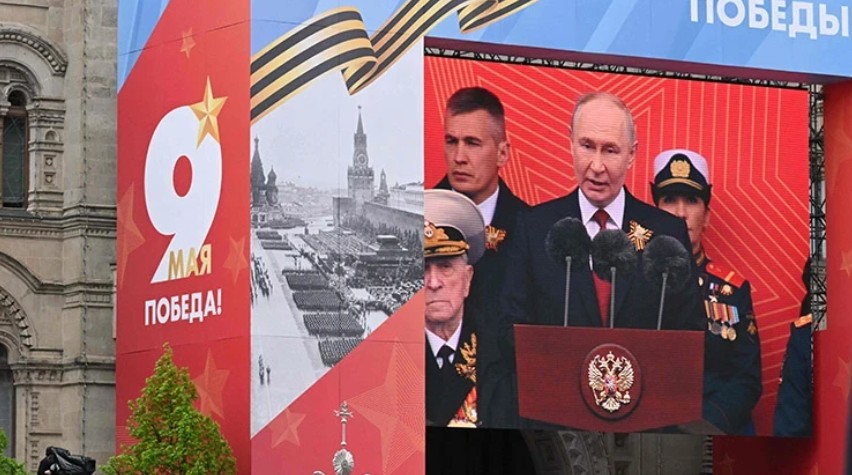
MOSCOW — As Russia marked the 81st anniversary of the Soviet victory over Nazi Germany, President Vladimir Putin delivered a defiant address during the annual May 9 military parade in Red Square. Amidst a complex strategic backdrop marked by a temporary ceasefire and intense frontline attrition, Putin’s message to the Russian armed forces and the public was unequivocal: “Victory has always been ours, and it will always be ours.”
Addressing thousands of troops, including veterans of the ongoing conflict in Ukraine, Putin framed the current hostilities as an existential defense against an “aggressive force” backed by the entire NATO bloc.
“We have a common goal. Everyone is making a personal contribution to Victory,” Putin declared from the rostrum. “Victory is taking shape both on the battlefield and behind the front lines. I firmly believe that our cause is just! We stand together!”
A Parade of Symbolism Over Hardware
For defense analysts and OSINT monitors observing the event, the composition of the parade was as telling as the President’s rhetoric. Historically a sprawling showcase of Moscow’s latest main battle tanks (MBTs), intercontinental ballistic missiles (ICBMs), and advanced aerospace assets, this year’s Victory Day parade was notably scaled back, concluding in roughly 45 minutes.
Heavy modern armor was largely absent from the cobblestones of Red Square. Instead, the procession was dominated by ceremonial infantry units, internal security forces, and historical World War II-era vehicles like the iconic T-34 tank.
This visual shift underscores the immense material toll the prolonged conflict has exacted on Russian mechanized and armored units. The decision to prioritize marching troops over modern tactical hardware highlights a strategic messaging reorientation by the Russian Ministry of Defense—focusing the domestic narrative on historical resilience and manpower rather than showcasing overwhelming technological superiority.
The Ceasefire Paradox
Putin’s uncompromising rhetoric contrasts sharply with the immediate diplomatic reality on the ground. The May 9 celebrations coincided with a 72-hour temporary ceasefire—brokered through initiatives led by U.S. President Donald Trump—facilitating a massive, reciprocal exchange of 1,000 prisoners of war.
While the artillery temporarily falls silent along the line of contact, Putin’s speech serves as a critical psychological operation. By directly linking the current geopolitical struggle to the existential survival of the Great Patriotic War, the Kremlin aims to maintain domestic mobilization and military morale. The clear signal to both NATO adversaries and the Russian public is that the current tactical pause does not represent a shift in long-term strategic objectives.