
Nilgiri-Class Frigate Explained: Project 17A Stealth Warships, Weapons and Indian Navy Role

The Indian Navy is expanding fast, and the Nilgiri class is one of the clearest signs. Built under Project 17A, these seven stealth frigates are among the most capable warships ever designed and built in India, armed with BrahMos supersonic cruise missiles and long-range air defence. Here is what they bring.
- Seven stealth frigates built under Project 17A
- Four built by Mazagon Dock (MDL) in Mumbai, three by GRSE in Kolkata
- Displacement of about 6,670 tonnes; length about 149 metres
- Armed with 8 BrahMos missiles and 32 Barak-8 (MRSAM) air defence missiles
- Lead ship INS Nilgiri commissioned in January 2025
What is Project 17A?
Project 17A is the follow-on to the Shivalik-class (Project 17) frigates that entered service from 2010. The new ships were designed by the Indian Navy’s Warship Design Bureau with improved stealth features, a cleaner superstructure and more advanced sensors and weapons. Around three-quarters of the equipment and materials are sourced from Indian companies.
The ships
The seven frigates are Nilgiri, Udaygiri, Taragiri and Mahendragiri from Mazagon Dock Shipbuilders, and Himgiri, Dunagiri and Vindhyagiri from Garden Reach Shipbuilders and Engineers. The names revive those of earlier Leander-class frigates that served from the 1970s to the 2010s, many named after Indian mountain ranges.
Weapons and sensors
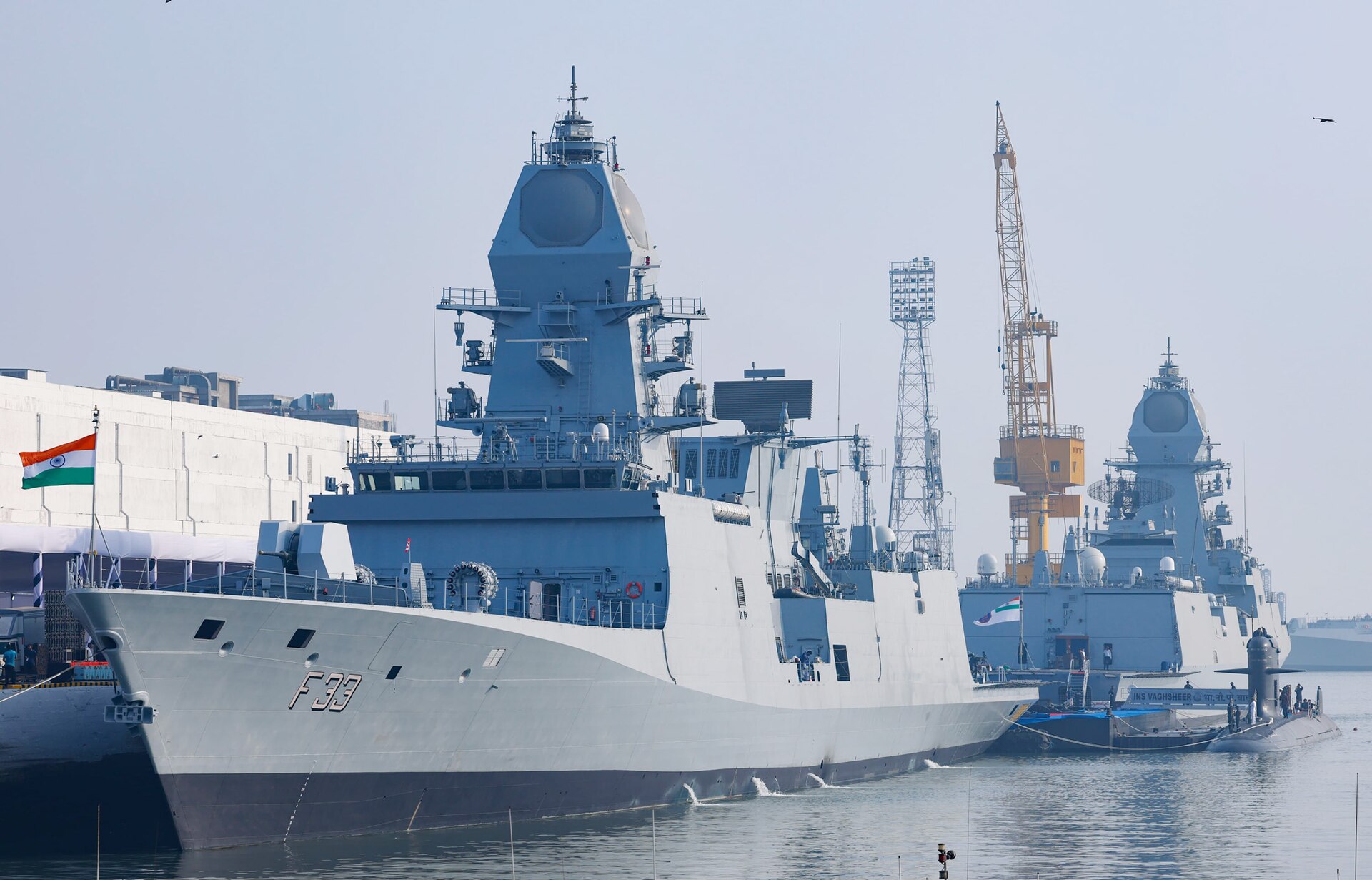
Each frigate carries eight BrahMos supersonic anti-ship and land-attack cruise missiles and 32 Barak-8 medium-range surface-to-air missiles, guided by the MF-STAR active electronically scanned array radar. Close-in defence comes from a 76mm main gun and rapid-fire guns, while torpedoes and anti-submarine rockets support underwater warfare. The ships can operate a medium helicopter such as the MH-60R Seahawk.
Propulsion
The Nilgiri class uses a combined diesel or gas (CODOG) arrangement with General Electric LM2500 gas turbines and MAN diesel engines, giving a top speed of around 28 knots. An integrated platform management system automates much of the ship’s operation.
Commissioning timeline
INS Nilgiri was commissioned on 15 January 2025 in Mumbai, alongside the destroyer INS Surat and the submarine INS Vagsheer. INS Udaygiri and INS Himgiri followed together on 26 August 2025, the first time ships from two different Indian shipyards were commissioned on the same day. The remaining ships are being delivered through 2026, completing the class.
Verdict
The Nilgiri class gives the Indian Navy a modern, well-armed and largely home-built frigate force for the Indian Ocean, where China’s naval presence is growing. With Project 17B already planned as a follow-on, the class also shows that Indian shipyards can now deliver complex warships at a steadier pace.
Featured image: Government of India / GODL-India, via Wikimedia Commons