
Link 16 Explained, the Network Behind Every NATO Air Battle

Link 16 is the tactical datalink that lets NATO aircraft, ships and air defense batteries share one radar picture in near real time, hopping across 51 frequencies in the 960–1215 MHz band roughly 77,000 times a second (one hop per 13-microsecond pulse) to shrug off jamming, and carrying J-series messages defined by MIL-STD-6016. Fielded in the 1980s and still expanding today, it is the closest thing allied forces have to a common nervous system, and understanding it explains half of how modern air battles are actually fought.
What is Link 16 and how does it work
Link 16 is a time-division network. Every participant, a fighter, an AWACS, a destroyer, a Patriot battery, is assigned time slots, 128 of them per second across the network, and transmits only in its slots. Messages ride the 960-1215 MHz band and hop pseudo-randomly across 51 frequencies, with encryption and error coding layered on top, which makes the signal hard to jam and hard to exploit. Terminals are known by their program names, JTIDS for the original refrigerator-sized units and MIDS for the modern small-form-factor ones.
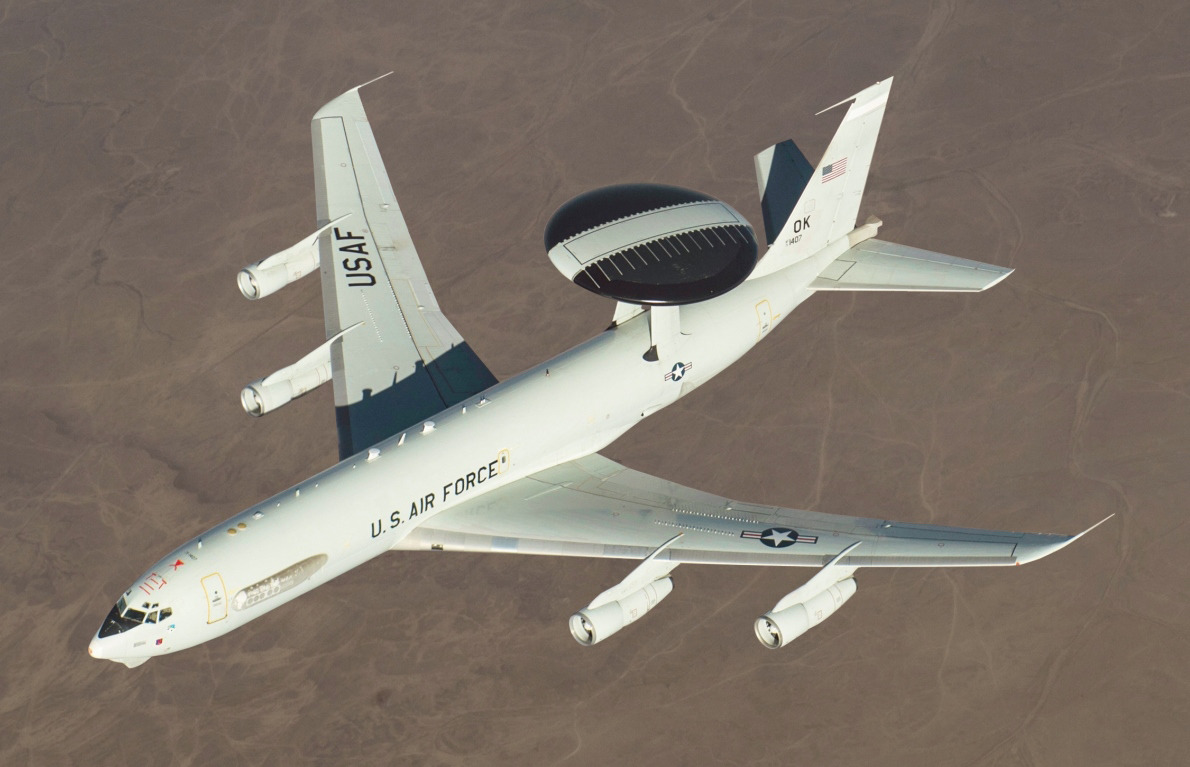
Because every user hears every slot, there is no central server to kill. An E-3 or E-7 usually manages the network, but the mesh keeps working if it drops out, and relays can stretch coverage beyond the roughly 300 nautical mile line-of-sight limit between airborne platforms.
What data does Link 16 actually share
The catalog of J-series messages covers surveillance tracks, friendly positions, engagement status, text, and even secure voice. In practice the traffic that matters most is the track picture, every radar contact any node holds, fused into a single display in every cockpit. A fighter pilot sees what the AWACS sees, what the Aegis destroyer offshore sees, and what wingmen see, without anyone speaking on the radio.
That fused picture enables tactics that would otherwise be impossible, silent intercepts where the shooter’s own radar never radiates, handoffs where a modern AESA radar tracks a target for a missile fired by someone else, and air defense engagements coordinated across services and nations.
Link 16 vs Link 22 and other datalinks
| Datalink | Band | Range | Role |
|---|---|---|---|
| Link 16 | 960-1215 MHz (L-band) | Line of sight, ~300 nmi air-to-air | NATO standard tactical picture and C2 |
| Link 22 | HF and UHF | Beyond line of sight over HF | NATO maritime successor to Link 11 |
| Link 11 | HF/UHF | Beyond line of sight | Legacy naval link being retired |
| MADL | Ku-band, directional | Short, between aircraft | Stealthy F-35-to-F-35 sharing |
| IFDL | Directional, fighter-to-fighter | Short | F-22 flight-internal sharing |
| SATCOM links | UHF/X/Ka | Global | Reachback, not the dogfight picture |
Why stealth jets need different datalinks
Link 16 transmissions are omnidirectional and relatively powerful, which is fine for an F-16 and a problem for a stealth aircraft trying to stay electronically invisible. The F-22 fields the directional IFDL and the F-35 the MADL, narrow, low-probability-of-intercept links that pass data between stealth jets without lighting up the spectrum. The penalty is fragmentation, fifth-generation jets historically could receive Link 16 but were reluctant to transmit, and gateway aircraft or pods are used to translate between the stealth links and the F-35 community and everyone else.
How datalinks decide modern air battles
Ukraine demonstrated the point from both directions. Western-donated assets plugged into a NATO-style picture have let a small air force generate outsized effects, while Russian aircraft, which lack a fleet-wide equivalent and rely on narrower proprietary links, have been described by Western analysts as slower to share targeting data between platforms. The lesson is driving every next-generation program, collaborative combat aircraft are being designed around the network first and the airframe second, and upgrades like cryptographic modernization and higher-throughput MIDS-JTRS terminals are treated as urgent operational needs rather than routine maintenance.
The vulnerability is the flip side. A network everyone depends on is a network worth attacking, and electronic warfare against datalinks, GPS and communications is now a core Russian and Chinese discipline. NATO’s answer is layered, frequency-hopping resilience in Link 16 itself, directional links for stealth aircraft, and satellite paths as backup.
Link 16 frequently asked questions
What is Link 16 in simple terms?
A jam-resistant military radio network that lets aircraft, ships and air defense systems share a single live map of the battle, each transmitting in assigned time slots.
What is the range of Link 16?
Line of sight, roughly 300 nautical miles between high-flying aircraft, less to surface units; relays and satellite gateways extend it further.
Is Link 16 encrypted?
Yes. Traffic is encrypted and frequency-hops across 51 frequencies, and crypto modernization programs continue to upgrade its resistance.
What is the difference between Link 16 and Link 22?
Link 22 is the NATO maritime link built for beyond-line-of-sight ranges over HF, replacing Link 11; Link 16 remains the line-of-sight tactical standard.
Does the F-35 use Link 16?
It carries Link 16 but prefers its stealthy directional MADL link when emissions matter; gateways translate between the two worlds.
What data rate does Link 16 support?
Standard Link 16 passes data at 31.6, 57.6 or 115.2 kilobits per second depending on the packing structure. Modern MIDS JTRS terminals add an Enhanced Throughput mode that lifts the protected data rate from 115 kbps to more than 1 Mbps, according to L3Harris and Viasat.
Who builds Link 16 terminals?
In the United States, Viasat and Data Link Solutions (a BAE Systems–Collins Aerospace joint venture) build MIDS JTRS and MIDS-LVT terminals; L3Harris also markets a MIDS JTRS terminal. In Europe, the EuroMIDS consortium led by Thales produces MIDS-LVT for NATO users (Data Link Solutions data sheet).
How many time slots does Link 16 have?
The network divides each second into 128 time slots of 7.8125 milliseconds; a 12-second frame holds 1,536 slots, and slots are assigned to individual units or groups such as fighters or AWACS.
- L3Harris – MIDS JTRS terminal data sheet (MIL-STD-6016, enhanced throughput, 200 W output)
- Data Link Solutions – MIDS JTRS data sheet
- US Army Weapon Systems Handbook 2012 – MIDS (FAS mirror)
- Military & Aerospace Electronics – Navy awards MIDS JTRS contracts to Viasat and Data Link Solutions
- Military & Aerospace Electronics – Viasat MIDS JTRS Link 16 upgrades (115 kbps to over 1 Mbps)