MiG-35 Explained: Russia’s Most Advanced Fulcrum, Specs, Radar and Why Few Were Built
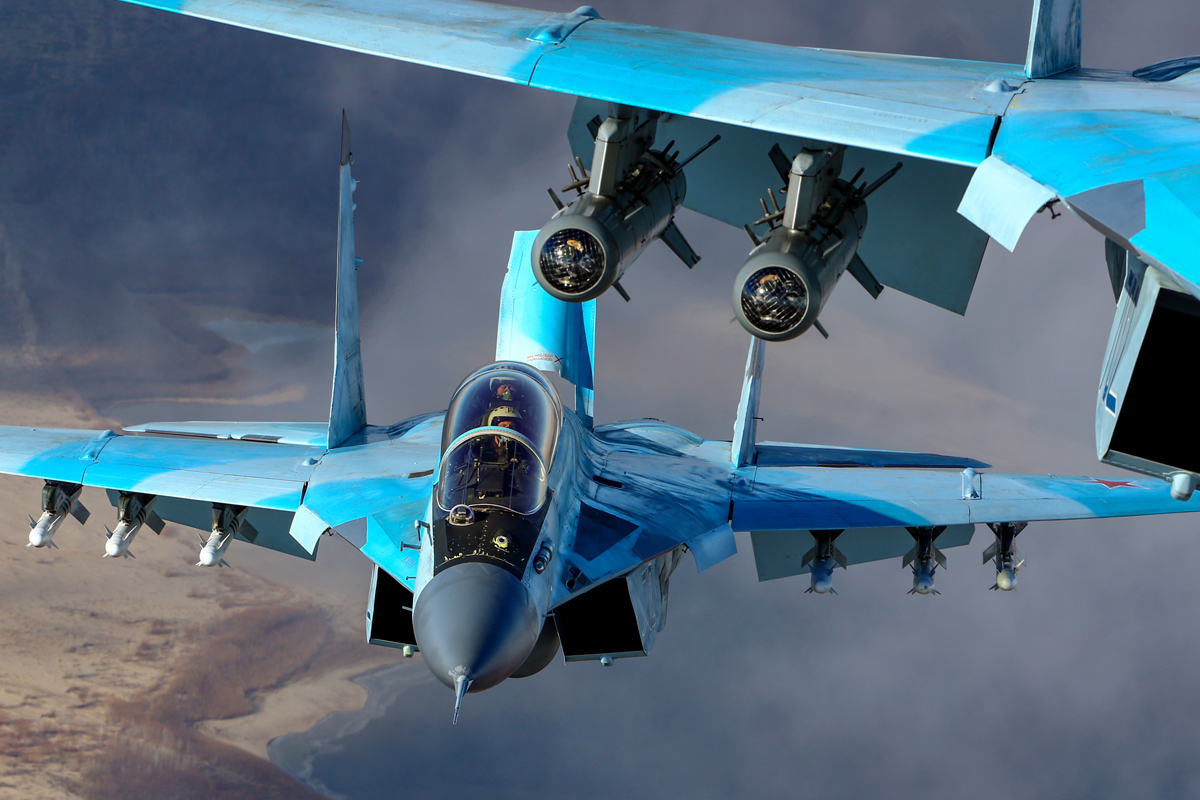

The MiG-35 is the final evolution of the famous MiG-29 Fulcrum, offering modern radar, more fuel, better engines and a wider range of weapons in a familiar airframe. On paper it is a capable, affordable multirole fighter. In practice, it has struggled to win orders at home or abroad. Here is why.
- 4++ generation multirole fighter developed by RSK MiG (now part of UAC)
- Derived from the MiG-29K/KUB naval fighter; NATO name “Fulcrum-F”
- Twin RD-33MKV engines; top speed around Mach 2.2
- Up to about 6.5 tonnes of weapons on 9 hardpoints
- Russia has bought only a small batch; no confirmed export customer
What is the MiG-35?
The MiG-35 grew out of the MiG-29M and MiG-29K family, which redesigned the original 1980s Fulcrum with a stronger airframe, more internal fuel, a modern glass cockpit and fly-by-wire controls. The single-seat MiG-35S and two-seat MiG-35UB share the same airframe, making training and maintenance simpler. It was officially presented in 2017 as Russia’s new light multirole fighter.
Radar and sensors
Marketing materials have centred on the Zhuk-AE active electronically scanned array radar, one of Russia’s first fighter AESA radars, although production aircraft for the Russian Air Force were reportedly delivered with a more conventional radar. The jet also carries the OLS-K infrared search and track and laser rangefinding system and modern electronic warfare equipment.
Engines and weapons
Two RD-33MKV engines give the MiG-35 more thrust and better fuel efficiency than earlier MiG-29s, with an optional thrust-vectoring version offered for export. It can carry R-77 and R-73 air-to-air missiles, Kh-31 and Kh-35 anti-ship missiles, guided bombs and other munitions on nine hardpoints, as well as a 30mm cannon.
The Indian competition
The MiG-35 was one of six contenders in India’s Medium Multi-Role Combat Aircraft competition in the late 2000s, but it was eliminated in 2011, with the Rafale eventually selected. That loss was a major blow, because India had been the most important potential buyer. MiG has since offered the jet again in later Indian fighter tenders.
Russian orders
Russia’s Aerospace Forces signed a contract for just six MiG-35s in 2018. With limited budgets, Moscow prioritised the heavier Su-30SM, Su-35S and Su-57. Export interest from countries such as Egypt went instead to related MiG-29M/M2 aircraft, and sanctions after 2022 have made new export deals even harder.
Verdict
The MiG-35 is a solid upgrade of a proven design, but it arrived too late and in a market dominated by more capable or better-supported fighters. Unless a major customer emerges, it is likely to remain a footnote in Russian military aviation rather than the successor to the MiG-29 that many expected.
Featured image: Ministry of Defence (Russia) / CC BY 4.0, via Wikimedia Commons