Russia’s Cruise Missiles: Kalibr, Kh-101, Kh-69 and Oniks
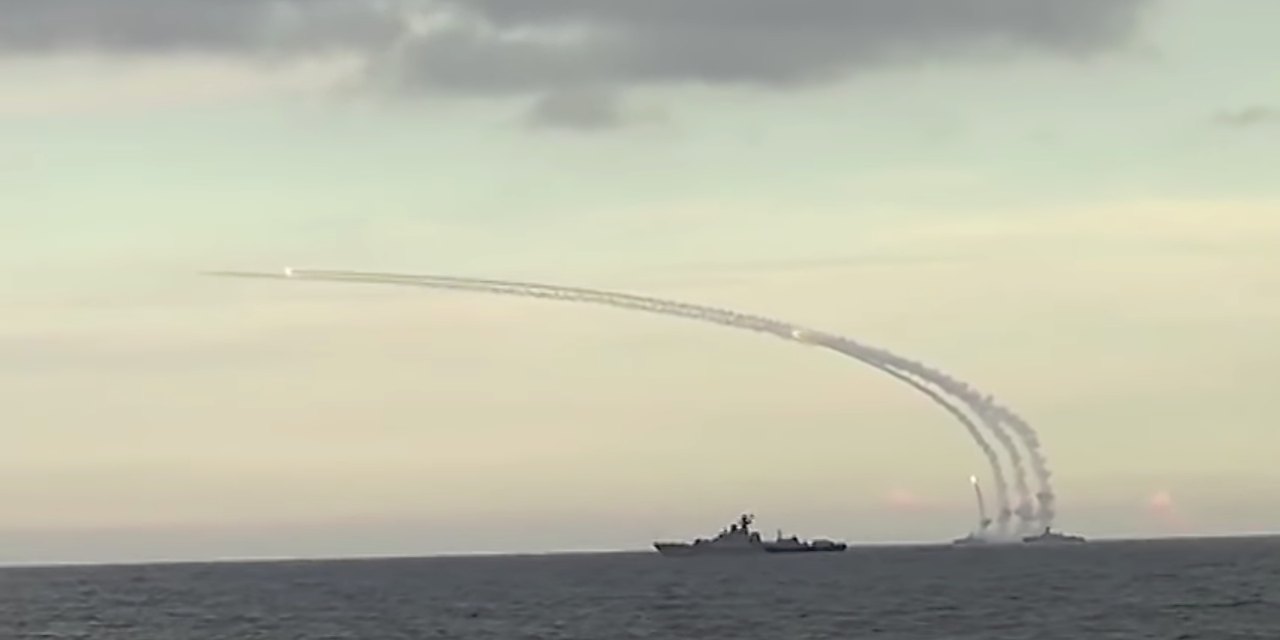
Russia’s main cruise missiles are the air-launched Kh-101 and the ship-launched Kalibr, both able to hit targets more than 1,500 km away with a warhead of about 400 kg. Around them is a family of shorter-range and faster weapons: the Iskander-K, the Kh-69, the supersonic Oniks and the Soviet-era Kh-22.
These missiles have carried much of Russia’s long-range bombing of Ukraine since 2022. This guide explains what each one does, how it finds its target and how many Russia is thought to build.
What cruise missiles does Russia have?
A cruise missile is in effect a small pilotless aircraft. It flies inside the atmosphere under jet power, usually at low altitude and below the speed of sound, following a programmed route. That makes it slower than a ballistic missile but harder to see on radar and able to approach from any direction. Russia’s ballistic types are covered in what missiles Russia has.
| Missile | Launched from | Speed | Range | Warhead |
|---|---|---|---|---|
| Kh-101 | Tu-95MS, Tu-160 | Subsonic | At least 2,500 km | About 400 kg |
| Kalibr (3M14) | Ships and submarines | Subsonic | 1,500 to 2,500 km | About 450 kg |
| Iskander-K (9M728) | Iskander ground launcher | Subsonic | About 500 km | About 480 kg |
| 9M729 | Ground launcher | Subsonic | Up to 2,500 km, US assessment | Not disclosed |
| Kh-69 | Su-34, Su-35, Su-57 | Subsonic | About 400 km | About 310 kg |
| P-800 Oniks | Ships, submarines, Bastion coastal launchers | Mach 2.5 | 300 to 800 km | About 250 kg |
| Kh-22 / Kh-32 | Tu-22M3 | Mach 3.5 to 4 | 600 to 1,000 km | Up to about 900 kg |
Kh-101, the main long-range strike missile
The Kh-101 entered service in the early 2010s and replaced the Soviet Kh-555. It has a flattened, radar-deflecting body, a small turbofan engine and a range of at least 2,500 km, which lets Tu-95MS and Tu-160 bombers launch from over the Caspian Sea or the Volga region without leaving Russian airspace. The rest of Russia’s combat aircraft are covered in what fighter jets Russia has.
It navigates by inertial sensors and satellite signals, then matches camera images of the ground against stored pictures in the final approach. How that works is explained in our guide to cruise missile guidance. Missiles recovered in Ukraine show steady changes: decoy flares, a second warhead in place of some fuel and cluster munitions. The nuclear version is designated Kh-102.
Kalibr, the navy’s cruise missile
The Kalibr made its debut in October 2015, when small warships in the Caspian Sea fired 26 missiles at targets in Syria about 1,500 km away. It fits a universal vertical launcher carried by frigates, corvettes of only 950 tonnes and submarines, which gave even minor Russian warships a strategic reach.
Its use against Ukraine has been limited by geography. Ukrainian missiles and naval drones forced the Black Sea Fleet out of Sevastopol to Novorossiysk, and launches now come from fewer ships. That helps explain why Kalibr stocks are high while Kh-101 stocks are low. More detail is in our Kalibr guide.
Iskander-K and the 9M729
The Iskander-K is a cruise missile fired from the same launcher as the Iskander-M ballistic missile, with a declared range of about 500 km. Its longer-range relative, the 9M729, is the weapon the United States cited when it withdrew from the Intermediate-Range Nuclear Forces Treaty in 2019, arguing that it flew far beyond the treaty’s 500 km limit.
In August 2025 Russia said it no longer considered itself bound by its own moratorium on deploying such missiles. Ukraine’s foreign minister said in October 2025 that Russia had fired the 9M729 at Ukraine 23 times since that August, with one missile flying about 1,200 km.
Oniks and Kh-22, the supersonic missiles
The P-800 Oniks is a ramjet-powered anti-ship missile that flies at about Mach 2.5. Russia fires it at land targets from Bastion coastal batteries in Crimea, mostly at the Odesa region. The Kh-22, designed in the 1960s to destroy aircraft carriers, and its Kh-32 upgrade are launched from Tu-22M3 bombers and dive on the target at about Mach 4.
Speed makes all three hard to intercept, and poor accuracy against land targets makes the Kh-22 especially dangerous to civilians. Their naval role is covered in our top 10 anti-ship missiles, and the faster Zircon in Russia’s hypersonic missiles.
How many cruise missiles can Russia build?
Ukrainian military intelligence publishes the only detailed estimates. They show Kh-101 output rising sharply, from a few dozen a month in 2024 to as many as 87 in July 2026.
| Missile | Stockpile | Monthly output |
|---|---|---|
| Kh-101 | About 100 | 60 to 87 |
| Kalibr | About 450 | About 20 |
| Iskander-K | More than 60 | About 15 |
| Kh-32 | More than 250 | About 10 |
| P-800 Oniks | About 600 | About 5 |
| Kh-69 | Not stated | About 4 |
Investigators examining wreckage have repeatedly found Western-made microchips in these missiles, bought through intermediaries despite sanctions.
Frequently asked questions
What is the difference between a cruise missile and a ballistic missile?
A cruise missile flies like an aircraft, low and usually subsonic. A ballistic missile is boosted on a high arc and falls on its target at several times the speed of sound.
What is the range of the Kalibr missile?
The land-attack version is estimated at 1,500 to 2,500 km.
How many Kh-101 missiles does Russia make?
Between 60 and 87 a month in mid-2026, according to Ukrainian military intelligence.
Which aircraft launch Russian cruise missiles?
Tu-95MS and Tu-160 bombers carry the Kh-101, Tu-22M3 bombers carry the Kh-22 and Kh-32, and tactical jets such as the Su-34 carry the Kh-69.
Can Russian cruise missiles carry nuclear warheads?
Several can. The Kh-102 is a nuclear version of the Kh-101, and the Kalibr and Iskander-K are considered dual-capable.
- CSIS Missile Threat – Missiles of Russia: missilethreat.csis.org
- Ukrainska Pravda – Ukraine’s Defence Intelligence on Russia’s missile stockpiles and production rates (August 2026): pravda.com.ua
- The New Voice of Ukraine – Ukrainian intelligence data on Russian missile output (July 2026): english.nv.ua
- Wikipedia – Kh-101: en.wikipedia.org
- Wikipedia – 9M729: en.wikipedia.org