China’s Sixth-Generation Fighters: What Are the J-36 and J-50?
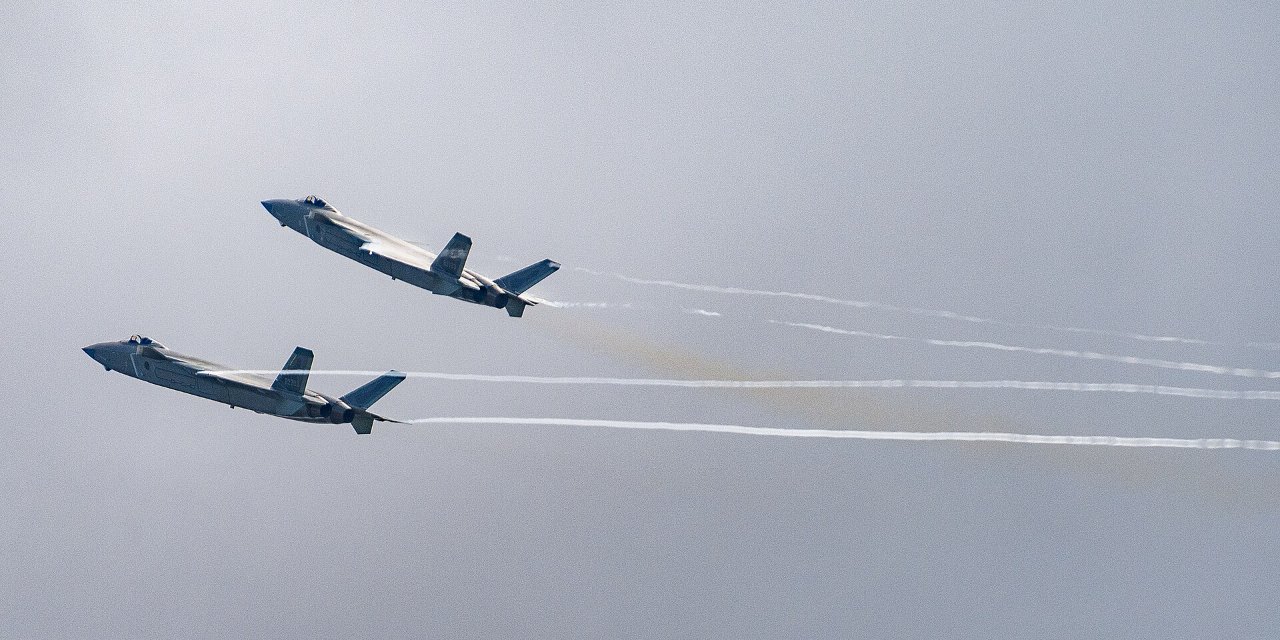
On 26 December 2024 two new Chinese combat aircraft were photographed in flight on the same day: a large three-engine tailless jet from Chengdu, known in the West as the J-36, and a smaller twin-engine tailless design from Shenyang, often called the J-50 or J-XDS. Both are widely seen as China’s first sixth-generation fighter prototypes. At least three J-36 prototypes have flown since, and by mid-2026 both Chinese and American air force leaders were describing it as a sixth-generation aircraft.
This guide sets out what is known about the two aircraft and how they compare with the American F-47.
What are China’s sixth-generation fighters?
China has not officially named either aircraft. “J-36” comes from a number painted on the first Chengdu prototype, and “J-50” is an unofficial name used by Western analysts for the Shenyang design. Neither has been formally unveiled, but Chinese state media began acknowledging the Chengdu aircraft in 2025, calling it the “ginkgo leaf” jet because of its shape. Both remove the vertical tail, which reduces radar signature from every angle, a key feature of sixth-generation designs.
| Aircraft | Maker | Configuration | What is known |
|---|---|---|---|
| J-36 (unofficial) | Chengdu Aircraft Corporation | Large tailless flying wing, three engines | Two crew side by side; large internal weapons bays; at least three prototypes |
| J-50 / J-XDS (unofficial) | Shenyang Aircraft Corporation | Tailless lambda wing, two engines | Smaller; thrust-vectoring nozzles reported; possible carrier role |
| F-47 (for comparison) | Boeing (United States) | Not publicly revealed | Contract awarded March 2025; first flight planned for 2028 |
J-36: the big tri-jet
The J-36 is a very large aircraft for a fighter, with a diamond-shaped double-delta wing, a dorsal air intake and three engines, an arrangement not seen in a combat jet for decades. Its two pilots sit side by side, and its main weapons bay is estimated at about 7.6 metres long, large enough for long-range air-to-air missiles or heavy strike weapons. Analysts believe it is designed for long range and high speed, possibly to strike tankers, early-warning aircraft and bases far from China, and to command groups of drones. A second prototype began flying in October 2025 with thrust-vectoring nozzles, and a third was seen on 25 December 2025.
J-50: Shenyang’s design
The Shenyang aircraft is smaller, with two engines and a lambda-shaped wing with movable wingtips. Some analysts believe it may become a carrier-based fighter, given Shenyang’s work on the J-15 and J-35. Satellite images in 2025 showed it at the same test base near Lop Nur as the J-36. Its comparison with the American F-47 is the subject of our article on the F-47 and J-50.
What makes a fighter sixth-generation?
There is no fixed definition, but sixth-generation fighters are generally expected to have stealth from all angles, longer range, more powerful sensors, adaptive engines and the ability to control drones. They are designed to work as the centre of a network rather than as individual fighters. Our guide to sixth-generation fighters explains the concept. Europe has its own programmes, including the Tempest/GCAP led by Britain, Italy and Japan.
How does China compare with the United States?
The United States awarded the contract for its sixth-generation fighter, the Boeing F-47, in March 2025, with a first flight planned for 2028. China appears to be several years ahead in flight testing, with two designs in the air since 2024. That does not mean it will field them first, because development and production take years after first flight. China’s current fighter force is covered in our guide to Chinese fighter jets.
Frequently asked questions
Does China have a sixth-generation fighter?
China is flight-testing two prototypes widely seen as sixth-generation fighters, the J-36 and the J-50, both first seen in December 2024. Neither is in service.
What is the J-36?
A large, tailless, three-engine combat aircraft built by Chengdu, with two crew and large internal weapons bays. Its official name has not been announced.
What is the J-50?
A smaller, tailless, twin-engine design from Shenyang. “J-50” and “J-XDS” are unofficial names used by analysts.
When did the J-36 first fly?
It was first seen in flight on 26 December 2024. At least three prototypes had flown by the end of 2025.
Is China ahead of the US in sixth-generation fighters?
In flight testing, yes. China’s prototypes have flown since 2024, while the American F-47 is due to fly in 2028.
Why does the J-36 have three engines?
China has not said. Analysts believe the third engine provides extra power for speed, range and electrical systems such as sensors and possibly directed-energy weapons.
- Wikipedia – Chengdu J-36 (summary of public reporting): en.wikipedia.org
- National Security Journal – New stealth J-36 and J-XDS fighters might be undergoing testing: nationalsecurityjournal.org
- Army Recognition – China accelerates development of sixth-generation fighters J-36 and J-50: armyrecognition.com
- TWZ – How many J-20 Mighty Dragon fighters does China actually have? (July 2026): twz.com