CH-47F Chinook Specs, Variants, Cost and Operators

The CH-47F Chinook is Boeing’s tandem-rotor heavy-lift helicopter, carrying up to about 55 troops or roughly 10 tonnes of cargo at speeds near 300 km/h. A design whose lineage runs back to the early 1960s, the F model is still being bought by more than a dozen countries, and a Block II upgrade is meant to keep it flying into the 2060s.
What is the CH-47F Chinook
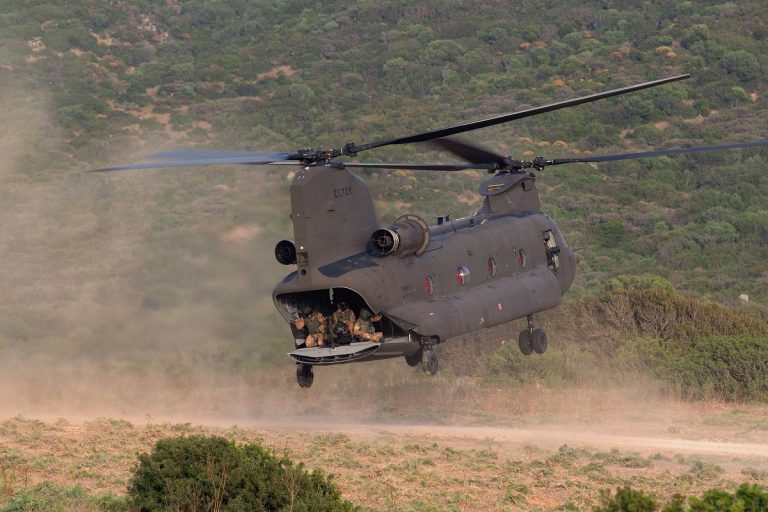
The Chinook is built by Boeing Defense at Ridley Park, Pennsylvania, and it is the standard heavy-lift helicopter of the US Army and many allied forces. Two counter-rotating rotors on a long fuselage give it a large cargo bay with a rear ramp, and the twin engines sit in pods on each side of the rear pylon. The CH-47F is the digital remanufactured version of the older CH-47D, with a glass cockpit, new avionics and a strengthened airframe.
The aircraft carries troops, artillery pieces, vehicles and supplies, and it can lift downed helicopters and light aircraft under a sling load. Its closest peers are the Sikorsky CH-53K and the Russian Mi-26, but no other Western helicopter has sold in similar numbers. It also appears in our review of top 10 military transport aircraft.
CH-47F Chinook specifications
| Parameter | Value |
|---|---|
| Manufacturer | Boeing Defense, Space and Security (USA) |
| Crew | 3 to 4 (two pilots, flight engineer, crew chief) |
| Rotors | Two three-blade rotors, each about 18.3 m in diameter |
| Engines | 2 x Honeywell T55-GA-714A, about 4,700 shp each |
| Max takeoff weight | About 22,700 kg |
| Maximum speed | About 315 km/h (170 knots), reported |
| Cruise speed | About 260 km/h |
| Range | About 740 km |
| Service ceiling | About 6,100 m |
| Payload | Up to 33 to 55 troops or about 10 t of internal cargo; about 12.7 t external |
The engines are supplied by Honeywell, whose role in military propulsion is covered in our Honeywell Aerospace profile. A digital automatic flight control system lets crews fly in poor visibility, while the ramp and triple cargo hooks allow loading from several heights.
CH-47F variants and Block II
| Variant | Role | Notes |
|---|---|---|
| CH-47F | Standard transport | Digital cockpit and strengthened airframe; US Army and export standard |
| MH-47G | Special operations | Extended range, terrain-following radar, aerial refueling; US Army 160th SOAR |
| CH-47F Block II | Upgrade | Improved rotor blades, stronger drive train and greater lift; first deliveries planned later in the decade |
| Chinook HC6 | UK Royal Air Force | Based on the CH-47F with British modifications |
| CH-47F(I) | Indian Air Force | Indian configuration of the F model |
Block II adds new fiberglass rotor blades, a strengthened airframe and a tougher transmission, and Boeing says it will raise payload at high altitude and hot temperatures. Delays in the flight test program have pushed the first fielding dates back.
CH-47F Chinook operators
The US Army operates the largest fleet, several hundred airframes across conventional and special operations units. Export customers include the United Kingdom, the Netherlands, Italy, Australia, Canada, Japan, South Korea, Singapore, Spain, Egypt and India, which bought 15 CH-47F(I) helicopters for its Air Force. Germany has committed to a large buy to replace its aging heavy-lift fleet. Egypt’s airframes are shown in our image, a representative US Army example, since local deliveries have used a similar standard.
Unit cost depends on equipment, and is reported at roughly $35 to $40 million, with major sustainment costs on top. The mature supply chain and widespread training make it easy to keep flying, which is a major reason that buyers keep returning to the type.
CH-47 Chinook combat record
The Chinook flew in Vietnam, and its earliest heavy lifts included artillery and downed aircraft recovery. In the 1982 Falklands conflict a single British Chinook, Bravo November, survived the loss of the Atlantic Conveyor and carried out much of the airlift. The type has since been a constant feature of operations in Iraq and Afghanistan, including special operations missions such as the 2005 Operation Red Wings, in which an MH-47 was shot down.
Its wartime value rests on lifting what no other helicopter can: howitzers, water, fuel and large casualties. It is, in effect, the flying truck on which forward bases depend. It pairs naturally with gunships such as the AH-64 Apache in air assault operations.
CH-47F Chinook frequently asked questions
How much can a CH-47F Chinook carry?
Roughly 10 tonnes of internal cargo, about 12.7 tonnes on external hooks, or up to around 55 troops in a dense layout.
How fast is a CH-47F?
Maximum speed is reported at about 315 km/h, with cruise near 260 km/h.
What engines does the CH-47F use?
Two Honeywell T55 turboshafts of roughly 4,700 shp each.
Who operates the CH-47F Chinook?
The US Army and many allies, including the UK, Netherlands, Italy, Australia, Canada, Japan, India and Egypt.
Why does the Chinook have two rotors?
The tandem arrangement removes the tail rotor, balances the load and lets the helicopter carry heavy cargo with a simple, compact layout.
- Boeing Chinook product literature
- US Army and Defense Security Cooperation Agency announcements
- Wikipedia – Boeing CH-47 Chinook (accessed October 2026)
- Defence & Tech reporting