Bayraktar KALKAN DİHA: Baykar’s VTOL Drone, Specifications and Service History

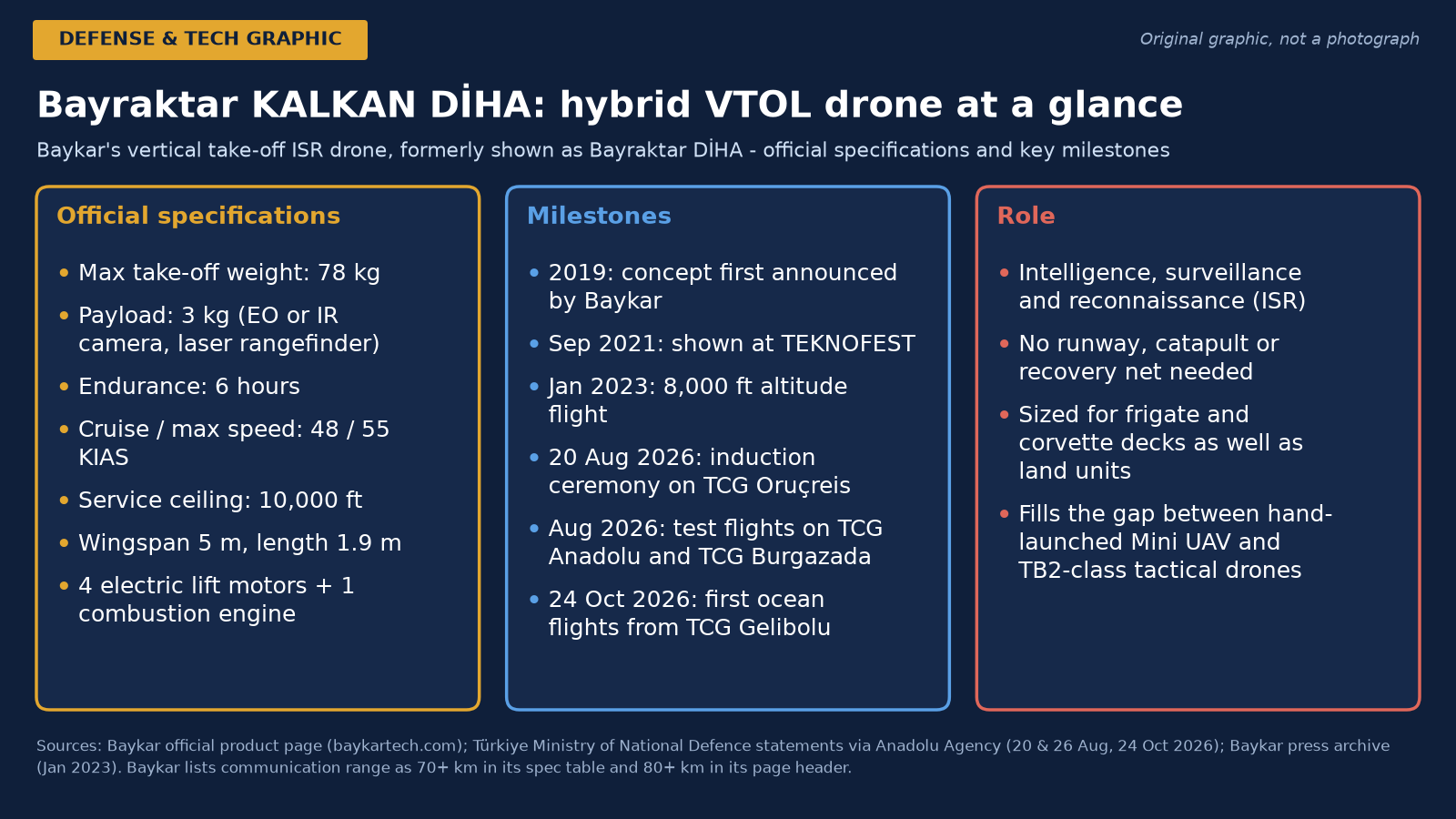
The Bayraktar KALKAN DİHA is a small vertical take-off and landing (VTOL) drone built by Türkiye’s Baykar for intelligence, surveillance and reconnaissance. It lifts off and lands on four electric motors, then switches to a combustion engine for cruise. Baykar gives it a 78 kg maximum take-off weight, a 3 kg sensor payload and six hours’ endurance. The aircraft was first announced in 2019 as the Bayraktar DİHA and entered Turkish service in August 2026 (Baykar, Anadolu Agency).
- Maker: Baykar, Türkiye. DİHA stands for Dikey İniş Kalkışlı İnsansız Hava Aracı, Turkish for vertical take-off and landing unmanned aerial vehicle
- Role: intelligence, surveillance and reconnaissance (ISR) from land sites and ships, with no runway needed
- Official figures: 78 kg maximum take-off weight, 3 kg payload, 6 hours’ endurance, 5 m wingspan
- Formally inducted into the Turkish Armed Forces at a ceremony on 20 August 2026
- Tested from TCG Anadolu and TCG Burgazada in August 2026, and from the frigate TCG Gelibolu in the Indian Ocean in October 2026
What is the Bayraktar KALKAN DİHA?
DİHA is a Turkish acronym for “vertical take-off and landing unmanned aerial vehicle”. Baykar first used it as the product name, Bayraktar DİHA. The company now markets the aircraft as Bayraktar KALKAN DİHA in Turkish and Bayraktar KALKAN VTOL in English, and both names point to the same product page on its website (Baykar, Turkish page). Kalkan means “shield”.
The design sits between Baykar’s hand-launched Bayraktar Mini UAV and the runway-dependent Bayraktar TB2. A Baykar engineer described it in 2021 as an intermediate class, “not a 5 kg hand-launched aircraft like the Mini UAV, and not as heavy as the tactical-class TB2” (AA interview, via TGRT Haber).
Bayraktar KALKAN specifications
The figures below are those Baykar publishes on its official product page, as checked on 25 October 2026.
| Parameter | Bayraktar KALKAN DİHA |
|---|---|
| Maximum take-off weight | 78 kg |
| Payload | 3 kg (interchangeable EO or IR camera, multi-target tracker, laser rangefinder) |
| Endurance | 6 hours |
| Cruise / maximum speed | 48 / 55 knots (KIAS) |
| Operational altitude | 6,000 ft |
| Service ceiling | 10,000 ft |
| Communication range | 70+ km (spec table; 80+ km on page header) |
| Propulsion | 4 electric motors (lift) + 1 internal combustion engine (cruise) |
| Wingspan / length / height | 5 m / 1.9 m / 0.7 m |
| Take-off and landing | Autonomous vertical take-off and landing |
Two caveats apply. First, Baykar’s page gives the communication range as “70+ km” in the specification table but “80+ km” in its headline figures. Second, at the induction ceremony in August 2026, Anadolu Agency reported an “operational range” of 500 km. Baykar does not list that figure on its product page, so it should be read as a reported value rather than a manufacturer specification (Anadolu Agency).
How the hybrid VTOL design works
Most small drones force a choice. Multirotors can take off from almost anywhere but run out of battery quickly. Fixed-wing aircraft fly for hours but need a runway, a catapult or a net. KALKAN tries to combine the two. Its four electric motors handle the vertical phases, and a single internal combustion engine drives the aircraft in wing-borne cruise flight (Baykar).
Baykar says the flight control system supports fully autonomous take-off, cruise and landing, assisted by sensor fusion, as well as a semi-autonomous mode. Mission functions include route following, object tracking, loitering over an area and automatic return to base. The company also describes the system architecture as fault-tolerant. The sensor is Baykar’s own BG160 electro-optical/infrared (EO/IR) gimbal with a laser rangefinder, and the day and night cameras are interchangeable (Baykar).
In 2021 the same Baykar engineer said an alternator on the engine recharges the batteries in flight and that the aircraft needs an area of about 20 by 20 metres to take off and land. Those remarks described the prototype of the time (AA interview, via TGRT Haber).
Development history
Baykar first announced the DİHA concept in 2019 (Baykar press archive). In September 2021 the aircraft was on display at TEKNOFEST, and the company said flight testing was split into two phases. Fixed-wing flights with a domestically produced petrol engine came first, and flights using the electric lift motors followed (SavunmaSanayiST).
The figures quoted for the prototype in 2021 were different from today’s: about 50 kg take-off weight, a 5 kg payload, up to 12 hours’ endurance and a 150 km communication range. The engineer also said a fuel-injected engine developed by Turkish firm Erin Motor was fitted to the test aircraft and was planned for the type (AA interview, via TGRT Haber). Baykar’s current page is more conservative, with a heavier aircraft, a lighter payload and half the endurance. It does not name the engine supplier.
In January 2023 Baykar released footage of an 8,000 ft operational-altitude flight. At the time the company said it planned to bring the aircraft into service in 2023 and that it could operate from the amphibious assault ship TCG Anadolu (Baykar, Anadolu Agency). In the end, service entry came three years later than that target.
Service with the Turkish Armed Forces
A ceremony marking KALKAN’s entry into the inventory took place on 20 August 2026 aboard the frigate TCG Oruçreis, during TEKNOFEST Mavi Vatan at the Gölcük Naval Shipyard Command. Defence Minister Yaşar Güler, Presidency of Defence Industries (SSB) President Prof. Dr. Haluk Görgün, the force commanders and Baykar chairman Selçuk Bayraktar attended (Anadolu Agency). Neither the ministry nor Baykar disclosed how many systems were delivered.
Six days later, the Ministry of National Defence (MSB) said test flights had been completed from TCG Anadolu (L-400) and the MİLGEM corvette TCG Burgazada (F-513), as part of trials for using KALKAN on naval platforms (Anadolu Agency, CNN Türk). On 24 October 2026 the ministry reported the first flight trials in ocean conditions, from the frigate TCG Gelibolu of the Somalia Naval Task Group in the Indian Ocean (Anadolu Agency). Our news report covers those ocean flights from TCG Gelibolu.
For a navy, the appeal is simple. A frigate or corvette with a helicopter deck can carry a small drone that extends surveillance beyond the ship’s radar horizon without launching a manned helicopter. Our guides to how many warships Türkiye has and Türkiye’s drone inventory put KALKAN in that wider fleet context. As of 25 October 2026, Defense and Tech had found no officially announced export customer for KALKAN.
Where KALKAN fits in Baykar’s line-up
Baykar’s portfolio now runs from mini UAVs to the AKINCI high-altitude strike drone. The Bayraktar TB3 is the company’s answer for short-deck ships such as TCG Anadolu, but it is an armed, much larger aircraft. KALKAN fills a different role. It is a light ISR sensor that a single ship or ground unit can launch and recover itself. For the company behind it, see our Baykar company profile.
International equivalents
Shipborne and expeditionary VTOL drones are a busy market. Shield AI’s V-BAT is a tail-sitter that takes off and lands vertically on a single ducted fan, and has been delivered to several government users. See our report on the V-BAT delivery to Taiwan’s coast guard. Schiebel’s Camcopter S-100 takes a third approach, as an unmanned helicopter. These aircraft differ in size, endurance and payload, so a direct “which is better” ranking would be misleading. What sets KALKAN apart for Turkish users is that the airframe and the BG160 sensor are Baykar’s own designs. In 2021 a Baykar engineer said the aircraft uses avionics, electronics and software methods already proven on the company’s Mini UAV, TB2 and AKINCI (AA interview, via TGRT Haber).
What is still unknown
Several points are not public: the number of systems ordered and delivered, the unit or programme cost, the supplier of the production engine and any export orders. This page will be updated as official information becomes available.
Frequently asked questions
Who makes the Bayraktar KALKAN?
Baykar, the Turkish company that also builds the Bayraktar TB2, TB3, AKINCI and KIZILELMA.
Is KALKAN the same as the Bayraktar DİHA?
Yes. Bayraktar DİHA was the original name. Baykar now calls the aircraft Bayraktar KALKAN DİHA in Turkish and Bayraktar KALKAN VTOL in English, on the same product page.
Is the Bayraktar KALKAN armed?
Baykar presents it as an intelligence, surveillance and reconnaissance aircraft with a 3 kg camera and laser-rangefinder payload. It does not list weapons for it.
Which ships has KALKAN flown from?
According to Türkiye’s Ministry of National Defence, it has flown from TCG Anadolu and TCG Burgazada (August 2026) and from the frigate TCG Gelibolu in the Indian Ocean (October 2026). Its induction ceremony was held aboard TCG Oruçreis.
Last updated: 25 October 2026.
Sources: Baykar official product pages (English and Turkish) and press archive; Türkiye Ministry of National Defence statements reported by Anadolu Agency (20 and 26 August, 24 October 2026) and CNN Türk; Anadolu Agency interview with a Baykar engineer (September 2021, via TGRT Haber); SavunmaSanayiST (September 2021).