
Drone Swarms in Europe: Countries, Companies and Programmes
Europe is building military drone swarms on two tracks at once. Germany has approved a €4.3 billion loitering-munition framework and wants a scalable swarm capability in service by 2027; the British Army finished the first phase of a Dstl swarm testbed in September 2026; France expects its first units to field small swarms within two years; and Ukraine’s Swarmer, whose software has run more than 100,000 combat missions, listed on Nasdaq in March. None of this is what closed Luxembourg and Berlin airports in September 2026, but those incursions are why the money is now moving.
- Germany’s Bundestag budget committee approved a €4.3 billion, seven-year loitering-munition framework on 25 February 2026: 4,300 Helsing HX-2 and 2,200 Stark Virtus in the first call-offs, both described as swarm-capable, for Panzerbrigade 45 in Lithuania by 2027.
- The British Army completed eight weeks of experiments with an eight-drone Swarm Capability Test Bed built by Dstl, BlueBear (Saab) and the Applied Intuition-led Disruptor Group; more trials run in 2026 and 2027.
- French Army planners told Defense News in December 2025 that the first swarm use cases, “packs of five to 10 drones”, arrive within two years and wider rollout within five.
- Swarmer raised $17.25 million gross in a Nasdaq IPO on 17 March 2026 and agreed to buy Ukrainian robot maker Ratel Robotics for up to $224 million in September; KrattWorks of Estonia lets one operator run up to seven drones in Ukraine.
- STM flew Türkiye’s first live-fire swarm of 20 KARGU loitering munitions under a single operator at Polatlı on 27 January 2026 and signed KARGU’s first EU export the same month.
- Berlin Brandenburg logged 28 drone sightings in the first half of 2026 (eight in all of 2025) and closed its airspace for 45 minutes on 23 September; the EU’s European Drone Defence Initiative targets initial operating capability by the end of 2026.
Why Europe is asking about swarms now
The question arrived on the departure boards. On the evening of Friday 18 September 2026 Luxembourg’s only international airport suspended operations after unauthorised uncrewed aircraft were detected over the field, diverting flights and affecting hundreds of passengers before operations resumed. Five days later a drone was spotted on the northern runway at Berlin Brandenburg at 8pm; German air traffic control closed the airspace minutes later and reopened it at 9:05pm. DFS had logged 28 sightings at BER in the first half of 2026, seven of which stopped flights, against eight in all of 2025.
The more serious case came earlier. On 4 August 2026 an explosive-laden drone crashed near Leipzig/Halle, the hub for military cargo to NATO’s eastern flank and Ukraine; it failed to detonate. On 1 September Interior Minister Alexander Dobrindt said “Russia is responsible for the hybrid attack in Leipzig” and Berlin ordered the Russian consulate in Bonn closed. A year earlier Copenhagen had shut for four hours and Prime Minister Mette Frederiksen had called the drone wave “the most serious attack on Danish critical infrastructure to date”.
None of these were swarms in the engineering sense. They were single aircraft or a handful, flown by people, and their effect came from where they appeared. But they gave the European Commission the political cover for the European Drone Defence Initiative, the so-called drone wall, which is meant to reach initial operating capability by the end of 2026 and full capability in 2027 or 2028. And they made the mirror-image question unavoidable: if a few drones can do this, what does a European army do with a hundred that talk to each other?
What makes a swarm a swarm
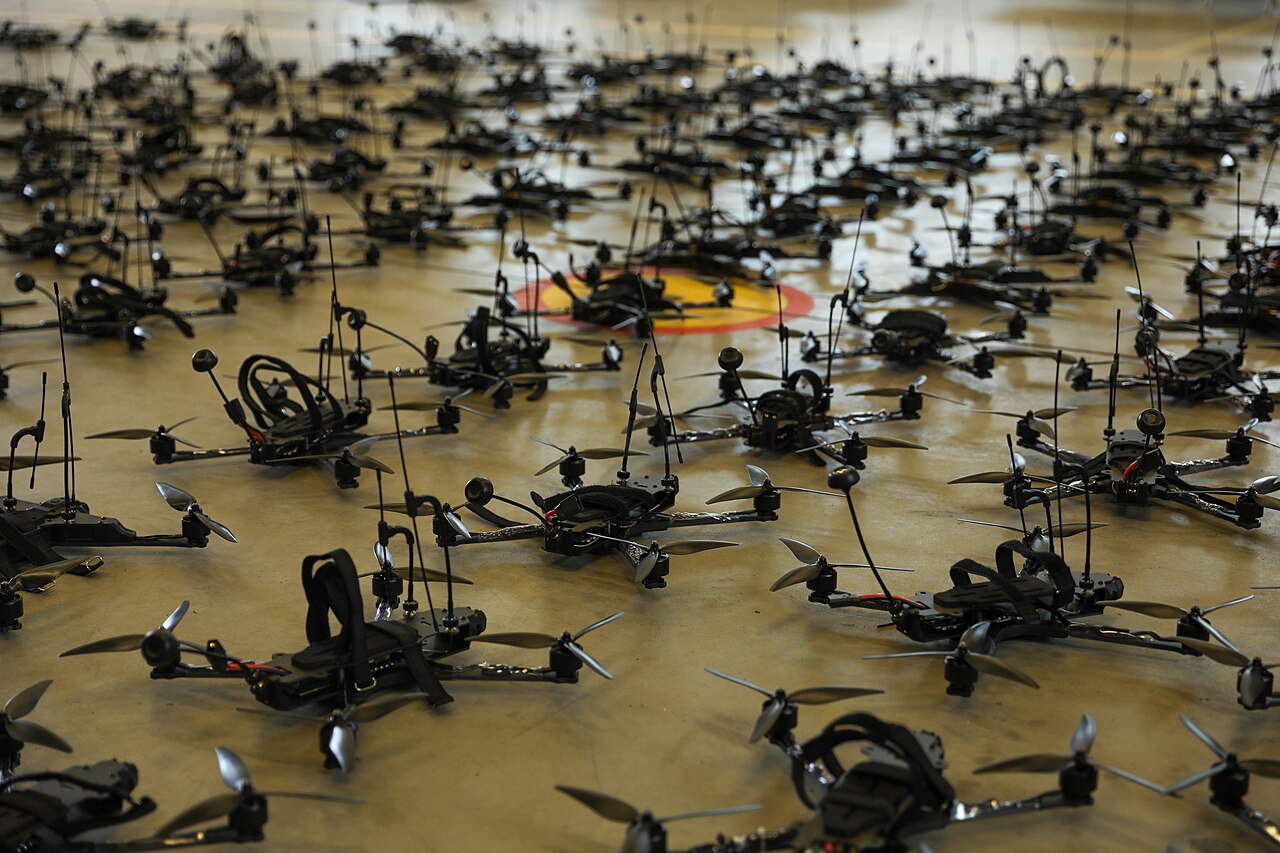
A swarm is not a large number of drones; Ukraine’s first-person-view fleets, mostly one pilot per aircraft, are mass, not swarming. A swarm is a group of uncrewed systems that share a mission and negotiate among themselves how to carry it out, so the human at the ground station sets intent (search this area, hold this line, escort that vehicle) rather than steering each aircraft. Five properties recur in every European programme: distributed autonomy, so no single aircraft is the brain; a mesh datalink between the drones; shared sensing; a one-to-many control ratio; and mission-management software that lets the operator re-task aircraft while the group is airborne.
The one-to-many ratio is the number the armies watch. KrattWorks of Estonia told Euronews in September 2026 that one operator can run up to seven of its drones at once in Ukraine, with the aircraft finishing the mission on their own if jamming cuts the link. BlueBear, now Saab’s autonomy unit in the UK, says its SwarmCommand platform has flown 21 systems simultaneously. STM put 20 KARGU loitering munitions under one operator in January 2026, and Swarmer describes its software as vendor-agnostic code that lets one operator coordinate hundreds of platforms across air, ground and sea. The gap between seven and hundreds is a question of how much decision-making the software is trusted with, and how well the mesh survives interference.
That is why the hardware matters less than it looks. Helsing’s Altra, Stark’s Minerva, Quantum Systems’ MOSAIC UXS, the Bundeswehr’s own C2-UMS Bw and Swarmer’s stack are all mission-management layers designed to sit above whichever airframe a customer buys. The Dutch Ministry of Defence made this explicit in July 2026 when it signed a €30 million, three-year agreement with Intelic to build the software architecture that connects its aerial and ground uncrewed systems before it buys more platforms. Software first, drones second.
Germany: from trial series to a 2027 fielding target
Here the money tells the story. On 25 February 2026 the Bundestag’s budget committee approved framework agreements worth up to €4.3 billion over seven years for medium-range loitering munitions, with first call-offs of 4,300 Helsing HX-2 and 2,200 Stark Virtus at about €270 million each, according to ESUT. Both were described as swarm-capable, networked through Helsing’s Altra and Stark’s Minerva software. The first user is Panzerbrigade 45, the brigade Germany is standing up in Lithuania, with an operational target of 2027; Helsing’s deliveries begin in the third quarter of 2026. A separate order of roughly €300 million for Rheinmetall’s FV-014 followed in April, per Defense News.
The swarm part is being proven in a running series of Bundeswehr trials. On 29 April 2026 Stark reported that the latest series had integrated its Virtus munitions and Minerva software with Quantum Systems’ Vector reconnaissance drone in a reconnaissance-strike network, with the stated aim of giving the Bundeswehr “a scalable, operational capability by 2027”. On 29 January Rheinmetall had flown its LUNA NG reconnaissance aircraft in a swarm of uncrewed systems, including loitering munitions, at the Army Combat Training Centre in Saxony-Anhalt using the Bundeswehr’s C2-UMS Bw management system. At Eurosatory in June it showed a container mock-up holding 18 FV-014s, a concept rather than a product.
The industrial base underneath is now unusually well funded. Helsing closed a $1.8 billion Series E at an $18 billion valuation on 13 July 2026, the largest round for a European defence start-up. Quantum Systems raised $1.2 billion at roughly $8 billion ten days earlier, on about €300 million of 2025 revenue, and in September agreed to fold XTEND’s XOS autonomy into MOSAIC UXS for swarm operations. How Helsing got there is a story of its own (Helsing Explained: Europe’s Defence AI Firm, Drones, Funding), and the wider field competing for the same Bundeswehr budget lines is mapped in Europe’s Defence AI Companies: Who Is Building What in 2026.
The programme map: UK, France, Nordics, southern Europe and the EU
Outside Germany the picture is less tidy on the ground. Most European swarm work still sits at FIELD TRIAL or DEMONSTRATOR maturity, run by research agencies rather than procurement offices, and the operational proof continues to come from Ukraine. Several of the most interesting entries are start-ups working directly with a national research establishment.
The table uses the maturity labels DefenceAndTech applies across this cluster. Where a programme has an operational airframe but a still-experimental swarm mode, both are shown, because that distinction is exactly what procurement offices are paying to resolve in 2026 and 2027.
| Programme / product | Country | Company / agency | Purpose | Status | Latest milestone |
|---|---|---|---|---|---|
| HX-2 + Altra | Germany | Helsing / Bundeswehr | Strike | PROCUREMENT | 4,300 ordered; deliveries from Q3 2026 |
| Virtus + Minerva | Germany | Stark / Bundeswehr | Strike, recce-strike | PROCUREMENT; swarm FIELD TRIAL | Trial series Apr 2026; 2,200 ordered |
| LUNA NG in swarm (HUSAR) | Germany | Rheinmetall / Bundeswehr | ISR | FIELD TRIAL | Swarm test, Jan 2026 |
| FV-014 container launcher | Germany | Rheinmetall | Strike | CONCEPT (launcher); munition PROCUREMENT | Mock-up, Eurosatory Jun 2026 |
| Software Defined Swarms CTB | UK | Dstl, British Army; BlueBear (Saab), Disruptor Group | ISR, collective control | FIELD TRIAL | Phase 1 done, 8 UAVs, Sep 2026 |
| Army swarm packs / Pendragon | France | Army Future Combat Lab, DGA | ISR, combined air-ground | DEMONSTRATOR (planned) | Demo planned 2026; use in units within 2 years |
| Sonora / DELCO drones | France | Harmattan AI / DGA | ISR (mass supply) | SERIAL PRODUCTION | 5,000 more ordered 28 May 2026 |
| Valkyrie | Norway | Six Robotics / Armed Forces, FFI | Multi-drone control | FIELD TRIAL | €12m seed, Jul 2026 |
| Uncrewed integration software | Netherlands | Intelic / MoD | C2, interoperability | PROCUREMENT | €30m, 3 years, Jul 2026 |
| K-SWARM (CUC-T) | Italy / Türkiye | Leonardo / Baykar | Crewed-uncrewed teaming | FLIGHT TEST | M-346 with KIZILELMA, May 2026 |
| UAV collision-avoidance for swarms | Spain | Indra, Tecnobit-Oesía | Airspace integration | PROTOTYPE | Flight tests, Jan 2026 |
| OSKAR (PERUN) | Poland | MoD PERUN programme | UGV swarm control | LAB | Funded 23 Jul 2026 |
| Swarmer software | Ukraine / US | Swarmer | Multi-domain coordination | OPERATIONAL | 100,000+ missions; Ratel deal Sep 2026 |
| KrattWorks control | Estonia | KrattWorks | ISR, strike control | OPERATIONAL (Ukraine) | 7 drones per operator, Sep 2026 |
| SABUVIS II | EU (PL, DE, PT, SI) | EDA | Underwater ISR, MCM | DEMONSTRATOR | Phase II closed Feb 2026 |
| STRATUS | EU | EDF 2025, with Ukrainian partner | Cyber defence for swarms | LAB | Selected 15 Apr 2026 |
| KARGU swarm (KERKES) | Türkiye | STM / SSB | Strike | Airframe OPERATIONAL; swarm FIELD TRIAL | 20-drone live fire, 27 Jan 2026 |
United Kingdom: a testbed the Army now owns
The UK has talked about swarms longer than anyone in Europe. 216 Squadron reformed at RAF Waddington in 2020 as the experimental swarming unit, yet a ministerial answer reported by Janes in March 2024 confirmed it had run no trials of its own. The live work moved to the Army. On 16 September 2026 Dstl announced completion of Phase 1 of the Software Defined Swarms Concept Demonstrator: a Swarm Capability Test Bed of eight uncrewed aircraft, two rival control approaches, one from BlueBear (part of Saab) and one from the Applied Intuition-led Disruptor Group, and eight weeks of experimentation by soldiers.
Brigadier Kieran Sheldon, the Army’s head of military capability plans, called the partnership “hugely energising”, and Dstl says further trials and field tests run through 2026 and 2027 to shape procurement decisions. It is still FIELD TRIAL maturity: no UK swarm has been recommended for acquisition.
France: two years to the first packs
France has set the most explicit timetable. Colonel Philippe Bignon, head of the exploration bureau at the French Army’s Future Combat Laboratory, told Defense News in December 2025 that the first swarm capabilities would reach units within two years and spread within five, arriving as “packs of five to 10 drones” rather than clouds of thousands. The Pendragon project, a first autonomous combat unit of ground robots, air drones and AI-based command, was due a demonstration in 2026; no public result had been reported by the end of September.
The industrial engine is Harmattan AI, founded in 2024, which raised a $200 million Series B led by Dassault Aviation in January 2026 at a $1.4 billion valuation, delivered the DGA’s first 1,000 Sonora soldier drones early in 2026, and on 28 May received an order for 5,000 more for delivery by early 2027 after the aircraft performed at Exercise Orion 26. Those are individual reconnaissance drones, not a swarm, but they are the mass a French swarm would be built on.
Nordics and the Netherlands: software and sea trials
Norway’s Six Robotics is the most interesting new name. Founded in 2023 and grown to nearly 90 staff, it built its Valkyrie multi-drone autonomy with the Norwegian Armed Forces and FFI, delivered a first swarm, then raised a €12 million seed in July 2026 from DTCP, Denmark’s state investor EIFO and Scale Capital. It also partners with Stark on Virtus, which is how a Norwegian start-up ends up inside the German programme. Denmark approved new counter-UAS and drone purchases in July 2026. European Defence Tech Startups: Who Funds Them and Who Buys looks at the venture side of these smaller markets.
The Netherlands is also training against the threat. The air-defence frigate HNLMS Evertsen spent three days at the Aberporth range off Wales in late 2025 in Exercise Sharpshooter, a QinetiQ-run series mixing live Banshee targets, Hammerhead surface drones and synthetic threats to rehearse against swarm-type attacks; Commander Marcel Keveling said it “taught us many lessons”.
Italy, Spain, Poland: teaming, airspace and ground swarms
Leonardo approaches swarming through crewed-uncrewed teaming. In May 2026 at Baykar‘s flight-test centre in Çorlu, an M-346 fighter-attack variant commanded a Bayraktar KIZILELMA uncrewed fighter through formation changes, separations and rejoins under the K-SWARM programme, with algorithms from Leonardo’s labs in Turin and Venegono. It is a FLIGHT TEST milestone in the loyal-wingman line, and belongs with the programmes in Europe’s Loyal Wingman Programmes: Who Is Building CCAs.
Spain and Poland are working on the enabling problems. Indra and Tecnobit-Oesía tested a camera-and-radar collision-avoidance system on a multirotor in January 2026, which Indra calls a precondition for swarm operations in shared airspace. Poland’s PERUN programme, signed off on 23 July 2026 with Prime Minister Donald Tusk present, funds 29 projects including OSKAR, a system for one operator to control a swarm of uncrewed ground vehicles; the same announcement put Poland’s planned 2026 spend on drones and counter-drone systems at about $6.85 billion.
Ukraine, Estonia and the EU programmes
The operational proof is Ukrainian. Swarmer’s coordination software has been in combat since April 2024 and had passed 100,000 missions when the company sold 3.45 million shares at $5 on the Nasdaq Capital Market for $17.25 million gross, with trading opening on 17 March 2026. On 10 September it agreed to buy Ratel Robotics, a Ukrainian ground-vehicle maker with $86 million of 2026 contracts, for up to $224 million. Swarmer keeps offices in Poland and Estonia, where KrattWorks, Threod and Electric Wings show what a 40,000-strong army does with cheap drones.
Brussels funds the edges. The European Defence Fund’s 2025 call, announced on 15 April 2026, put €1.07 billion into 57 projects, among them STRATUS, an AI-based cyber-defence system for drone swarms with a Ukrainian subcontractor. The European Defence Agency’s SABUVIS II, led by Poland with Germany, Portugal and Slovenia, closed its second phase in February 2026 after demonstrations of coordinated underwater vehicle swarms without satellite navigation. Neither is a fielded swarm; both are the research layer under one.
Türkiye: STM’s 20-drone live fire and the first EU export
Türkiye belongs in this map for a reason most European countries cannot yet claim: a live-fire swarm of armed drones under one operator. On 27 January 2026 at the General Nahit Şenoğul range in Polatlı, near Ankara, STM launched 20 KARGU rotary-wing loitering munitions fitted with anti-personnel warheads, which navigated to the mission area autonomously and struck designated targets on a single command, with Defence Industries Secretary Haluk Görgün and Land Forces commanders present. STM says its architecture has no central control node, so the mission continues if some aircraft are lost, and that the KERKES navigation package, delivered to the SSB in 2022, lets the swarm fly without satellite positioning. General manager Özgür Güleryüz called it “a strategic threshold”.
The export record is what separates STM from a demonstrator. KARGU entered the Turkish Armed Forces inventory in 2018, and on 16 January 2026 STM announced its first European sale, a contract with an unnamed NATO and EU member to integrate KARGU and the fixed-wing ALPAGU onto armoured vehicles with battle-management software, taking STM’s UAV user base to 15 countries. Both engage only with a human in the loop, the company stresses. There is no public evidence that any customer has bought the swarm mode as a fielded capability, so the honest label is OPERATIONAL for the airframe and FIELD TRIAL for the swarm.
Bottlenecks, and the counter-swarm mirror
That is where the industrial bottleneck starts. The first constraint is the link. Every programme above depends on drones talking to each other under interference: KrattWorks designs for the case where jamming severs the operator link, STM built KERKES because satellite navigation cannot be assumed, and SABUVIS had to solve bandwidth and latency underwater. The second is certification and airspace: a swarm flying beyond line of sight in peacetime needs collision avoidance and regulatory approval, which is why Indra is testing sense-and-avoid and why most European swarm flying still happens on military ranges.
The third is munition supply and cost. Germany’s framework runs to €4.3 billion because an operational swarm is consumed, not maintained; Helsing told Janes in 2025 its first factory could reach 1,000 HX-2 a month and a second plant would take the total to 2,500, numbers that only make sense if the Bundeswehr expects to fire them in quantity. The DGA’s 5,000-drone order follows the same logic. The fourth is the human. French planners told Defense News that ethics, operator psychology and how soldiers adapt to one-to-many control remain open problems, and the companies that have addressed it publicly, STM among them, keep a human authorising each strike.
Finally, the mirror. Everything that makes a swarm hard to build makes it hard to stop, which is why the same governments fund both sides. Britain’s Thales-led radio-frequency weapon immobilised more than 100 drones in trials at Manorbier reported in April 2025 at about 10 pence a shot; NATO’s Project Flytrap 5.0 ran more than 50 vendor systems through the Pabradė range in Lithuania in May 2026 with US and British units. How Europe’s directed-energy and interceptor programmes are meant to answer the threat is covered in Counter-Drone Lasers in Europe: Operational or Prototype?, because a European army that can field a swarm will be fielding it against someone who can too.
Frequently asked questions
How does a military drone swarm work?
A swarm is a group of drones that share one mission and coordinate among themselves over a mesh datalink, so a single operator sets the task rather than flying each aircraft. The drones share sensor data, redistribute roles if one is lost and keep working when the link to the operator degrades. Current European systems run from seven aircraft per operator (KrattWorks) to about 20 (STM, BlueBear) in trials.
Which European countries have operational drone swarms?
Strictly, none of the EU or NATO European militaries has declared a swarm operational. Ukraine uses swarm software from Swarmer and KrattWorks in combat. Germany is the closest to fielding, with a 2027 target for Panzerbrigade 45 in Lithuania; the UK and France are at field-trial and demonstrator stage; Türkiye’s STM has completed a live-fire 20-drone swarm test but no fielded swarm has been confirmed.
Which companies build drone swarm technology in Europe?
Helsing (Altra, HX-2) and Quantum Systems (MOSAIC UXS, Vector) in Munich, Stark (Minerva, Virtus) in Berlin, Rheinmetall (LUNA NG, FV-014), Saab’s BlueBear in the UK, Harmattan AI in France, Six Robotics in Norway, Intelic in the Netherlands, Indra in Spain, Leonardo with Baykar on crewed-uncrewed teaming, STM in Türkiye, and Swarmer and KrattWorks from Ukraine and Estonia.
Were the September 2026 airport drone incidents swarm attacks?
No. The Luxembourg closure on 18 September and the 45-minute Berlin Brandenburg closure on 23 September involved single drones or small numbers, and the Leipzig incident of 4 August that Germany blamed on Russia used one explosive-laden drone with two more found later. They are hybrid incursions, not swarms, but they have accelerated both the EU’s counter-drone initiative and national swarm programmes.
How much is Europe spending on drone swarms?
The clearest figure is Germany’s €4.3 billion, seven-year loitering-munition framework approved in February 2026, with initial call-offs of about €270 million each to Helsing and Stark. Private capital is larger still: Helsing raised $1.8 billion in July 2026 and Quantum Systems $1.2 billion. The EU’s 2025 European Defence Fund round put €1.07 billion into 57 projects, including one on cyber defence for swarms.
Sources
- Euronews: Operations resume at Luxembourg airport after ‘unauthorised’ drones halt flights (September 2026)
- DW: Berlin Airport briefly suspends flights over drone sighting (September 2026)
- Defense News: German government blames Russia for Leipzig airport drone attack with explosives (September 2026)
- CBS News: Denmark calls drones near airports a “hybrid attack” (September 2025)
- European Security & Defence: Europe’s Drone Wall, Ready, EDDI, Go! (March 2026)
- ESUT: Loitering Munition, Beschaffung von mehr als 6.000 Kampfdrohnen gebilligt (February 2026)
- Stark Defence: STARK performs drone swarms in Bundeswehr exercise (April 2026)
- Rheinmetall: LUNA NG successfully tested in drone swarm (January 2026)
- Defense News: Rheinmetall pitches shipping container that can spit out swarms of attack drones (June 2026)
- Defense News: Helsing raises $1.8 billion in Europe’s biggest defense-startup round (July 2026)
- Janes: Bundeswehr is procuring HX-2 loitering munition, Helsing confirms (July 2025)
- The Next Web: Quantum Systems raises $1.2bn at an $8bn valuation (July 2026)
- The Defense Post: Quantum Systems, XTEND integrate AI autonomy for sensing, swarming, strike (September 2026)
- GOV.UK / Dstl: Dstl drone swarm accelerates Army autonomy ambition (September 2026)
- Janes: British Army experiments with UAV swarming, deploys base C-UAV system (September 2026)
- Janes: UK’s swarming drone rollout stymied by ‘competing resource priorities’ (March 2024)
- Defense News: France is two years from fielding drone swarms in its armed forces (December 2025)
- TechCrunch: Harmattan AI raises $200M Series B led by Dassault Aviation (January 2026)
- Aviacionline: France orders 5,000 additional Sonora drones from Harmattan AI (June 2026)
- Resilience Media: Six Robotics raises €12M to help individual drones work as a team (July 2026)
- Unmanned Airspace: Denmark to purchase new counter-UAS and drone systems (July 2026)
- The Defense Post: Netherlands signs $34M deal to build next-gen integration software for drones (July 2026)
- QinetiQ: First international Sharpshooter exercise (December 2025)
- Leonardo: Leonardo and Baykar set major milestone with successful first K-SWARM live trials (June 2026)
- Unmanned Airspace: Indra reports progress on its multi-rotor UAV conflict detection system (January 2026)
- Aviacionline: Poland funds 29 strategic projects under the PERUN programme (July 2026)
- Investing.com: Swarmer completes $17.25 million IPO on NASDAQ (March 2026)
- citybiz: Swarmer to acquire Ratel Robotics in deal valued up to $224 million (September 2026)
- Euronews: Estonian defence sector bets on cheap, smart and flexible military drone systems (September 2026)
- European Commission: Commission to invest €1.07 billion in 57 defence projects supporting European Readiness Flagships (April 2026)
- The Defense Post: Europe moves into the depths with underwater drone swarm project (February 2026)
- STM: STM achieves a first in Türkiye: swarm UAVs score direct hits in live ammunition test (January 2026)
- STM: KARGU and ALPAGU head to Europe (January 2026)
- Shephard: KERKES gives Turkey capability to operate drones in GPS-denied environment (October 2022)
- Defense News: In first, British Army uses radio-wave weapon to knock out drone swarm (April 2025)
- US Army: Project Flytrap accelerates NATO’s counter-drone lethality (May 2026)