NVL Group, the Family Yards Behind Germany’s Warships
NVL Group is the family-owned shipbuilding house that delivers most of the German Navy’s surface ships, running four northern German yards and a workforce of roughly 2,000 people. Carved out of the Lürssen Group’s naval business in 2021 and acquired by Rheinmetall in a deal completed in early 2026, the Bremen-based builder sits at the center of Germany’s attempt to rebuild its naval industrial base.
What is NVL Group
| Item | Detail |
|---|---|
| Full name | NVL B.V. & Co. KG (Naval Vessels Lürssen) |
| Headquarters | Bremen, Germany |
| Origin | Naval division of the Lürssen Group, separated as NVL in 2021; Lürssen founded 1875 |
| Ownership | Acquired by Rheinmetall in a transaction completed in early 2026; previously owned by the Lürssen family |
| Employees | Roughly 2,000 across the group |
| Revenue | Reported at roughly €1 billion annually |
| Main yards | Peene-Werft (Wolgast), Blohm+Voss and Norderwerft (Hamburg), Lürssen-Kröger (Schleswig-Holstein) |
| Core products | Frigates, corvettes, offshore patrol vessels, intelligence ships, auxiliaries, naval repair |
NVL stands for Naval Vessels Lürssen. When the Lürssen family decided to separate its famous superyacht business from warship construction in 2021, everything naval went into NVL, the yards, the design offices and the in-service support organization. The result was a pure-play naval builder that, measured by hulls delivered to the German Navy over the past two decades, has few domestic rivals on the surface-ship side, while TKMS dominates beneath the waves.
NVL shipyards from Hamburg to Wolgast
| Yard | Location | Role |
|---|---|---|
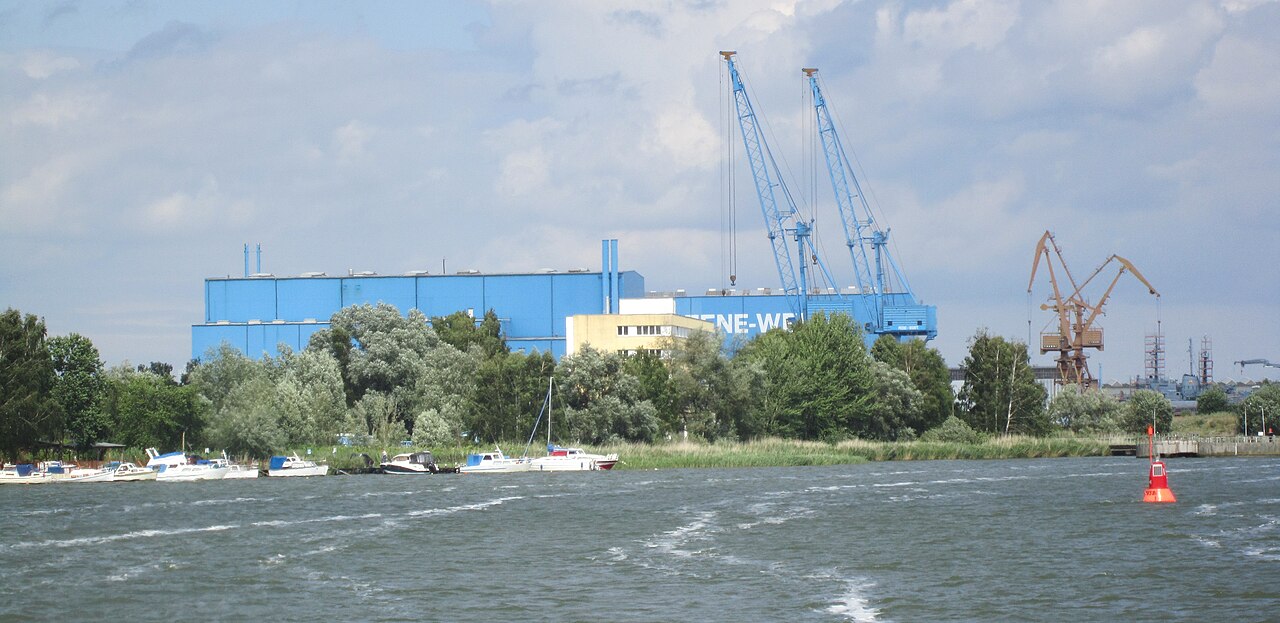
| Peene-Werft | Wolgast, Baltic coast | New construction of corvettes, patrol boats and ship sections |
| Blohm+Voss | Hamburg | Large-ship assembly, outfitting and the German Navy’s major repair dock |
| Norderwerft | Hamburg | Repair, refit and maintenance of naval and government vessels |
| Lürssen-Kröger | Schacht-Audorf, Schleswig-Holstein | Specialized construction and section building |
The network logic matters more than any single slipway. Sections are fabricated where capacity exists, moved by barge, and assembled where the dock fits the ship. Blohm+Voss, acquired by Lürssen in 2016, gave the group the large covered building dock in Hamburg that now anchors frigate work, while Peene-Werft in Wolgast keeps series production of smaller combatants alive on the Baltic coast.
What NVL builds for the German Navy
NVL leads the second batch of five K130 Braunschweig-class corvettes, builds the Type 424 signals-intelligence ships replacing the Oste class, and delivered the F125 Baden-Württemberg-class frigates as part of an industrial consortium. On the F126 frigate program, the largest surface combatants Germany has ordered since the war, the Netherlands’ Damen holds the design contract but construction runs through German yards, with NVL facilities in Wolgast and Hamburg cutting steel. Add the navy’s repair and modernization workload at Blohm+Voss and Norderwerft, and a large share of the German surface fleet passes through an NVL gate at some point in its life.
That position was earned partly by default. Germany spread naval work across competing private yards for decades, and consolidation came late compared with France, where Naval Group concentrated national surface and submarine work under one roof in the 2000s.
NVL exports and small combatants
Lürssen built its naval reputation on fast attack craft, and NVL inherited that export book. Recent and current programs include offshore patrol vessels for Bulgaria built with a local partner yard in Varna, patrol boat classes for Gulf and Southeast Asian customers, and a long line of coast guard and police craft. The company’s pitch is a family of proven small-combatant designs plus technology transfer, local assembly where the customer wants it, a model well suited to navies that buy hulls in fours and sixes rather than dozens.
Why Rheinmetall bought NVL
Rheinmetall announced in 2025 that it would buy NVL, and the deal closed in early January 2026, taking Düsseldorf’s ammunition-and-vehicles giant into shipbuilding for the first time. The strategic logic runs both ways. Rheinmetall gets a naval prime at the moment European fleets are growing again, a trend visible across the world’s major navies, and NVL gets a deep-pocketed owner able to finance yard modernization and compete for the electronics-heavy value inside modern warships. German officials have also pushed for naval consolidation, and a Rheinmetall-owned NVL changes the long-running debate about merging German surface shipbuilding with TKMS.
NVL Group frequently asked questions
Who owns NVL Group?
Rheinmetall, which completed its acquisition of NVL from the Lürssen family in early 2026. Before that, NVL was the family-owned naval arm of the Lürssen Group.
What does NVL stand for?
Naval Vessels Lürssen, the name adopted when Lürssen’s warship business was separated from its yacht business in 2021.
Which shipyards belong to NVL?
Peene-Werft in Wolgast, Blohm+Voss and Norderwerft in Hamburg, and Lürssen-Kröger in Schleswig-Holstein.
What ships does NVL build?
K130 corvettes, Type 424 intelligence ships, sections and assembly work on the F126 frigate program, offshore patrol vessels for export, and naval repair and refit.
Is NVL the same company as Lürssen yachts?
No. The superyacht business remains with the Lürssen family; NVL took the naval yards and programs and is now part of Rheinmetall.
- Company information published by NVL and Rheinmetall (acquisition completed January 2026)
- Wikipedia – NVL Group and Lürssen (accessed October 2026)
- German Navy program information on K130, F125, F126 and Type 424
- Defence & Tech reporting on European naval industry