Moog, the Motion Control Giant Hiding Inside Western Weapons

Moog Inc. is the quiet giant of motion control, a $3.6 billion company whose actuators steer everything from the F-35’s control surfaces to satellite thrusters and the US Army’s newest air defense turrets. Founded in 1951 around a single invention, the electrohydraulic servo valve, the East Aurora, New York firm has become one of the most deeply embedded suppliers in Western aerospace and defense.
Moog at a glance
| Item | Detail |
|---|---|
| Full name | Moog Inc. |
| Headquarters | East Aurora, New York, United States |
| Founded | 1951, by William C. Moog with his brother Arthur and Lewis Geyer |
| Listing | NYSE, under MOG.A and MOG.B share classes |
| Revenue | Roughly $3.6 billion in fiscal 2024 |
| Employees | About 13,000 worldwide, reported |
| Segments | Space and Defense, Military Aircraft, Commercial Aircraft, Industrial |
| Core competence | Precision motion control, actuation, servo valves, turrets, space propulsion |
Who founded Moog and who owns it now
William Moog patented a practical electrohydraulic servo valve in 1951, a device that converts a small electrical signal into precise, powerful hydraulic motion. Missile programs of the 1950s needed exactly that, and the company grew from a garage-scale shop into the dominant name in servo actuation. The founder’s cousin, Robert Moog of synthesizer fame, is a separate story; the two businesses were never connected.
Moog remains independent and publicly traded on the NYSE, with a dual-class share structure that has helped it resist consolidation while peers were absorbed by larger primes. The company has stayed acquisitive on a small scale, but its identity is organic: motion control is the business, and has been for seven decades.
What does Moog make for the military
| Line | What it does | Where it flies or fights |
|---|---|---|
| Primary flight control actuation | Moves the control surfaces of fighter aircraft | F-35 Lightning II, other fast jets and trainers |
| Missile steering and fin actuation | Aerodynamic and thrust vector control for missiles | Tactical and strategic missile programs, US and allied |
| RIwP weapon turret | Reconfigurable armored turret mixing guns, missiles and sensors | US Army M-SHORAD / Sgt. Stout air defense vehicles |
| Space propulsion and avionics | Thrusters, valves, mechanisms, radiation-tolerant electronics | Military and commercial satellites, launch vehicles |
| Naval and ground actuation | Steering, stabilization and ammunition handling drives | Ships, submarines and armored vehicles |
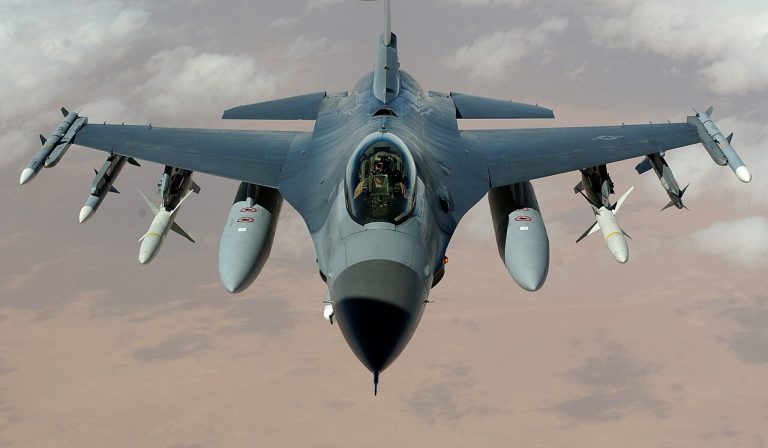
The common thread is the hardest class of motion problem: moving a control surface or a gun mount with high force, millisecond response and total reliability. On the F-35, Moog leads the primary flight control actuation, electrohydrostatic units that replaced conventional hydraulics, one of the aircraft’s genuinely novel subsystems. When a missile needs its fins or nozzle swiveled mid-flight, there is a fair chance the actuator carries the same label.
Moog RIwP turret and Army air defense
Moog’s most visible ground product is the RIwP, short for Reconfigurable Integrated-weapons Platform, an unmanned turret that can mix a 30mm cannon, Stinger and Longbow Hellfire missiles and sensors in swappable pods. The US Army selected it for the M-SHORAD air defense Stryker, now named Sgt. Stout, built to knock down drones and helicopters near the front line. As drone defense budgets climb, the turret line has become a growth business rather than a sideline, and it competes in the same space as the gun-based systems covered in our Skyranger 30 profile.
Moog in space
Moog’s Space and Defense segment supplies satellite propulsion systems, valves, separation mechanisms and radiation-hardened avionics, and its components have flown on missions from planetary probes to national security constellations. The company also builds thrust vector control for launch vehicles, the actuators that gimbal a rocket engine’s nozzle, a niche it shares with few others as US solid rocket and hypersonic production expands alongside newcomers like Ursa Major.
Moog financials and outlook
Moog closed fiscal 2024 with roughly $3.6 billion in revenue, up mid-single digits, with defense demand offsetting a slower commercial aerospace recovery. Military aircraft and space work together account for well over half the business. Margins run leaner than at software-flavored defense firms, motion control is a hardware game, but the order book is long-cycle and sticky: once an actuator is designed into an airframe or missile, it tends to stay for the program’s life.
The outlook rests on three currents: F-35 production and sustainment, missile inventory rebuilding across NATO, and short-range air defense, where RIwP gives Moog rare prime-adjacent visibility. The company sits one tier below household names such as Curtiss-Wright in public attention, and one tier above most component makers in how hard it would be to replace.
Moog frequently asked questions
What does Moog Inc. do?
It designs precision motion control: actuators, servo valves, turrets and space propulsion for aircraft, missiles, satellites and vehicles.
Is Moog Inc. related to Moog synthesizers?
Only by family. Founder William Moog and synthesizer inventor Robert Moog were cousins; the companies were always separate.
What does Moog build for the F-35?
Moog leads the primary flight control electrohydrostatic actuation that moves the fighter’s control surfaces.
What is the Moog RIwP turret?
A reconfigurable unmanned turret combining a 30mm gun, Stinger and Hellfire missiles, used on the US Army’s Sgt. Stout air defense vehicle.
How big is Moog?
Roughly $3.6 billion in fiscal 2024 revenue and about 13,000 employees, listed on the NYSE as MOG.A and MOG.B.
- Public Moog Inc. disclosures and investor materials (fiscal 2024)
- Wikipedia – Moog Inc. (accessed October 2026)
- US Army program information on M-SHORAD / Sgt. Stout
- Defence & Tech reporting on actuation and air defense suppliers