ATGM Generations Explained, From MCLOS Joysticks to NLOS Missiles
Anti-tank guided missiles have evolved through five distinct generations in seventy years, from joystick-steered darts of the 1950s to networked missiles that kill tanks 20 kilometers beyond the horizon. Each generation answered one question, how much can the missile do so the gunner can do less, and the answer now approaching is everything.
What are the ATGM generations
| Generation | Guidance | Gunner’s job | Examples |
|---|---|---|---|
| 1st (1950s-60s) | MCLOS, manual command to line of sight | Fly the missile by joystick while watching it | 9M14 Malyutka (AT-3 Sagger), SS-11 |
| 2nd (1970s-90s) | SACLOS, semi-automatic command via wire, radio or laser beam | Keep crosshairs on the tank until impact | TOW, Milan, HOT, Konkurs, Kornet |
| 3rd (1990s-2010s) | Fire-and-forget with imaging infrared seeker | Lock on, fire, leave | Javelin, HJ-12, Type 01 LMAT |
| 4th (2010s) | Lock-on-after-launch, fiber-optic or datalink, man in the loop | Fire first, choose or refine the target in flight | Akeron MP, HJ-10 |
| 5th+ (2020s) | NLOS, networked, third-party targeting at 8-30+ km | Approve a target someone else found | Akeron LP concepts, LMUR (per Russian statements), drone-teamed missiles |
Generation 1 MCLOS, flying by joystick
The first ATGMs, French SS-10s and Soviet Malyutkas among them, trailed wires and obeyed a joystick. The gunner had to track the target and the missile simultaneously and steer one onto the other, a skill that demanded hundreds of practice runs and collapsed under fire, hit rates in combat ran far below trial figures. The 1973 Middle East war made the Sagger notorious, though even then success leaned on saturation volleys and prepared positions. The lesson was blunt, human hands are the weakest link in terminal guidance.
Generation 2 SACLOS, the long middle age
SACLOS removed the joystick. The gunner simply held the sight’s crosshairs on the tank and the launcher measured the missile’s deviation, wire, radio or a laser beam carrying corrections automatically. Hit probabilities jumped, and the type armed the world for forty years, the American TOW, Franco-German Milan and HOT, the Soviet Konkurs, later Russia’s laser beam-riding Kornet, whose penetration figures remain manufacturer claims. The costs were exposure, the gunner had to stay locked on for the missile’s entire ten-second-plus flight while the target’s friends shot back, and vulnerability to the explosive reactive armor that SACLOS-era warheads eventually answered with tandem charges, the same measure-countermeasure race that shaped tanks like the Leopard 2 and its protection packages.
Generation 3 fire-and-forget
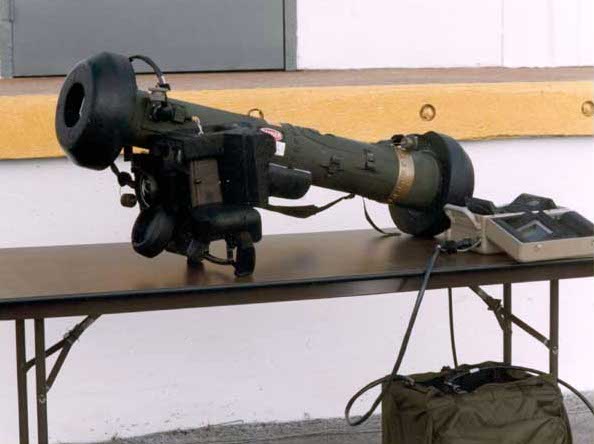
The third generation put the tracker in the missile. An imaging infrared seeker memorizes the target’s heat picture at lock-on and chases it autonomously, so the team can displace the moment the round leaves, and most such missiles add top attack, diving onto thin roof armor with tandem warheads. The FGM-148 Javelin defined the class and Ukraine turned it into a symbol; China’s HJ-12 and Japan’s Type 01 follow the same formula. The trade is cost, a seeker in every round makes each shot a five-to-six-figure decision, and clever adversaries learned to blind or decoy early seekers with thermal clutter.
| Generation | Exposure during flight | Typical range |
|---|---|---|
| 1st, MCLOS | Full flight, actively steering | Up to ~3 km |
| 2nd, SACLOS | Full flight, tracking the target | ~2-5.5 km |
| 3rd, fire-and-forget | None after launch | ~2.5-4.5 km |
| 4th, man-in-the-loop | Optional, from cover via datalink | ~4-8 km |
| 5th, NLOS networked | None, target from third-party sensors | ~8-30+ km |
Generations 4 and 5, NLOS and the networked missile
The newest missiles stop requiring the shooter to see the target at all. Fiber-optic spools or radio datalinks stream the seeker’s picture back to the operator, who can fire toward a grid reference, watch the feed, and select or switch targets mid-flight, lock-on after launch. France’s Akeron MP brings this to the infantry at 4-5 kilometers; helicopter and vehicle-launched NLOS weapons, China’s fiber-optic HJ-10, Russia’s LMUR per Russian statements, and Western programs in the Akeron LP class, push engagement ranges to 8-30 kilometers using drones or other sensors to find the target. The boundary with loitering munitions is dissolving from both directions, missiles gaining loiter and drones gaining tandem warheads, and Ukraine’s cheap FPV drones now perform a crude version of the same mission for one percent of the price.
ATGM generations frequently asked questions
What is the difference between MCLOS and SACLOS?
MCLOS requires the gunner to manually steer the missile with a joystick; SACLOS only requires keeping the sight on the target while the system steers the missile automatically.
What generation is the Javelin?
Third generation, fire-and-forget. Its imaging infrared seeker guides itself after lock-on, and the missile attacks the roof armor with a tandem warhead.
What does NLOS mean for missiles?
Non-line-of-sight, engaging targets the launcher cannot see, using a datalink or fiber-optic feed and targeting data from drones or other sensors, at ranges from roughly 8 to beyond 20 kilometers.
Are wire-guided missiles obsolete?
Not yet. SACLOS weapons like TOW and Kornet remain in massive worldwide service because they are cheap, jam-resistant and proven, though their exposed guidance time is an increasing liability.
Do FPV drones replace ATGMs?
They overlap more every year. Drones are far cheaper but slower and weather-limited; missiles remain the tool for fast, armored, defended targets, which is why armies are buying both.
- Reference works on anti-tank guided weapon development
- Wikipedia – Anti-tank guided missile (accessed October 2026)
- Manufacturer literature for Javelin, Akeron MP, Kornet and HJ-series (claims noted)
- Defence & Tech reporting on the Ukraine anti-armor fight