Iran Claims Second US Underwater Drone Seizure in Hormuz

Iran’s Islamic Revolutionary Guard Corps (IRGC) Navy says it captured a second American unmanned underwater vehicle (UUV) in the Strait of Hormuz on September 27, following a “coordinated intelligence and electronic warfare operation.” U.S. Central Command (CENTCOM) rejected the claim within a day, saying it maintains “positive control of all of our operational drone assets” and calling Tehran’s account “clearly desperate.” The dispute is the second of its kind in three weeks, after CENTCOM confirmed on September 8 that Iran had recovered a different, malfunctioning U.S. drone in the same waterway. Neither the new seizure nor Iran’s full account of it has been independently verified.
What Happened
According to statements carried by Iranian outlets including Mehr News Agency and Press TV, the IRGC Navy said its forces intercepted an autonomous underwater vehicle near the entrance to the Strait of Hormuz on September 27. Iranian state media initially identified the device as a REMUS 600, then described it as a Mk 18 Mod 2 Kingfish, the U.S. Navy’s mine-hunting variant built on the REMUS 600 hull. IRGC spokesman Brigadier General Hossein Mohebbi framed the incident as a show of force, saying, “The Strait of Hormuz is not only open, but a hunting ground for the IRGC Navy targeting American submarines,” according to reporting relayed by the Jerusalem Post.
CENTCOM spokesman Navy Captain Tim Hawkins disputed the claim on September 28, saying the U.S. military retains “positive control of all of our operational drone assets” in the region and dismissing the Iranian account as “clearly desperate,” per SOFX and Kurdistan24. As of this writing, the Pentagon has not confirmed the loss of any vehicle in connection with the September 27 claim, and no imagery of the alleged capture has been independently authenticated.
The dispute follows a separate, partially confirmed incident on September 8, when Iran’s IRGC said it had recovered an Anduril Dive-LD autonomous undersea vehicle at the mouth of the strait and released video and photographs of the device being hoisted from the water. In that case, CENTCOM acknowledged the loss but disputed Iran’s characterization of it as a capture, with Hawkins stating the vehicle had been “essentially dead in the water for more than a day” and was “defective and malfunctioning well before” Iran’s announcement. He said the Dive-LD “neither collected sensitive data nor carried any classified sonar or radar equipment,” according to DefenseScoop.
The Product/System
The two incidents involve different classes of unmanned undersea vehicle. The Anduril Dive-LD is a roughly 5.8-meter, three-ton torpedo-shaped autonomous vehicle built by Anduril Industries, capable of operating independently for up to ten days at depths of up to 6,000 meters. Its stated mission set includes undersea battlespace intelligence, surveillance and reconnaissance, mine countermeasures, anti-submarine warfare and seafloor mapping, with an estimated unit cost near $2.5 million. An Anduril spokesperson described it as “an attritable autonomous system, meaning it is designed from the outset to operate in dangerous environments where loss of the vehicle is an expected possibility,” adding that the platform had accumulated “thousands of hours” of operations within the CENTCOM area of responsibility.
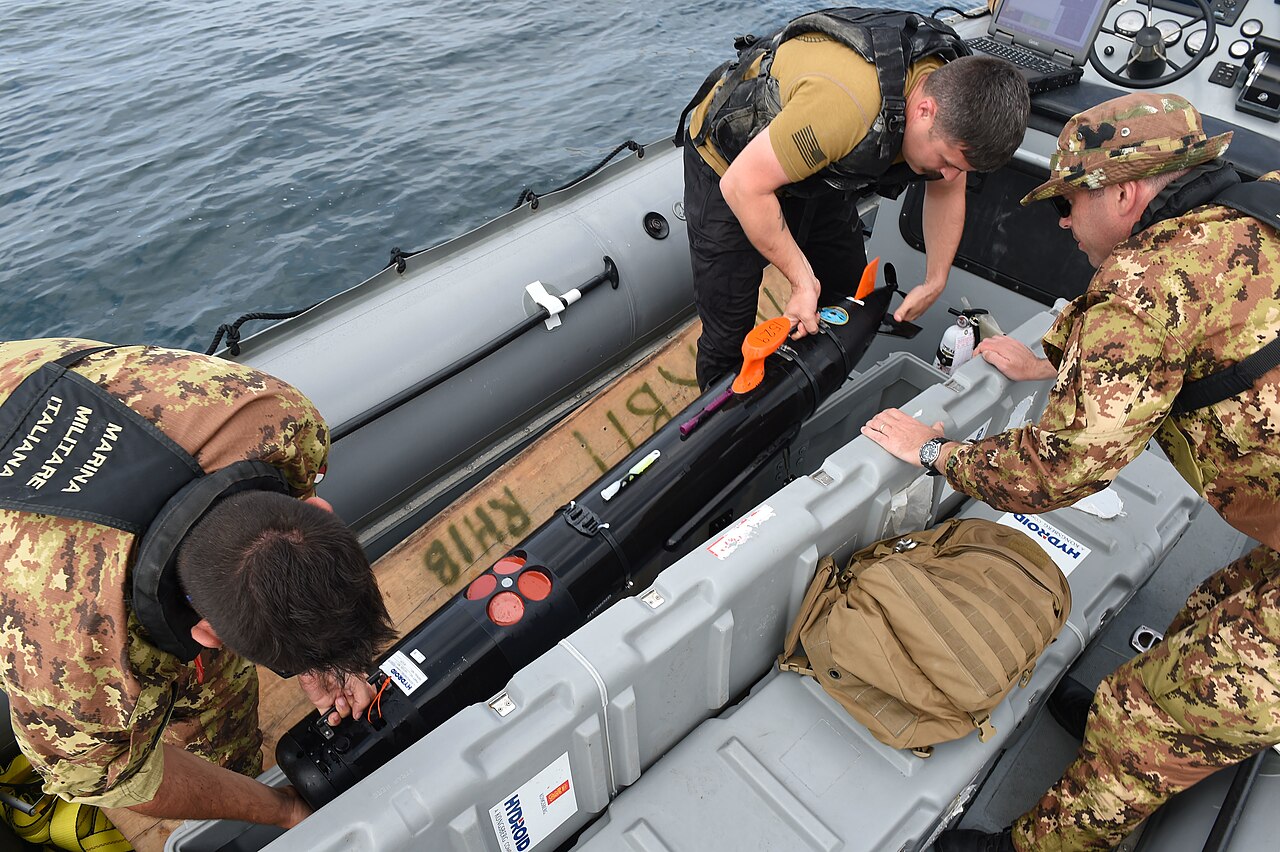
The Mk 18 Mod 2 Kingfish, the system Iran says it seized on September 27, is a roughly 13-foot torpedo-shaped autonomous underwater vehicle built on Hydroid’s REMUS 600 hull. Hydroid, now part of Huntington Ingalls Industries, delivered more than 90 of the vehicles to the U.S. Navy before production closed out in February 2023. It is rated to a depth of about 600 meters, carries an endurance of roughly 70 hours and a range near 286 nautical miles, and uses side-scan sonar for mine-countermeasures work — a considerably less exotic, more numerous system than the Dive-LD.
Who Uses It
Both vehicle types are operated by the U.S. Navy. The Dive-LD has been fielded by the Navy’s Unmanned Undersea Vehicle Squadron (UUVRON-1) as part of a wider push to expand attritable, low-cost autonomous systems in contested waters — part of the broader shift toward unmanned naval platforms discussed in our explainer on unmanned naval systems. The Mk 18 Mod 2 Kingfish has been in U.S. Navy mine-countermeasures service for over a decade, with more than 90 units built. No other confirmed military operators of either system have been reported.
Undersea drones are becoming a broader point of great-power competition, not just a U.S.-Iran issue: China is separately reported to be building a suspected large uncrewed undersea mothership in Shanghai, as covered in our report on China’s XXLUUV program.
Why It Matters
The dueling claims are unfolding against the backdrop of an unresolved U.S.-Iran military standoff that has simmered since strikes and naval clashes earlier in 2026, with the Strait of Hormuz — through which roughly a fifth of global oil trade transits — as its central pressure point. For Tehran, publicizing drone seizures, verified or not, serves as low-cost information warfare: each claim signals that the IRGC Navy can contest a waterway the U.S. Navy treats as a permissive operating environment for unmanned systems. For Washington, the recurring claims test how much operational detail CENTCOM is willing to disclose to counter them without confirming losses it may not want to acknowledge.
The episodes also illustrate a structural vulnerability of “attritable” autonomous systems: designed to be cheap enough to lose, they generate a steady stream of contested incidents that adversaries can exploit for propaganda regardless of the vehicles’ actual intelligence value. CENTCOM’s insistence that the September 8 vehicle carried no classified sensors reflects an effort to manage that exposure.
What Happens Next
Independent confirmation of the September 27 claim — through satellite imagery, authenticated video of the recovered hardware, or a further Pentagon statement — has not yet emerged, and this account should be treated as unverified pending such evidence. If CENTCOM continues to deny any loss, the incident will likely remain a matter of dueling narratives rather than a confirmed materiel loss, consistent with the pattern of the current standoff, in which neither side has reported a shoot-down of a manned or unmanned U.S. aircraft for seven consecutive reporting periods as of September 28, according to Global Security’s operational tracking.
FAQ
Did Iran actually capture a second U.S. underwater drone?
That is Iran’s claim, made by the IRGC Navy on September 27. CENTCOM has rejected it and says it maintains positive control of its drone assets; no independent verification has emerged.
What is the difference between the Dive-LD and the Mk 18 Mod 2 Kingfish?
The Dive-LD is a larger, deeper-diving, more expensive Anduril-built vehicle designed for extended ISR and anti-submarine missions. The Mk 18 Mod 2 Kingfish is an older, shorter-range Hydroid/HII-built mine-countermeasures vehicle based on the REMUS 600 hull.
Was the September 8 drone seizure confirmed?
Partially. CENTCOM confirmed the loss of an Anduril Dive-LD but disputed Iran’s framing, saying the vehicle had already malfunctioned and carried no classified equipment before Iran recovered it.
Why does the Strait of Hormuz matter for this story?
It is one of the world’s most important oil chokepoints and has been the site of recurring U.S.-Iran naval friction throughout 2026, making any claimed intercept there strategically and symbolically significant for both sides.
Has the U.S. Navy lost other drones in the region before?
Yes. Unmanned surface and undersea vehicles have been intercepted or disputed in Gulf waters in past years; the “attritable” design philosophy behind systems like the Dive-LD anticipates some losses as an operational trade-off for lower cost.
Sources
- SOFX, “CENTCOM Rejects Iran’s Claim of Second US Underwater Drone Seizure in Hormuz,” Sept. 28, 2026 — CENTCOM’s Sept. 27 denial and technical specifications of the Mk 18 Mod 2 Kingfish. sofx.com
- DefenseScoop, “US military’s Anduril Dive-LD drone was ‘dead in the water’ before Iran nabbed it,” Sept. 8, 2026 — CENTCOM and Anduril statements on the first incident. defensescoop.com
- The Jerusalem Post, “US denies IRGC claim that it captured second American submarine in Hormuz,” Sept. 27–28, 2026 — IRGC spokesman quote and U.S. denial. jpost.com
- Kurdistan24, “CENTCOM Says Seized US Underwater Drone Carried No Classified Equipment” — CENTCOM’s assessment of the first drone’s sensitivity. kurdistan24.net
- Euronews, “Iran’s Revolutionary Guards claim seizure of second US underwater drone in Strait of Hormuz,” Sept. 27, 2026 — timeline and Iranian framing of both incidents. euronews.com
- Global Security, “Iran War 2026 — Day 213 Update — 28 September 2026” — broader operational context on the U.S.-Iran standoff. globalsecurity.org