ANKA-III (ANKA-3): Specs, Engine, 80-Aircraft Order and Delivery Timeline

ANKA-III (also written ANKA-3) is Turkish Aerospace’s (TUSAŞ) jet-powered, tailless flying-wing unmanned combat aircraft. It first flew on 28 December 2023, has flown with two prototypes and is now being redesigned into a larger serial-production configuration, with first deliveries to the Turkish Air Force expected between the second half of 2027 and early 2028. TUSAŞ’s product page currently lists a 7,250 kg maximum take-off weight, a 1,700 kg payload, a 40,000 ft ceiling and Mach 0.7 at 30,000 ft. In October 2026 a company official told Breaking Defense that the Turkish armed forces have ordered 80 aircraft; no contract document or value has been published.
- Maker: Turkish Aerospace (TUSAŞ), Ankara; programme followed by the Presidency of Defence Industries (SSB)
- Type: tailless flying-wing UCAV with a single turbofan and internal weapons bays
- First flight: 28 December 2023, fully autonomous, 1 h 10 min (TUSAŞ)
- Armed tests: TEBER-82 guidance kit and TOLUN munition firings (TUSAŞ)
- Current TUSAŞ data: 8.9 m length, 13.1 m span, 7,250 kg MTOW, 1,700 kg payload, 40,000 ft, Mach 0.7
- Order: 80 aircraft for the Turkish armed forces, according to a TUSAŞ official (October 2026); first delivery 2027–early 2028 depending on the statement
- Engine: a Ukrainian turbofan today, according to TUSAŞ’s general manager; TEI’s TF6000 is being developed as a domestic option
What is ANKA-III?
ANKA-III is the third member of TUSAŞ’s ANKA family, after the propeller-driven ANKA medium-altitude long-endurance drone and the larger twin-engine AKSUNGUR. Unlike those two, it has no vertical tail: the whole aircraft is a single blended wing, a layout chosen to keep its radar signature low. TUSAŞ calls it Türkiye’s first tailless, turbofan-powered UAV and lists low radar observability, high payload capacity and internal payload stations as its defining features (TUSAŞ product page).
The company’s December 2023 first-flight release described a wide mission set: intelligence, surveillance and reconnaissance; strike with air-to-ground munitions; engaging helicopters, propeller aircraft and drones with air-to-air weapons; suppressing radar and air-defence emitters; close support of friendly forces; signals and communications intelligence; electronic warfare; and acting as a communications relay (TUSAŞ, December 2023). SSB President Prof. Dr. Haluk Görgün summarised it the same way after the first flight: reconnaissance, surveillance, air-to-air and air-to-ground missions, enabled by a high payload, a tailless structure and a low radar cross-section (SSB).
ANKA-III specifications
TUSAŞ has published two sets of figures, and they should not be mixed. The first-flight release of December 2023 gave a 1,200 kg payload, Mach 0.7 maximum cruise speed, a 40,000 ft ceiling and 10 hours’ endurance. The product page, checked on 14 November 2026, now shows larger numbers that match the “grown” production configuration described by general manager Mehmet Demiroğlu in 2026 (see below). Older figures still circulating online (7.9 m length, 12.5 m span, 6,500 kg take-off weight) describe the prototype stage.
| Parameter | TUSAŞ product page (Nov 2026) | TUSAŞ first-flight release (Dec 2023) |
|---|---|---|
| Length / wingspan / height | 8.9 m / 13.1 m / 2.5 m | not given |
| Maximum take-off weight | 7,250 kg | not given (product page text: “approximately 7 tonnes”) |
| Maximum payload | 1,700 kg | 1,200 kg |
| Ceiling | 40,000 ft | 40,000 ft |
| Speed | Mach 0.7 at 30,000 ft (maximum) | Mach 0.7 (maximum cruise) |
| Endurance | 10 hours (page text) | 10 hours |
| Combat radius | 1,075 km air-to-air (1+1 GÖKDOĞAN, AESA radar, IRST); 750 km air-to-ground (8 × TOLUN, EOTS) | not given |
| Payload stations | 2 internal and 2 external | 2 fuselage stations (650 kg each), inner-wing stations (650 kg each), outer-wing stations (100 kg each) |
The product page also lists manned-unmanned teaming, electronic warfare, an electro-optical targeting system, an AESA radar, an infrared search-and-track sensor and a self-protection suite (missile warning, directed infrared countermeasures, radar warning receiver, RF jammer and decoy, chaff and flares). It mentions take-off from and landing on an aircraft carrier as a feature; TUSAŞ has not published any ship-borne trial. All of these are manufacturer statements, not independently tested values.
Test history: from first flight to armed sorties
TUSAŞ says ANKA-III ran its first engine test in 2023. On 28 December 2023 the first prototype lifted off at 08:38, flew for 1 hour 10 minutes, reached 8,000 ft and 150 knots, performed a go-around and landed automatically; the flight was fully autonomous and escorted by a HÜRKUŞ trainer and an ANKA drone (TUSAŞ). President Recep Tayyip Erdoğan shared the video and SSB published it on its website (SSB).
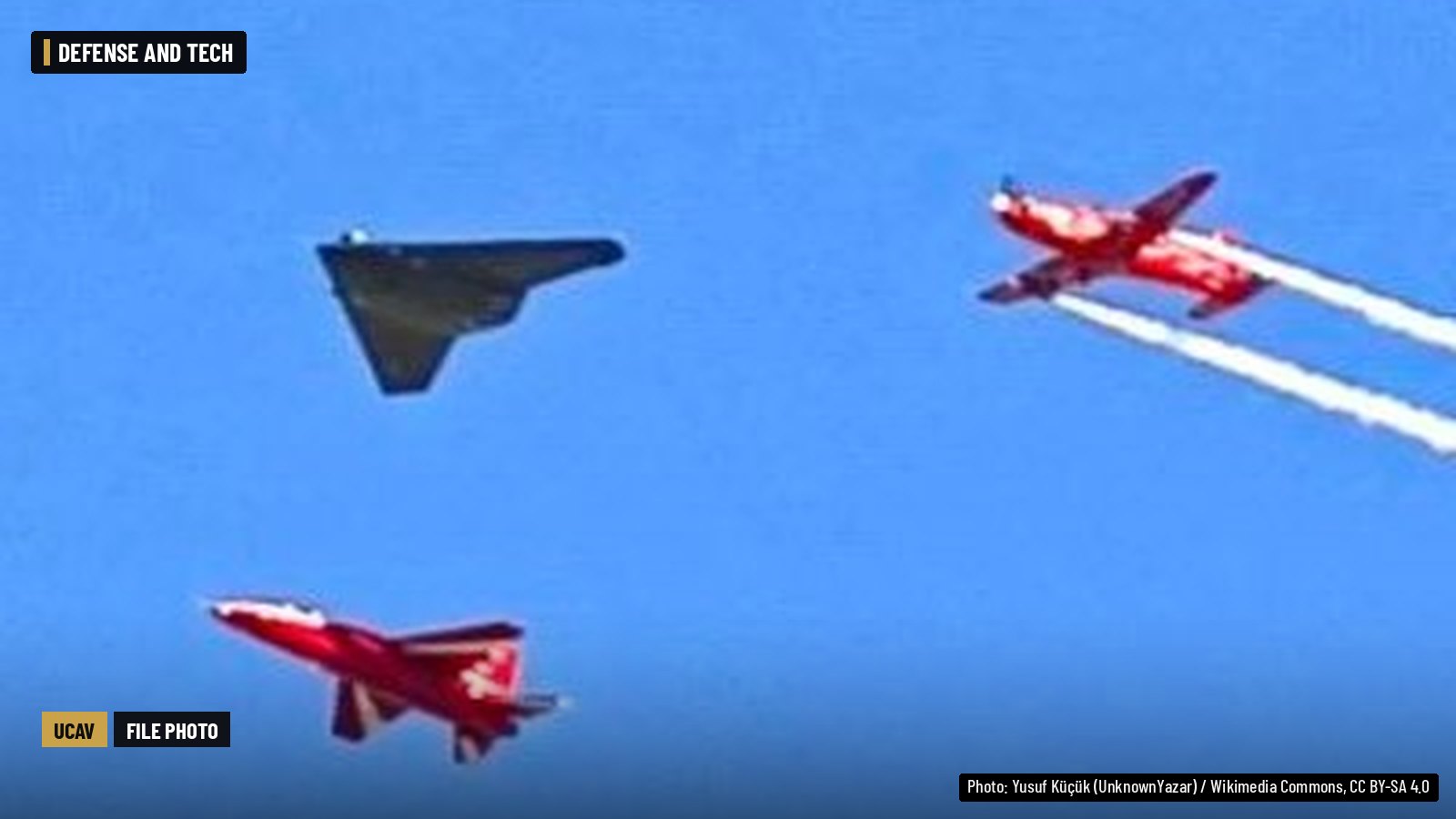
Armed testing followed. According to TUSAŞ, on its 12th sortie the aircraft hit its target with a TEBER-82 guidance kit, and a second firing test was carried out with the TOLUN munition. A second prototype has also started flying. The aircraft made a public flying appearance alongside a HÜRJET and a HÜRKUŞ at TEKNOFEST 2024 in Adana, the event shown in this article’s file photo.
The production configuration: a “grown” ANKA-III
In a July 2026 interview on Habertürk’s Airport programme, TUSAŞ general manager Mehmet Demiroğlu said the two prototypes had shown what needed to change and that the company had started building prototypes of a “second configuration”, the final serial-production design. He said the changes further reduce the radar cross-section, improve paint and coatings, increase range and endurance and raise the payload “from 1.3 tonnes to 1.7 tonnes”, and that the aircraft can now be used for both air-to-ground and air-to-air engagements (as quoted by haber.aero). At that point he expected the new version to fly in the first quarter of 2027 and deliveries to begin in the second half of 2027.
On 3 October 2026 Demiroğlu said the new configuration had been frozen and production had begun, that the new prototypes should fly in the first half of 2027, and that deliveries to the Turkish Air Force would start at the end of 2027 or the beginning of 2028. Two weeks later, during a press visit organised by Türkiye’s Ministry of National Defence, a TUSAŞ official told Breaking Defense that a second ANKA-III production line had been completed and was due to open in November 2026, that it would build the enlarged variant with an expected payload of 1.75 tonnes (against about 1.3 tonnes for the original), and that the first aircraft from the new line would roll out “soon” (Breaking Defense, 16 October 2026). Breaking Defense later withdrew a production-rate figure from its report, and we do not use it. As of 14 November 2026 we found no official TUSAŞ or SSB announcement that the line has opened.
How many ANKA-III has Türkiye ordered?
The only public figure is 80 aircraft for the Turkish armed forces, given by a TUSAŞ official to Breaking Defense in October 2026. SSB, the Ministry of National Defence and TUSAŞ have not published a contract date, value or the split between the original and enlarged variants. No export customer has been announced; Demiroğlu said in July 2026 that there is “very serious interest” from abroad as well as at home, without naming countries. TUSAŞ’s Turkish product page says ANKA-III “will be delivered to the Air Force Command within the planned schedule”.
Engine and foreign dependency
TUSAŞ’s product page does not name the engine. Demiroğlu said in the July 2026 interview that the engine is Ukrainian, that there is currently no problem with its supply, that TUSAŞ is following TEI’s TF6000 work closely and that other engine options are also being evaluated. Defence media identify the powerplant as an Ivchenko-Progress AI-322-family turbofan (The Aviationist); TUSAŞ has not confirmed the exact model on its product page. TEI general manager Prof. Dr. Mahmut F. Akşit said in July 2026 that TF6000 prototype engines should be delivered to TUSAŞ and Baykar in early 2027 for testing, and that the platform makers will decide whether to fly them (TURDEF). Until a domestic engine is qualified, ANKA-III depends on a foreign propulsion supply chain, the same issue that shapes KAAN and other Turkish jet programmes.
Where ANKA-III fits
ANKA-III belongs to a small class of jet-powered, low-observable flying-wing combat drones. Comparable designs include France-led Dassault nEUROn (a technology demonstrator), Russia’s S-70 Okhotnik and China’s GJ-11; each has a different status and published data are uneven, so we do not rank them. In Türkiye it sits alongside Baykar’s Bayraktar KIZILELMA, a jet-powered unmanned fighter with a different airframe concept and its own programme. Inside TUSAŞ it extends the ANKA and AKSUNGUR line into contested airspace, and the company describes it as able to team with crewed aircraft. For the wider picture see our TUSAŞ company profile, what drones Türkiye has and our explainer on radar cross-section.
FAQ
Is ANKA-III in service?
No. As of November 2026 it is in flight and firing tests with two prototypes, and TUSAŞ statements put first deliveries to the Turkish Air Force between the second half of 2027 and early 2028.
When did ANKA-III first fly?
On 28 December 2023, in a fully autonomous 70-minute flight from which it landed automatically, according to TUSAŞ.
How much can ANKA-III carry?
TUSAŞ’s product page lists a 1,700 kg maximum payload. Its 2023 release gave 1,200 kg for the original design; TUSAŞ officials have described the original as about 1.3 tonnes and the enlarged production variant as 1.7–1.75 tonnes.
How many ANKA-III has Türkiye ordered?
80, according to a TUSAŞ official quoted by Breaking Defense in October 2026. No official contract details have been published.
What engine does ANKA-III use?
A Ukrainian turbofan, according to TUSAŞ’s general manager; media reports name the AI-322 family. TEI’s domestic TF6000 is due to reach TUSAŞ for testing in early 2027.
Sources
- TUSAŞ – ANKA-III product page (EN) and (TR), accessed 14 November 2026
- TUSAŞ – ANKA III completes its first flight (December 2023)
- SSB – Anka-3 makes its first flight (8 January 2024)
- Breaking Defense – Turkish Aerospace expands Anka 3 production with new line for upgraded drone (16 October 2026)
- haber.aero – Demiroğlu on the new ANKA-III version (Habertürk interview, July 2026)
- Savunma+ – Demiroğlu: new ANKA-3 prototypes to fly in 2027 (3 October 2026)
- TURDEF – TEI aims to deliver TF6000 for pre-integration tests in 2027
- The Aviationist – ANKA-3 update (May 2024)
- Wikimedia Commons – cover photograph, ANKA-3 with HÜRJET and HÜRKUŞ at TEKNOFEST 2024 (CC BY-SA 4.0)
Last updated: 14 November 2026. This page was rewritten and expanded on this date; earlier specification figures have been replaced with TUSAŞ’s current data, and the differences are explained above. Cover: file photo, TEKNOFEST 2024, Adana; Photo: Yusuf Küçük (Commons user UnknownYazar), CC BY-SA 4.0, cropped and upscaled.