TUSAŞ AKSUNGUR: Specs, PD170 Engine, Weapons and Operators
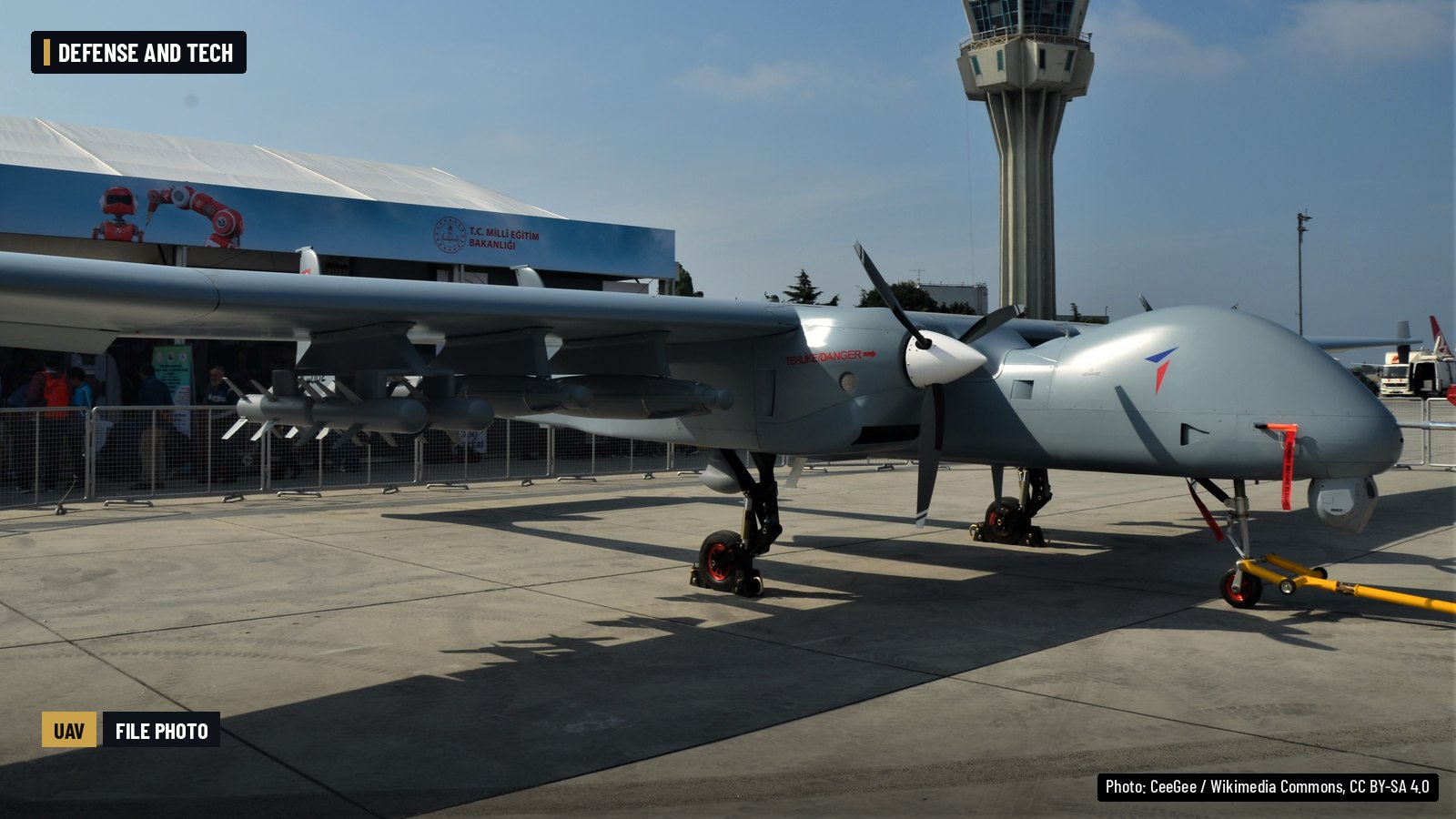

AKSUNGUR is Turkish Aerospace’s (TUSAŞ) twin-engine, medium-altitude long-endurance (MALE) drone, built for day-and-night intelligence, surveillance, reconnaissance and strike missions. Derived from the ANKA, it first flew on 20 March 2019 and flew its first field mission in the second quarter of 2021. TUSAŞ lists a 24 m wingspan, a 3,300 kg maximum take-off weight, a payload of more than 750 kg, endurance of up to 50 hours and a 40,000 ft service ceiling. Since November 2023 it has flown on two TEI-PD170 turbodiesel engines made in Türkiye. Outside Türkiye, it has been shown in service in Kyrgyzstan and Niger.
- Maker: Turkish Aerospace (TUSAŞ), Ankara, a subsidiary of the Turkish Armed Forces Foundation (TSKGV) and an affiliate of the Presidency of Defence Industries (SSB)
- Class: twin-engine MALE UAV for ISR and strike, with SATCOM for beyond-line-of-sight control
- First flight: 20 March 2019, 4 h 20 min, automatic take-off and landing (TUSAŞ)
- TUSAŞ data: 24 m span, 12.5 m length, 3,300 kg MTOW, 750+ kg payload, up to 50 h, 40,000 ft
- Engines: two TEI-PD170 turbodiesels (first AKSUNGUR flight on PD170 in November 2023)
- Users shown publicly: Türkiye; Kyrgyzstan (Border Service, October 2023); Niger (presented September 2025). Nigeria lists 12 as “expected” (October 2026)
What is AKSUNGUR?
AKSUNGUR sits in the middle of TUSAŞ’s ANKA family. It is larger than the single-engine ANKA and, unlike the jet-powered ANKA-III flying wing, it keeps a conventional propeller layout: a twin-boom airframe, a high wing and two piston engines, which TUSAŞ describes as turbocharged diesels. The company says it developed AKSUNGUR from the ANKA platform in about 18 months, and that it shares a common avionics architecture and ground segment with ANKA and ANKA-III (TUSAŞ product page; TUSAŞ).
TUSAŞ markets it as a “high payload capacity” UAV. Its sensors and payloads include an electro-optical/infrared camera, synthetic aperture radar with ground moving-target indication, signals intelligence and electronic warfare equipment, satellite communications and a radio relay. TUSAŞ also lists precision-guided bombs, laser-guided rockets and anti-tank missiles as weapon options. The design has redundant flight-control computers and datalinks, automatic take-off and landing, automatic return to base if the link is lost, retractable landing gear and wing and tail de-icing.
AKSUNGUR specifications
The figures below are the manufacturer’s, as shown on TUSAŞ’s English product page on 15 November 2026. They are not independently verified.
| Parameter | TUSAŞ figure |
|---|---|
| Wingspan | 24 m |
| Length / height | 12.5 m / 3.84 m |
| Maximum take-off weight | 3,300 kg |
| Payload capacity | 750+ kg (the same page’s text says “1-ton”) |
| Endurance | Up to 50 hours |
| Service ceiling | 40,000 ft |
| Datalink / SATCOM range | 250+ km / 5,000+ km |
| Engines | 2 × turbocharged diesel (TEI-PD170, 172 hp ±2 each per TEI) |
Two points need care. First, payload: the table says more than 750 kg, while the text on the same page, and a 2025 TUSAŞ release, call it a 1-tonne payload. Second, endurance: “up to 50 hours” is a design figure. The longest flight TUSAŞ itself has described is 49 hours. Our earlier version of this page said AKSUNGUR had “demonstrated” 50 hours; that was wrong and has been corrected.
Engine: the TEI-PD170
AKSUNGUR’s engines are TEI-PD170 turbodiesels from TUSAŞ Engine Industries (TEI). The engine came out of a project run under the SSB to give Türkiye its first domestically developed aviation engine for MALE drones. TEI quotes 172 hp (±2), a two-stage turbocharger, a 162 kg dry weight, a 45,000 ft ceiling and the ability to run on JP-8, Jet A-1, JP-5 or EN 590 diesel. The PD170 first flew on an ANKA on 27 December 2018 and entered series production in 2019 (TEI).
TUSAŞ says AKSUNGUR first flew on the national PD170 in November 2023, staying up for 41 hours and reaching 30,000 ft. On 16 April 2025, flying from Mürted, it reached 40,000 ft on PD170 power, beating its earlier 37,500 ft. On that flight it carried an ASELSAN AF500 camera and an ASPİLSAN heated battery (TUSAŞ). TEI’s own page claims 45 hours in a single sortie and 42,000 ft with AKSUNGUR. Those figures are higher than TUSAŞ’s, and neither company explains the difference.
Some 2019 reports said the first AKSUNGUR flight already used PD170 engines. TUSAŞ, however, dates the first AKSUNGUR flight on PD170 to November 2023. TUSAŞ has not said publicly which engine its earlier flights used, so we do not name one.
Weapons and test milestones
- 20 March 2019: first flight, 4 hours 20 minutes, using automatic take-off and landing (TUSAŞ statement of 21 March 2019).
- Full munition load: TUSAŞ says AKSUNGUR flew for 28 hours at 20,000 ft with all six stations loaded with 12 ROKETSAN MAM-L smart micro-munitions. It was the first time it had flown for over a day with a full weapon load (TUSAŞ).
- Integration work: TUSAŞ says three different EO/IR cameras, two SATCOM systems, the 500-lb-class TEBER-81/82 and KGK-82 guidance kits and the PD170 engine have been integrated.
- 13 March 2025: released ASELSAN LGK-81 and LGK-82 laser-guided bombs from 30,000 ft on PD170 power, from two different stations; TUSAŞ reported direct hits (TUSAŞ).
- 16 April 2025: 40,000 ft on PD170 engines.
- October 2026, TURNAs-26: during the Turkish Naval Forces’ unmanned maritime systems exercise, AKSUNGUR flew from Ankara to the sea off Antalya under satellite control. There it dropped three ASELSAN aselBUOY 100P sonobuoys and one other sonobuoy from a pod. It then spent about four hours relaying acoustic data to its ground station in Ankara. TUSAŞ said it was the first time an aselBUOY had been dropped from a UAV (our report).
Service in Türkiye, including civil missions
TUSAŞ says AKSUNGUR flew its first field mission in the second quarter of 2021 and has since logged more than 1,000 hours in the field. It has not published the number of aircraft in Turkish service. Several of its public missions have been civilian ones. The General Directorate of Forestry has used it for wildfire detection since 1 June 2021 (TUSAŞ). After the February 2023 earthquakes, it sent imagery to the disaster agency AFAD. It also carried a mobile-phone base station, developed with Turkcell, over Adıyaman and Hatay to support communications for survivors and rescue teams (TUSAŞ).
Export customers
- Kyrgyzstan: On 28 October 2023, the Kyrgyz presidential press service said AKINCI and AKSUNGUR drones had entered service with the Border Service of the State Committee for National Security. It said they were bought from the national budget (Kabar). No quantity was given.
- Niger: AKSUNGUR was presented at Air Base 101 in Niamey during a visit by Defence Minister General Salifou Mody, according to the armed forces’ weekly bulletin on national television, as reported by APA on 29 September 2025. The bulletin said the purchase had been announced in April 2025 and that 12 Nigerien personnel had trained in Türkiye (APA).
- Nigeria (not confirmed as a sale): On 25 October 2026, the Nigerian Air Force listed 12 AKSUNGUR among its “additional expected aircraft”. It published no contract, value or delivery date (our report).
Neither TUSAŞ nor the SSB has published contract values or delivery numbers for these countries.
Where AKSUNGUR fits
Within TUSAŞ’s line-up, AKSUNGUR is the heavier, longer-endurance option above the ANKA, while the ANKA-III is the family’s jet-powered flying-wing member, still in testing. Its strengths, as TUSAŞ presents them, are endurance, payload and satellite control. That is why it has been used for long maritime and disaster-response sorties as well as strike tests. It also shows how far the supply chain has been localised: Turkish companies provide the engine (TEI), camera and laser kits (ASELSAN), battery (ASPİLSAN) and munitions (ROKETSAN). In the same Turkish market, Baykar’s twin-turboprop AKINCI is a larger strike UAV. For the wider picture, see what drones Türkiye has and our TUSAŞ company profile.
FAQ
Who makes AKSUNGUR?
Turkish Aerospace (TUSAŞ) in Ankara. Its PD170 engines come from TUSAŞ Engine Industries (TEI).
How long can AKSUNGUR stay in the air?
TUSAŞ gives “up to 50 hours” as the design figure. The longest flight TUSAŞ has described is 49 hours, and on the national PD170 engine it has reported 41 hours.
How much payload can AKSUNGUR carry?
The TUSAŞ specification table says more than 750 kg; other TUSAŞ texts describe a 1-tonne payload capacity. It has flown with 12 MAM-L munitions on six stations.
Which countries use AKSUNGUR?
Türkiye, Kyrgyzstan (Border Service, from October 2023) and Niger (presented in September 2025). Nigeria lists 12 as “expected” aircraft, but no contract has been announced.
Is AKSUNGUR the same as ANKA?
No. It was developed from ANKA and shares its avionics and ground segment, but it is a larger, twin-engine aircraft with a heavier payload.
Sources
- TUSAŞ – AKSUNGUR product page (EN) and (TR), accessed 15 November 2026
- TUSAŞ – AKSUNGUR completes 1,000 flight hours
- TUSAŞ – AKSUNGUR flies 28 hours with 12 MAM-L
- TUSAŞ – LGK-81 and LGK-82 firing test (13 March 2025)
- TUSAŞ – altitude record with the national engine (16 April 2025)
- TUSAŞ – base station support in the earthquake zone (February 2023)
- TUSAŞ – wildfire detection for the General Directorate of Forestry
- TEI – TEI-PD170 turbodiesel aviation engine
- Kabar (Kyrgyz state news agency) – Border Service receives AKINCI and AKSUNGUR (28 October 2023)
- APA – Niger Air Force unveils Turkish Aksungur combat drone (29 September 2025)
- Janes – Turkey advances Anka-Aksungur MALE UAV development (2019)
- Wikimedia Commons – cover photograph, AKSUNGUR at TEKNOFEST 2019 (CC BY-SA 4.0)
Last updated: 15 November 2026. This page was rewritten and expanded on this date. Specifications were rechecked against TUSAŞ’s current product page; the earlier claim of a “demonstrated” 50-hour flight and other unsourced statements were removed. Cover: file photo, TEKNOFEST 2019, Istanbul, 17 September 2019; Photo: CeeGee / Wikimedia Commons, CC BY-SA 4.0, cropped.