Greece Agrees to Keep Patriot Battery in Saudi Arabia as Houthi Attacks Continue
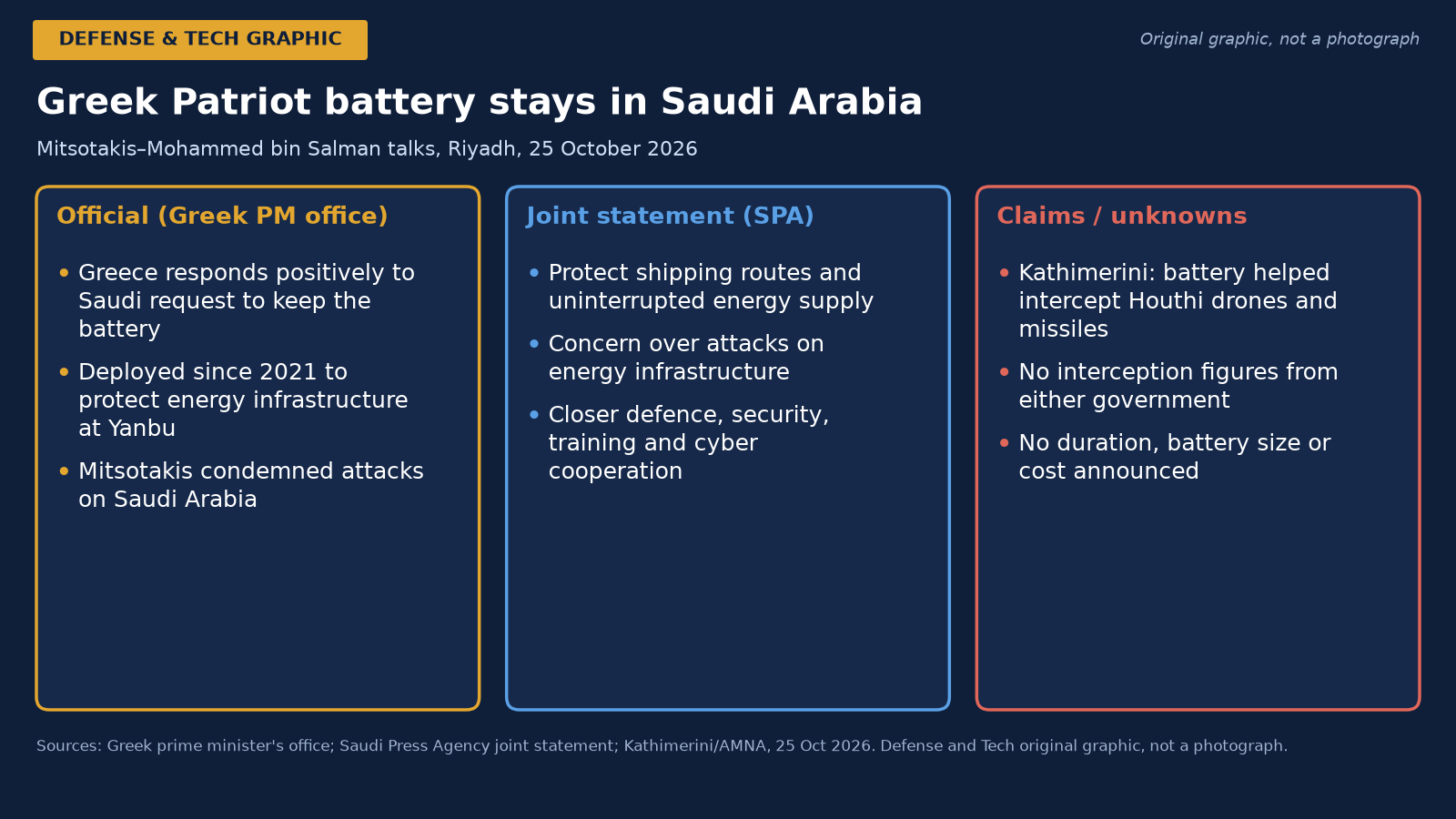
Greece will keep its Patriot air defence battery in Saudi Arabia after Prime Minister Kyriakos Mitsotakis agreed to a Saudi request during talks with Crown Prince Mohammed bin Salman in Riyadh on Sunday, 25 October 2026. The Greek prime minister’s office said Greece had contributed to Saudi air defence with a Patriot battery since 2021, protecting critical energy infrastructure at Yanbu on the Red Sea coast, and that it “responds positively” to the kingdom’s request for the system to stay “at this difficult juncture” (Greek prime minister’s office).
- Greek Prime Minister Kyriakos Mitsotakis met Saudi Crown Prince Mohammed bin Salman in Riyadh on 25 October 2026
- According to the Greek government, Greece responded positively to a Saudi request for its Patriot battery to remain in the kingdom
- The battery has been part of Saudi air defence since 2021, protecting energy infrastructure at Yanbu on the Red Sea coast
- Kathimerini reported that the battery has helped intercept Houthi drones and missiles; neither government gave interception figures
- No duration, battery size or cost of the extended deployment was announced
What was agreed
According to the Greek briefing note, Mitsotakis condemned the attacks on Saudi Arabia during the meeting. Kathimerini, citing the Athens-Macedonian News Agency, reported that the Greek battery has helped intercept Houthi drones and missiles aimed at energy infrastructure at Yanbu and other targets (Kathimerini). Neither government published interception figures, and Defense and Tech has not independently verified the claim. No end date, personnel number, battery composition or cost-sharing arrangement for the extended deployment was announced.
A joint statement carried by the Saudi Press Agency said both sides stressed the importance of protecting shipping routes and keeping energy supplies flowing, expressed concern over attacks on energy infrastructure, and agreed to deepen defence and security cooperation, including on terrorism, terrorist financing, training and cybersecurity (SPA, Arab News). According to Arab News, Greece also praised Saudi Arabia’s East-West Pipeline, which carries crude across the kingdom to Red Sea terminals including Yanbu.
Platform background
Patriot is a US-made long-range air and missile defence system built by RTX (Raytheon) and used by both Greece and Saudi Arabia. A battery typically combines a radar, an engagement control station and several launchers; Greece has not said which configuration or interceptor types it has in Saudi Arabia. For variants, interceptors and operators, see our Patriot missile system guide.
Previous developments
The decision comes as Saudi Arabia faces renewed Houthi missile and drone attacks. The Houthis have claimed strikes on Aramco facilities at Yanbu and Rabigh, which Saudi forces said they intercepted (our report), and declared King Khalid International Airport in Riyadh a military target (our report). For the full timeline, see our Houthi-Saudi war page.
Industry and strategic context
Greece first sent the battery in 2021 under a bilateral arrangement. The extension keeps a scarce asset away from home at a time when European demand for Patriot interceptors is high. For Riyadh it adds a layer of point defence at the Red Sea export hub that has become more important since Gulf shipping came under pressure. The visit was also the second session of the Saudi-Greek Supreme Council for Strategic Cooperation, which covers the planned electricity interconnection and the East to Med Data Corridor; bilateral trade reached about $1.7 billion in 2025, according to the joint statement as reported by Arab News.
Sources: Greek prime minister’s office, 25 October 2026; Saudi Press Agency joint statement and Arab News, 25 October 2026; Kathimerini/AMNA, 25 October 2026.