STM’s TUNGA-X Interceptor Drone Destroys Target UAV in TURNAs-2026 Naval Exercise
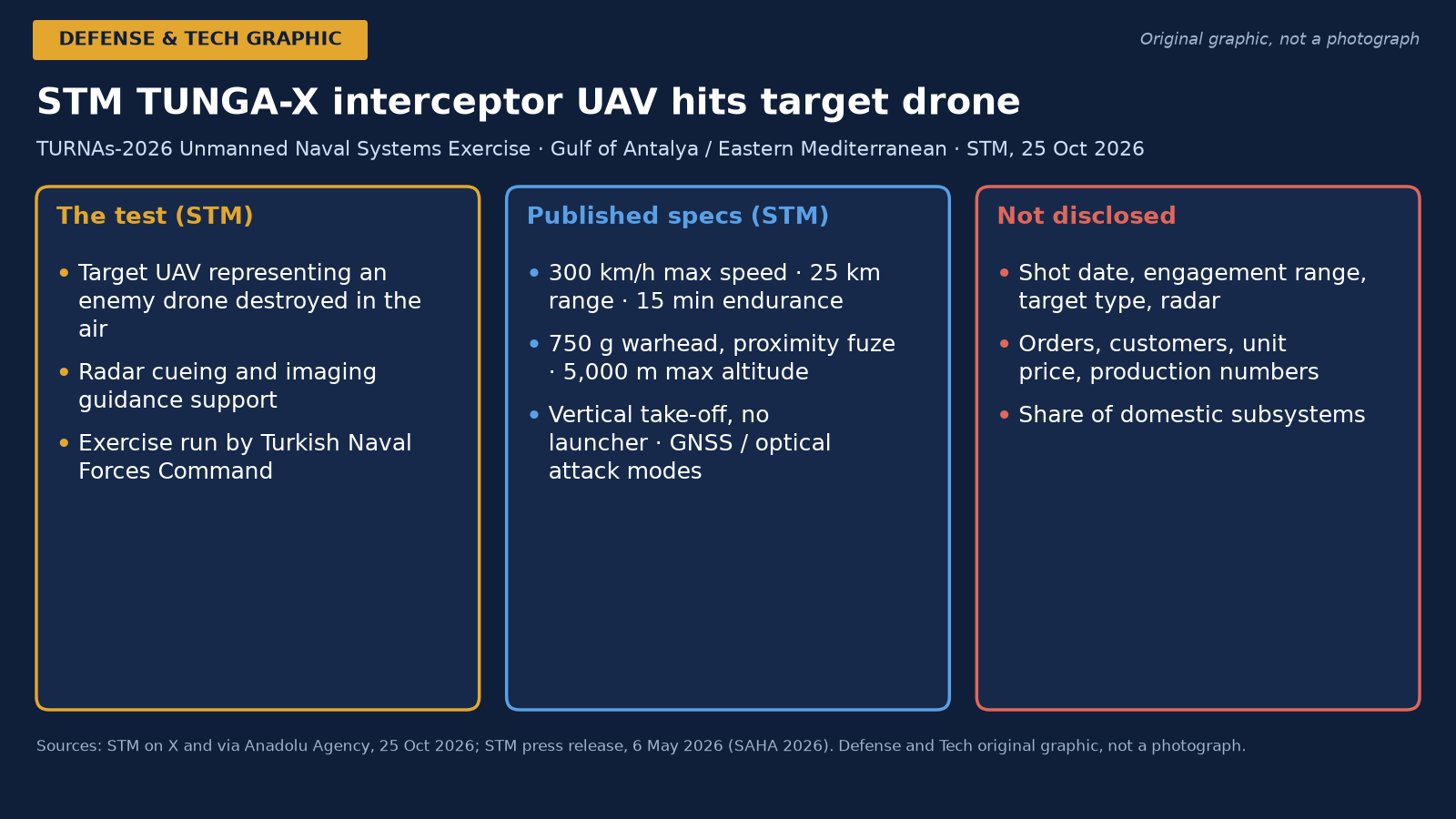
Turkish defence company STM says its TUNGA-X interceptor drone hit and destroyed a target UAV in the air during TURNAs-2026, the unmanned naval systems exercise run by the Turkish Naval Forces Command. STM published a 33-second video of the test on X on Sunday, 25 October 2026, saying the target, which represented an enemy UAV, was destroyed “with radar and imaging guidance support” (STM on X).
- STM says its TUNGA-X interceptor UAV hit and destroyed a target drone representing an enemy UAV during TURNAs-2026, run by the Turkish Naval Forces Command
- According to STM, the interception was made with radar and imaging guidance support
- STM gives TUNGA-X a top speed of 300 km/h, a range of up to 25 km, 15 minutes’ endurance and a 750 g warhead
- The system was first shown at SAHA 2026 in May and is designed to counter low-cost kamikaze drones
- No order, customer, unit price or production figure has been announced
What happened in the test
According to Anadolu Agency, which cited STM, the shot took place during the TURNAs-2026 Unmanned Naval Systems Exercise held in the Gulf of Antalya and the Eastern Mediterranean (Anadolu Agency). STM did not give the date of the shot, the distance or altitude of the engagement, the type of target drone or the radar used to cue the interceptor. Neither the Turkish Naval Forces Command nor the Ministry of National Defence had published a separate statement on the test at the time of writing.
Platform background
STM unveiled TUNGA-X at the SAHA 2026 defence exhibition in Istanbul in May (STM press release). It is a multirotor interceptor that takes off vertically without a launcher and can be flown manually or autonomously, with image-processing software for automatic target tracking. In the concept STM described, a radar detects a threat at about 10 km and passes it to TUNGA-X, which flies towards the target and confirms it with its electro-optical/infrared camera before a proximity fuze detonates the warhead. STM says the operator can abort an attack and bring the drone back.
STM’s published figures are a 750 g warhead (munition and fuze), 15 minutes’ endurance, a maximum speed of 300 km/h, a range of 25 km at 150 km/h and 1,500 m above ground level, and a maximum altitude of 5,000 m. Attack modes are GNSS guidance and optical guidance. The company says the system is modular and can be integrated on different carrier platforms. STM has not said which of the drone’s subsystems are produced in Türkiye.
Previous developments
TURNAs-2026 has been used to show a range of Turkish unmanned systems; on 24 October we reported on the Turkish Navy’s unmanned amphibious raid rehearsal off Antalya. STM is best known for the KARGU loitering munition and its unmanned surface and underwater work (our profile of STM). TUNGA-X is a defensive counterpart to that kind of weapon: a drone designed to hunt other drones.
Industry context
Interceptor drones have spread quickly since Ukraine began using them in large numbers against Shahed-type one-way attack drones. The case for them is cost: at SAHA, STM General Manager Özgür Güleryüz said countering cheap kamikaze drones with expensive air-defence missiles was not sustainable. STM has not published a unit price for TUNGA-X, and no order from the Turkish Armed Forces, the Presidency of Defence Industries (SSB) or an export customer has been announced. For the attack drones this class of interceptor is meant to stop, see our ranking of the world’s top loitering munitions.
Sources: STM on X, 25 October 2026; Anadolu Agency, 25 October 2026; STM press release, 6 May 2026 (Turkish).