How Many Warships Does the Royal Navy Have? Type 45, 26 and 31
The Royal Navy has 13 major surface combatants: six Type 45 destroyers and seven Type 23 frigates, alongside two aircraft carriers. It is the smallest escort force the navy has had in its modern history. The numbers fell further in 2025, when four frigates and both amphibious assault ships were retired. Thirteen new frigates are being built in Scotland, and the first is due to enter service in 2027 or 2028.
This guide sets out the fleet by class, explains what each type does and when the new ships arrive.
How many warships does the Royal Navy have?
The Ministry of Defence counted 52 vessels in the Royal Navy’s surface fleet and 12 in the Royal Fleet Auxiliary on 1 April 2026, plus nine submarines. Most of the surface fleet are patrol and mine warfare vessels.
| Type | Class | Number | Notes |
|---|---|---|---|
| Aircraft carrier | Queen Elizabeth | 2 | 65,000 tonnes each |
| Destroyer | Type 45 (Daring) | 6 | Air defence |
| Frigate | Type 23 (Duke) | 7 | Anti-submarine; being retired |
| Frigate | Type 26 (City) | 0 | 8 on order; first due 2027–2028 |
| Frigate | Type 31 (Inspiration) | 0 | 5 on order; first due by 2030 |
| Mine countermeasures vessel | Hunt, Sandown | 7 | Being replaced by drone systems |
| Patrol vessel | River, Archer and others | 26 | Offshore and inshore patrol |
| Amphibious assault ship | Albion | 0 | Both retired in 2025 |
The carriers are covered in our guide to British aircraft carriers and the submarines in our guide to British submarines.
Type 45: the air defence destroyers
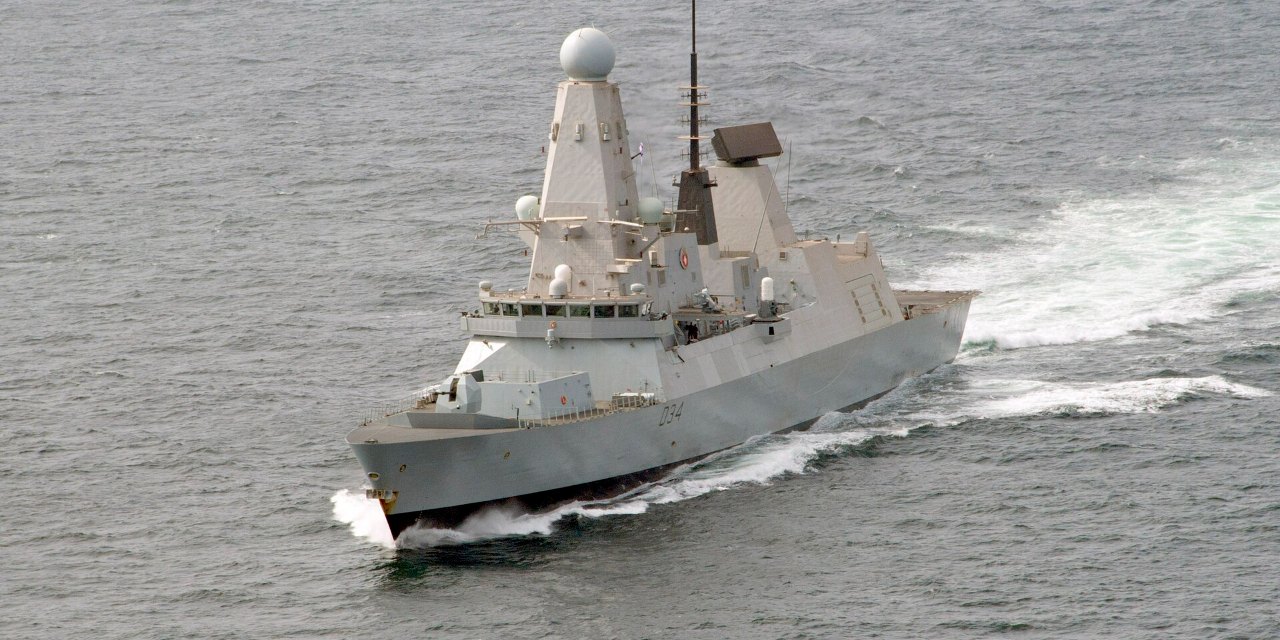
The six Type 45s, Daring, Dauntless, Diamond, Dragon, Defender and Duncan, were built by BAE Systems and commissioned between 2009 and 2013. They are 152 metres long and displace about 8,500 tonnes. Their SAMPSON radar, on top of the tall mast, can track hundreds of targets, and their Sea Viper missiles reach out to about 120 km. In April 2024 HMS Diamond shot down a Houthi ballistic missile in the Red Sea.
For most of their life the Type 45s have been held back by their power plant, whose turbines and diesel generators could not cope with the heat of the Gulf. A programme to add generators has been completed on most of the class. They are also receiving 24 additional cells for the CAMM missile, the Naval Strike Missile and, from 2027, the DragonFire laser, described in our report on DragonFire for the Type 45.
Type 23: the last of the old frigates
Sixteen Type 23 frigates were built between 1987 and 2002 to hunt Soviet submarines, and their towed sonar remains among the best in NATO. Seven are left. Several were given long life extensions as the new frigates ran late, and some have served for more than 30 years. They carry Sea Ceptor air defence missiles and the Naval Strike Missile, both described in our guide to British missiles.
Type 26: the new anti-submarine frigate
The Type 26, or City class, is the Type 23’s replacement for anti-submarine warfare. Eight are being built by BAE Systems in Glasgow: Glasgow, Cardiff, Belfast, Birmingham, Sheffield, Newcastle, Edinburgh and London. At about 6,900 tonnes they are large for frigates. They carry an acoustically quiet hull, a towed sonar, 24 Mk 41 vertical launch cells for strike missiles and 48 cells for CAMM.
The first, HMS Glasgow, was originally due in 2023 and is now expected to be ready for operations in 2027 or 2028. All eight are to be complete by the mid-2030s. The design has become an export success: Australia is building six as the Hunter class, Canada fifteen as the River class, and on 31 August 2025 Norway chose it for at least five ships in a deal worth about £10 billion. A comparison with its rivals is in our article on the Type 26, FREMM and Constellation.
Type 31: the general-purpose frigate
The Type 31, or Inspiration class, is a cheaper general-purpose frigate built by Babcock at Rosyth on the Danish Iver Huitfeldt design. Five are on order: Venturer, Active, Bulldog, Campbeltown and Formidable. They are meant for patrols, escort duties and presence in distant waters rather than for high-end anti-submarine work, and carry a 57 mm gun, two 40 mm guns and CAMM missiles. The first is due in service by the end of the decade. Indonesia and Poland have bought versions of the same design.
The Royal Fleet Auxiliary and the amphibious gap
The navy’s ships are supplied at sea by the Royal Fleet Auxiliary, a civilian-crewed fleet of tankers and supply ships. Its numbers have fallen too, with only nine of 12 ships in service in April 2026. The retirement of the amphibious assault ships HMS Albion and HMS Bulwark in 2025 left the Royal Marines dependent on auxiliary landing ships until new Multi-Role Strike Ships arrive in the 2030s.
Frequently asked questions
How many warships does the Royal Navy have?
Thirteen destroyers and frigates and two aircraft carriers in April 2026, within a surface fleet of 52 vessels including patrol and mine warfare ships.
How many destroyers does the UK have?
Six Type 45 air defence destroyers: Daring, Dauntless, Diamond, Dragon, Defender and Duncan.
How many frigates does the Royal Navy have?
Seven Type 23 frigates. Eight Type 26 and five Type 31 frigates are under construction to replace them.
When will the Type 26 frigate enter service?
The first, HMS Glasgow, is expected to be ready for operations in 2027 or 2028. All eight are due by the mid-2030s.
Does the Royal Navy have amphibious assault ships?
Not at present. HMS Albion and HMS Bulwark were retired in 2025. New Multi-Role Strike Ships are planned for the 2030s.
Which countries have bought the Type 26 design?
Australia, Canada and Norway.
- UK Ministry of Defence – UK armed forces equipment and formations 2026: gov.uk
- Defence Industry Europe – MoD figures: six destroyers, seven Type 23 frigates (August 2026): defence-industry.eu
- The Register – Norway’s £10bn UK frigate deal could delay Royal Navy ships (September 2025): theregister.com
- UK Defence Journal – Update on the progress of Britain’s new frigates (March 2025): ukdefencejournal.org.uk