

UK to Arm Type 45 Destroyers With DragonFire Laser From 2027

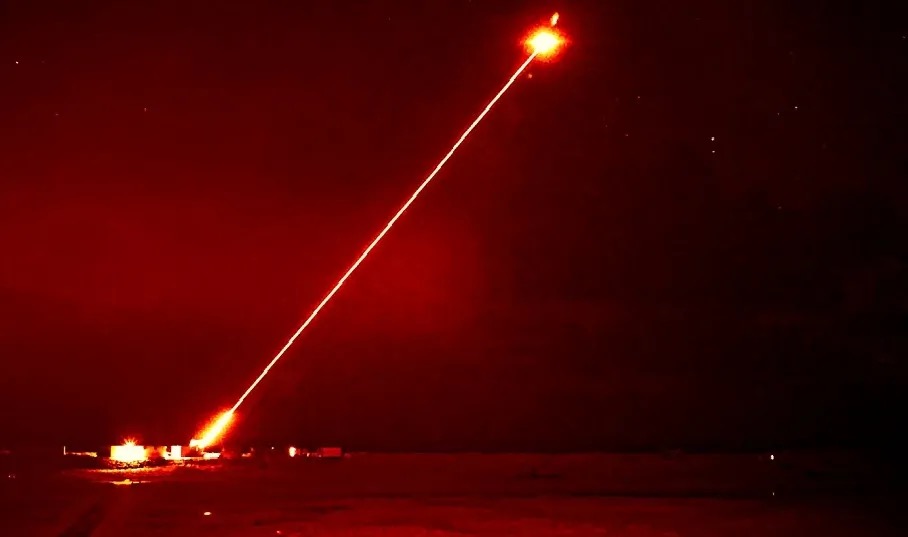
Britain will fit the DragonFire laser directed-energy weapon to a Royal Navy Type 45 destroyer in 2027, five years earlier than originally planned, as part of a broader package of air-defence and counter-drone investment set out by the Ministry of Defence.
Defence Readiness and Industry Minister Luke Pollard confirmed the accelerated timeline, which would make the Royal Navy the first European navy to deploy a high-energy laser weapon on a front-line warship. The commitment sits inside £490 million earmarked for directed-energy weapons and a wider £11.1 billion in planned weapons and munitions spending across the coming four financial years.
What DragonFire is
DragonFire is a 50 kW-class laser weapon developed by a consortium of MBDA UK, QinetiQ and Leonardo UK with the MoD’s Defence Science and Technology Laboratory. It is designed to engage small, fast aerial targets — principally drones and, at shorter ranges, some munitions — by holding a coherent beam on a fixed point until the target fails structurally.
The system’s headline attraction is not its lethality but its cost per engagement. The MoD has estimated a shot at roughly £10 of electricity, against tens or hundreds of thousands of pounds for the surface-to-air missiles a destroyer would otherwise expend. In a threat environment where an attacker can generate saturating numbers of cheap one-way attack drones, that exchange ratio is the entire strategic argument.
DragonFire demonstrated a high-power firing against aerial targets at the Hebrides range in January 2024, and a production contract worth about £316 million followed to move the weapon from trials hardware toward a fielded system. Current plans envisage installation across four Type 45 destroyers from 2027.
Why the Type 45
The Daring-class Type 45 is the Royal Navy’s dedicated air-defence platform, built around the Sea Viper system with Aster 15 and Aster 30 missiles and the SAMPSON multi-function radar. It is also the ship class with the electrical margin to support a high-energy laser — the integrated electric propulsion architecture that gave the class its early reliability problems is the same architecture that makes powering a 50 kW weapon feasible without a redesign.
The laser is one element of a Type 45 upgrade programme funded at around £600 million over the period from 2026-27 to 2029-30. The same programme covers missile improvements and an enhanced Sea Viper capability, with an initial ballistic missile defence capability planned for 2028. The six ships are scheduled to begin leaving service from 2035, with their role eventually distributed across the Royal Navy’s planned hybrid fleet rather than concentrated in a single successor class.
The wider package
The MoD set the DragonFire announcement alongside several linked commitments: more than £750 million for counter-drone systems, more than £350 million to double the British Army’s Sky Sabre ground-based air-defence systems, and roughly £790 million for protection of aircraft, drones and missiles. The department also committed to spending at least 10 percent of its annual equipment budget on novel technologies from 2026-27, with that line projected to rise from about £2.1 billion to £3.2 billion by 2029-30.
Taken together, the package describes a specific reading of the threat: that the most likely thing shooting at a British ship, base or airfield in the next decade is cheap, numerous and unmanned, and that the current answer — expensive interceptors fired one-for-one — does not scale.
Operational significance
The Royal Navy has direct recent experience of the problem. Type 45 destroyers deployed to the Red Sea from late 2023 expended Sea Viper missiles against Houthi drones and anti-ship missiles, engagements in which the cost asymmetry ran heavily against the defender and in which magazine depth — 48 vertical launch cells with no at-sea reload — became the limiting factor.
A laser does not solve that outright. Directed-energy weapons remain sensitive to atmospheric conditions, require dwell time on each target, and are poorly suited to fast, hardened or high-crossing-rate threats. What DragonFire offers is a deep magazine for the lowest tier of the threat set, preserving Aster rounds for targets that genuinely require them. That is a narrower claim than “laser replaces missile,” and it is the claim the MoD is now buying against.
Strategic context
Fielding a shipborne laser in 2027 would put Britain ahead of every other European navy and roughly alongside the United States, which has operated the 60 kW-class HELIOS system aboard the destroyer USS Preble. For European partners watching the timeline, the significant detail is less the weapon than the integration: proving that a high-energy laser can be installed on an in-service warship, powered from existing systems and operated by a normal ship’s company is the step that turns a demonstrator into a capability others can copy.
Sources
- UK Ministry of Defence statements by the Minister for Defence Readiness and Industry, September 2026
- Defence Industry Europe, “Britain to integrate DragonFire laser weapons on Royal Navy Type 45 destroyers from 2027,” 11 September 2026
- Navy Lookout, “Contract to deliver first laser weapons for the Royal Navy agreed”
- BFBS Forces News, “DragonFire fitted to first Type 45 destroyer by 2027 as part of £5bn drone and laser funding”
- Army Recognition, “UK confirms DragonFire laser weapon deployment on Type 45 air defense destroyers by 2027,” September 2026



[…] consortium behind the DragonFire laser, alongside MBDA UK and Leonardo UK; see our report on the UK plan to arm Type 45 destroyers with DragonFire from 2027 and our profiles of MBDA and Leonardo. For the prime contractors whose programmes QinetiQ tests and […]