US Hypersonic Missiles: Dark Eagle, CPS, HACM and ARRW
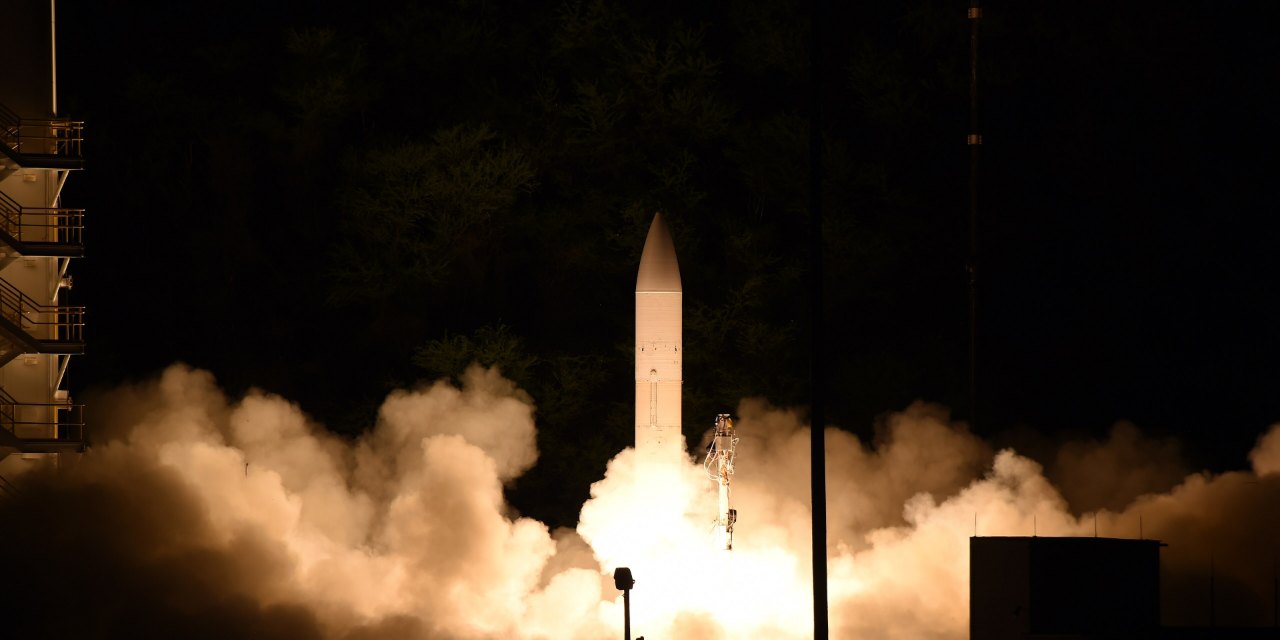
The United States has four hypersonic missiles in or close to service: the Army’s Dark Eagle, the Navy’s Conventional Prompt Strike, and the Air Force’s HACM and ARRW. Only Dark Eagle has reached an operational unit, and it did so in December 2025, several years after Russia and China fielded theirs.
This guide explains what each weapon is, how far it flies, what launches it and where each programme stands in October 2026.
What hypersonic missiles does the US have?
A hypersonic weapon flies faster than five times the speed of sound and, unlike a ballistic warhead, manoeuvres inside the atmosphere on the way to its target. There are two kinds. A boost-glide weapon is carried up by a rocket and then glides. A hypersonic cruise missile is powered all the way by a scramjet engine. The United States is building both, and all of them carry conventional warheads. The physics is covered in hypersonic missiles explained.
| Weapon | Service | Type | Launched from | Status |
|---|---|---|---|---|
| Dark Eagle (LRHW) | Army | Boost-glide | Trailer launcher | Fielding to the first battery began in December 2025 |
| Conventional Prompt Strike | Navy | Boost-glide, same missile as Dark Eagle | Zumwalt-class destroyers, later Virginia-class submarines | Launch method proven in 2025; first ship converted |
| HACM | Air Force | Scramjet cruise missile | Fighters and bombers | First flight test confirmed in October 2026 |
| AGM-183A ARRW | Air Force | Boost-glide | B-52H bomber | Revived in 2025; in procurement |
| Blackbeard | Army | Low-cost hypersonic strike missile | HIMARS | Prototype testing |
Dark Eagle: the Army’s Long-Range Hypersonic Weapon
Dark Eagle is a two-stage rocket topped with the Common Hypersonic Glide Body, an unpowered cone that separates and glides to the target. The Congressional Research Service gives a reported range of 1,725 miles, about 2,775 km. A battery has four trailer launchers with two missiles each, a command post and a support vehicle. Lockheed Martin leads the missile work and Dynetics, part of Leidos, builds the glide body.
The road to service was slow. A flight test failed in June 2022, several more were called off on the launch pad in 2023, and the Army missed fielding deadlines in 2023 and again in September 2025. Successful flights in 2024 cleared the way, and the first battery, part of the 1st Multi-Domain Task Force at Joint Base Lewis-McChord in Washington state, began taking delivery in December 2025. The launchers had already been sent to Australia for an exercise that summer.
Its future is less settled than that suggests. The administration’s 2027 budget proposes to end Army purchases and hand the programme to the Navy. Meanwhile Central Command asked in the spring to have the system sent to the Middle East, a request we examined in what Dark Eagle is and what its deployment would mean.
Conventional Prompt Strike: the Navy version
The Navy’s weapon is the same missile in a different launcher. Because it is too large for a standard vertical launch cell, it is pushed out of its tube by compressed gas and ignites in the air. The Navy proved that method in a test at Cape Canaveral in 2025.
The first ships to carry it are the three Zumwalt-class destroyers. Their unused 155 mm gun turrets are being replaced by four large tubes holding three missiles each, 12 in all. USS Zumwalt was the first to be converted. Virginia-class attack submarines with the Virginia Payload Module are due to follow in the 2030s.
HACM and ARRW: the Air Force missiles
The Hypersonic Attack Cruise Missile is the more important of the two. A rocket booster gets it up to speed and a Northrop Grumman scramjet then sustains flight above Mach 5. It is small enough to hang under a fighter, which a boost-glide weapon is not. RTX is the prime contractor. The Air Force confirmed on 6 October 2026 that HACM had made its first flight test at a range in Australia, about a year later than planned. It wants about $1.2 billion for the programme in fiscal 2027, including $404 million for the first production lot, with fielding to begin the same year.
The AGM-183A Air-launched Rapid Response Weapon is a boost-glide missile carried by the B-52. It failed several tests, was all but abandoned in 2023, and came back in 2025 when the Air Force decided it needed something sooner than HACM. Congress provided $362 million to buy missiles in fiscal 2026, and the 2027 request adds $452 million plus money for an improved version.
How the US compares with Russia and China
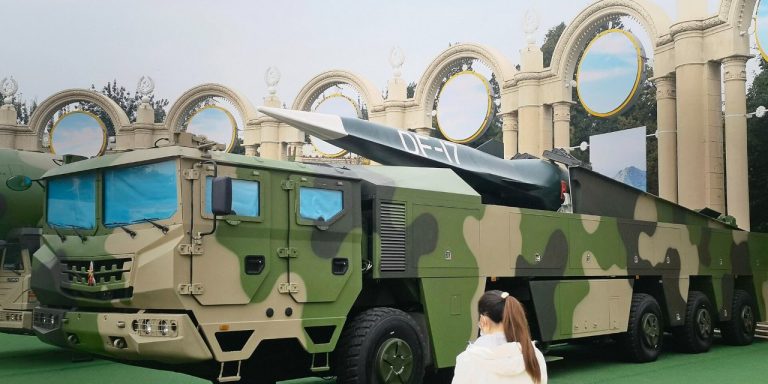
Russia has fired hypersonic weapons in combat since 2022, mainly the air-launched Kinzhal and the ship-launched Zircon. China has had the DF-17 boost-glide missile in service since about 2020. On that measure the United States is roughly five years behind.
Part of the reason is a choice. Russian and Chinese systems can carry nuclear warheads, which do not need to land precisely. American weapons are conventional only, so they must hit within metres at the end of a flight that heats the airframe to thousands of degrees. Part of it is infrastructure: few wind tunnels and test ranges, and a habit of cancelling tests after a single failure. The Army is also funding a cheaper weapon from the start-up Castelion, profiled in our Blackbeard article, to get numbers that Dark Eagle cannot provide.
Frequently asked questions
Does the US have hypersonic missiles?
Yes. The Army’s Dark Eagle began reaching its first battery in December 2025. The Navy and Air Force weapons are still in testing or early procurement.
What is the range of Dark Eagle?
The reported range is 1,725 miles, about 2,775 km.
How fast is Dark Eagle?
Faster than Mach 5. The exact speed is classified.
Can US hypersonic missiles carry nuclear warheads?
No. All current American hypersonic weapons are designed for conventional warheads only.
Why is the US behind Russia and China in hypersonic weapons?
It chose harder, conventionally armed designs that need great accuracy, and its test programme suffered repeated failures and delays between 2021 and 2023.
- USNI News – Report to Congress on the U.S. Army’s Dark Eagle Hypersonic Weapon (April 2026): news.usni.org
- DefenseScoop – Dark Eagle hypersonic weapon: Army fielding plans (January 2026): defensescoop.com
- Air & Space Forces Magazine – Hypersonic Attack Cruise Missile has first flight test (October 2026): airandspaceforces.com
- DefenseScoop – Air Force wants to develop follow-on to ARRW hypersonic missile (May 2026): defensescoop.com
- US Navy – U.S. Navy proves sea-based hypersonic launch approach (May 2025): navy.mil