M109A7 Paladin Specs, Variants, Cost and Operators
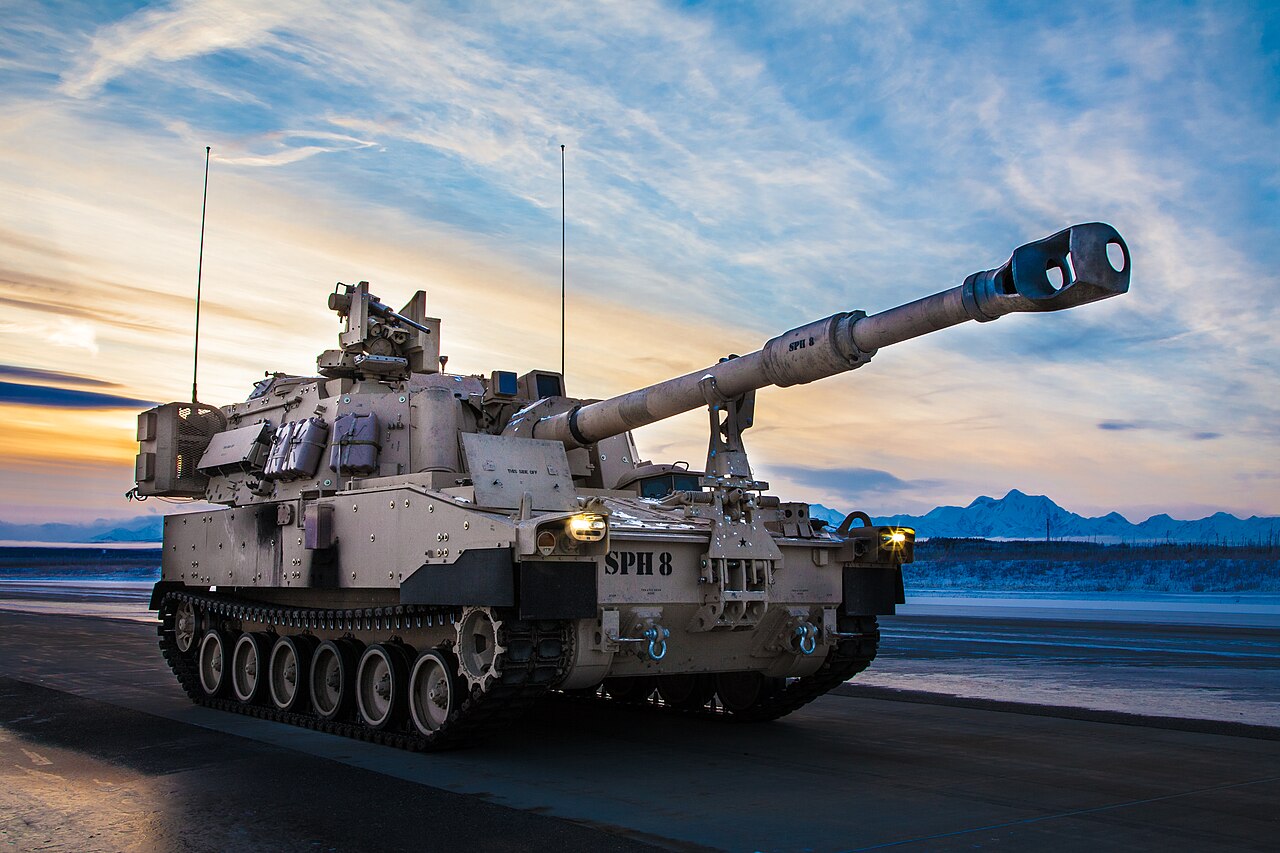
The M109A7 Paladin is the US Army’s current self-propelled howitzer, pairing the proven 155mm/39-caliber gun of the M109A6 with an essentially new chassis that shares engine, transmission and tracks with the Bradley fighting vehicle. It is the seventh major iteration of a design that first entered service in 1963, and the bridge between Cold War tube artillery and whatever the Army fields next.
What is the M109A7 Paladin
The M109A7, built by BAE Systems, is best understood as a new vehicle wearing a familiar turret. The program, once called Paladin Integrated Management, kept the M109A6’s cannon and cab but replaced the hull, suspension, engine, transmission and electrical system. Commonality with the Bradley simplifies the Army’s logistics, while a 600-volt onboard electrical backbone replaces older hydraulics and leaves growth room for future systems.
Each howitzer is fielded alongside the M992A3 ammunition carrier, which shares the same chassis and shuttles shells forward. Low-rate production began in 2017, full-rate production followed in 2020, and the type now equips the Army’s armored brigade combat teams.
M109A7 specifications
| Specification | Value |
|---|---|
| Role | Self-propelled 155mm howitzer |
| Manufacturer | BAE Systems Land & Armaments |
| Main gun | 155mm/39-caliber M284 cannon, M182A1 mount |
| Combat weight | Roughly 39 tons, with growth margin to about 45 |
| Crew | 4, commander, driver, gunner, loader |
| Automotive | Bradley-common 600hp-class diesel and HMPT transmission |
| Rate of fire | Up to about 4 rounds per minute maximum, 1 round per minute sustained |
| Onboard ammunition | About 39 complete rounds, plus 95-plus on the M992A3 carrier |
| Road speed | Around 60 km/h |
M109A7 range and ammunition
With standard M795 high-explosive shells the M109A7 reaches roughly 22 to 24 kilometers, rocket-assisted projectiles stretch that to about 30, and the GPS-guided M982 Excalibur can exceed 40 kilometers from the 39-caliber tube. The gun also fires precision guidance kits that turn conventional shells into near-precision weapons, smoke, illumination and the full NATO 155mm family.
That reach sits at the short end of the modern market. The 52-caliber guns of competitors such as the K9 Thunder and Germany’s PzH 2000 routinely out-range it, which is exactly the gap the Army’s canceled ERCA program was meant to close, and rocket systems like HIMARS now cover the deeper targets.
M109 variants from A1 to A7
| Variant | What changed |
|---|---|
| M109 (1963) | Original 155mm/23-caliber vehicle |
| M109A1/A2/A3 | Longer 39-caliber-class tubes, reliability fixes |
| M109A5 | M284 cannon standard, widely exported and upgraded abroad |
| M109A6 Paladin | New turret, onboard fire control, shoot-and-scoot capability |
| M109A7 | New Bradley-common chassis, 600V electrical system, same gun |
| M109-52 / KH179 hybrids | Industry-proposed 52-caliber upgrades, not adopted by the US Army |
Who operates the M109
The M109A7 itself serves only with the US Army, which plans several hundred sets. The wider M109 family, though, remains one of the most widespread artillery systems ever built, with operators including Taiwan, South Korea, Egypt, Greece, Switzerland, Norway, Latvia and more than a dozen others running earlier variants, many heavily modernized. Ukraine has received M109A4 and M109L derivatives from European stocks, and Ukrainian crews’ operator-reported experience credits the type with solid reliability under a punishing rate of use.
That installed base matters commercially. Every country still running an older M109 is a potential customer either for an A7-style rebuild or for the competing 52-caliber conversions offered by European and Asian industry, and several NATO members are weighing exactly that choice as their Cold War fleets age out.
What happened to ERCA
The Extended Range Cannon Artillery program mounted a 58-caliber XM907 gun on the A7 chassis, chasing 70-kilometer shots. Prototypes proved excessive barrel wear and mechanical strain, and the Army shut the effort down in 2024, redirecting funds toward evaluating existing 52-caliber guns and autoloaders on the market. Until that produces a decision, the A7 soldiers on as the armored force’s standard tube, with incremental ammunition improvements carrying the range burden.
M109A7 frequently asked questions
What is the range of the M109A7?
Roughly 22 to 24 kilometers with standard shells, about 30 with rocket-assisted projectiles, and over 40 kilometers with Excalibur guided rounds.
How much does an M109A7 cost?
Reported unit costs run in the low tens of millions of dollars for a howitzer and ammunition carrier set, varying by contract lot.
What replaced the ERCA program?
Nothing yet. After canceling ERCA in 2024, the Army began evaluating mature 52-caliber howitzers and upgrades as a follow-on path.
Does Ukraine use the M109?
Yes, earlier variants donated from European stocks; the newest A7 model serves only with the US Army.
How is the M109A7 different from the A6?
Same gun and similar cab, but a new hull with Bradley-common automotive parts, stronger suspension and a 600-volt electrical system.
- US Army and BAE Systems public literature
- Wikipedia – M109 howitzer (accessed October 2026)
- Congressional and budget documents on ERCA and artillery modernization
- Defence & Tech reporting on 155mm artillery programs