
Zircon, the Missile Russia Calls Unstoppable
Of Russia’s three showcase hypersonic weapons, the sea-launched 3M22 Zircon carried the most menace, a ship-killer advertised at Mach 9 against which carriers were said to have no answer. Then it was fired at Kyiv, pieces were collected from the craters, and the missile the wreckage described was stranger than the one in the speeches.
What Zircon was said to be
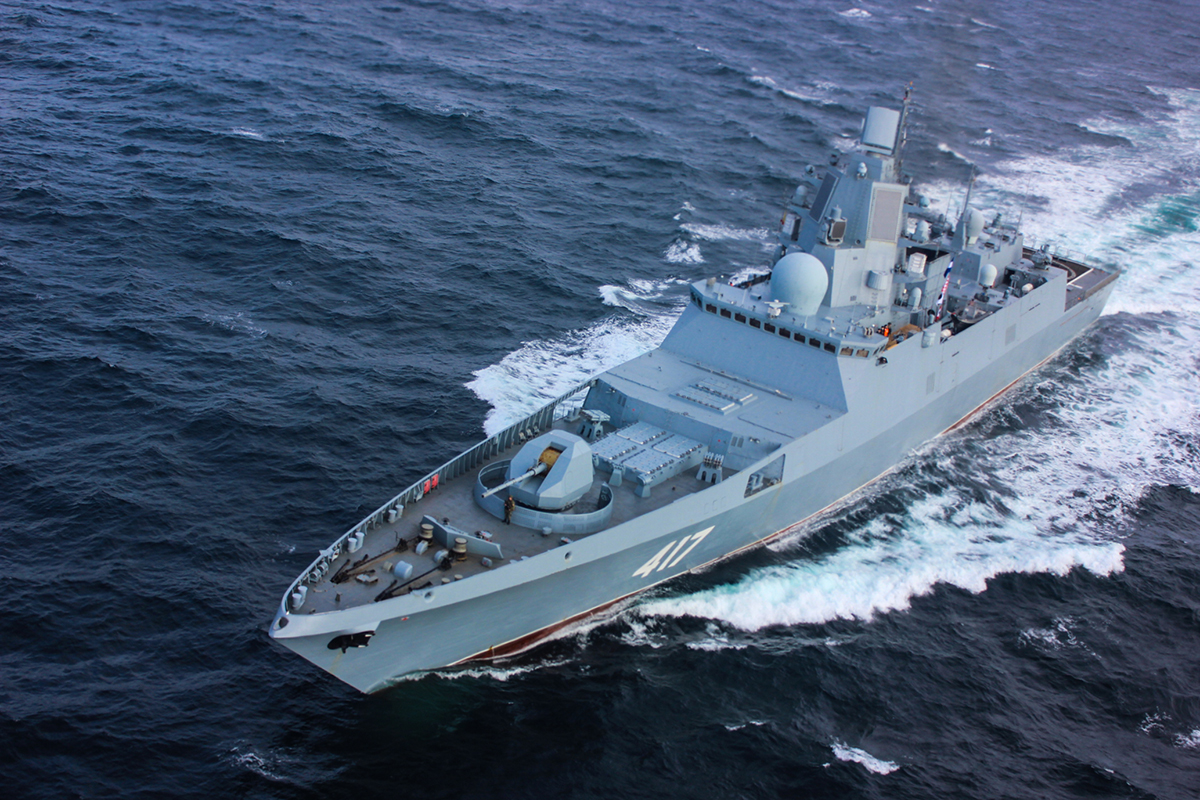
Developed by NPO Mashinostroyeniya, Zircon was presented as a scramjet-powered hypersonic cruise missile, roughly nine meters long, fired from the same 3S-14 vertical cells that carry Kalibr and Oniks, reaching Mach 8 to 9 and ranges beyond 1,000 kilometers against ships and land targets. President Putin personally announced test milestones, and the Admiral Gorshkov frigate’s 2023 Atlantic cruise with Zircon aboard was staged as a message to NATO navies.
What the wreckage said
Combat use gave independent analysts something no parade provides, debris. Examination of wreckage recovered in Ukraine indicated a two-stage solid-rocket configuration rather than the advertised scramjet sustainer, and sustained flight speeds assessed around Mach 5.5 to 6 rather than nine. That still makes Zircon a genuinely fast, high-diving threat, but one closer to an evolved Oniks than to the revolutionary air-breather of Russian state television.
| Parameter | Russian claim | Independent assessment |
|---|---|---|
| Propulsion | Scramjet cruise | Two-stage solid rocket (per wreckage analysis) |
| Top speed | Mach 9 | ~Mach 5.5-6 sustained |
| Range | 1,000+ km | Hundreds of km, profile-dependent |
| Intercept | Impossible | Operator-reported Patriot/SAMP-T intercepts, March 2024 |
Ships, submarines and launch platforms
The missile arms the Admiral Gorshkov-class frigates and is slated for the Yasen-class nuclear submarines, with the Severodvinsk conducting early launches, plus refitted cruisers and smaller Kalibr-capable combatants as integration spreads. A ground-launched derivative has also appeared in testing. Basing a headline weapon in standard cells is the shrewdest part of the program, since any Kalibr-capable hull becomes a potential Zircon shooter, complicating NATO targeting math fleet-wide.
Combat over Ukraine
Russia first fired Zircon at Ukraine in February 2024, and Ukrainian air defense reported intercepting rounds near Kyiv in March 2024 with Patriot and SAMP/T, claims Russia disputes. Strikes attributed to the missile have caused damage and casualties in Kyiv, but the weapon’s use against fixed city targets rather than ships suggests either operational testing or a shortage of missions matching its design, and each expenditure hands analysts more debris.
The carrier-killer question
Against ships, even the deflated Zircon is serious, a sea-skimming approach is not its profile, but a Mach 5-plus terminal dive compresses reaction time brutally and stresses any defense not built around high-end interceptors and layered sensors. American carrier groups, with SM-6, cooperative engagement and electronic warfare, are the hardest targets on earth, and the March 2024 intercepts by land-based systems suggest the unstoppable framing has not survived contact. The honest summary is a dangerous weapon, oversold, still maturing, and worth exactly the layered defenses Western navies are now buying.
Why the Speed Claims Keep Slipping
The pattern is now familiar across Russia’s hypersonic portfolio. Peak speed during a dive gets advertised as cruise speed, ranges quoted for high lofted trajectories get attached to sea-skimming mission profiles they cannot support, and every figure originates from state media with no independent verification. Physics adds its own tax, since a body traveling above Mach 5 in dense lower air wraps itself in ionized plasma that can blind its own seeker, forcing a slowdown before terminal homing against a moving ship.
None of this is unique to Russia, every nation markets its weapons, but the gap between claim and debris has been unusually wide in Ukraine. For defense planners the practical rule that has emerged is to build against the claimed threat while budgeting against the observed one.
What It Means for NATO Navies
Even an honest Mach 5.5 anti-ship missile compresses a fleet’s defensive timeline from minutes toward seconds, and Zircon’s arrival accelerated programs across the alliance, Aster 30 Block 1NT upgrades in Europe, SM-6 procurement increases in Washington, and renewed investment in shipboard electronic warfare and decoys that attack the seeker rather than the airframe. The cheapest defense against a fast missile remains making sure it never finds the ship.
The deeper shift is architectural. Navies are dispersing capability across more hulls, pushing sensors outward onto aircraft and unmanned platforms, and practicing emission control, because a supersonic-plus threat punishes any fleet that concentrates and broadcasts. In that sense Zircon has already changed NATO behavior, which is a form of success no intercept can fully undo.
Frequently asked questions
How fast is the Zircon missile really?
Russia claims Mach 9; analysis of wreckage from Ukraine suggests sustained speeds around Mach 5.5-6 on solid-rocket propulsion rather than the claimed scramjet.
Has Zircon been shot down?
Ukrainian operators reported Patriot and SAMP/T intercepts of Zircon near Kyiv beginning March 2024; Russia disputes the claims.
What launches Zircon?
Admiral Gorshkov-class frigates from 3S-14 vertical cells, with Yasen-class submarines and other Kalibr-capable hulls planned, plus a ground-launched variant in testing.
Is Zircon nuclear-capable?
It is assessed as nuclear-capable, like most large Russian cruise missiles, though its combat use has been conventional.
- Wikipedia – 3M22 Zircon (accessed October 2026)
- Open-source analyses of Zircon debris recovered in Ukraine
- Ukrainian air defense statements (operator-reported)