Russia’s Attack Helicopters: Ka-52 vs Mi-28 vs Mi-35
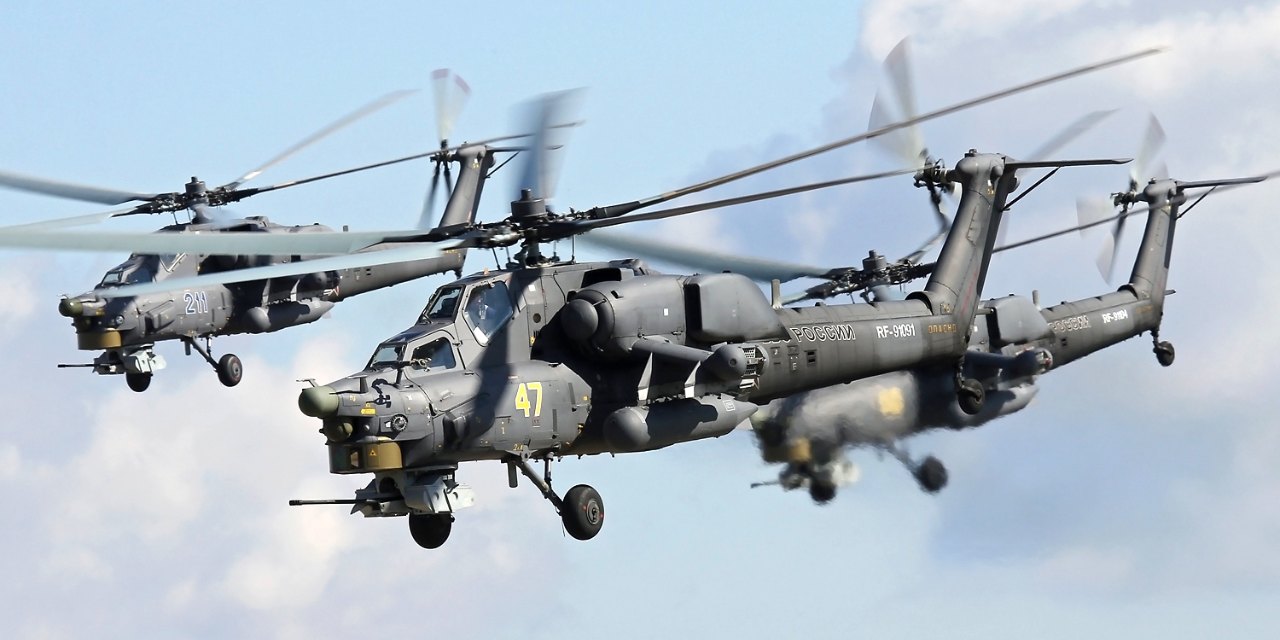
Russia flies three attack helicopters: the coaxial-rotor Ka-52 Alligator, the tandem-seat Mi-28N Night Hunter and the Mi-35M, the latest version of the Mi-24 Hind. They share the same engines and many of the same weapons but were designed around different ideas, and the war in Ukraine has tested all three.
This guide compares them side by side: layout, performance, armament, numbers and what four years of combat have shown about each.
What attack helicopters does Russia have?
Russia is unusual in fielding two modern gunships in parallel. In the 1980s the Kamov and Mil design bureaus competed to replace the Mi-24. Kamov’s single-seat Ka-50 won, but the collapse of the Soviet Union left neither design funded. When money returned in the 2000s the army bought both the two-seat Ka-52 and the Mi-28N, and kept upgrading the Mi-24 as well.
| Feature | Ka-52 Alligator | Mi-28N Night Hunter | Mi-35M |
|---|---|---|---|
| NATO name | Hokum-B | Havoc | Hind-E |
| Rotor layout | Coaxial, no tail rotor | Single main rotor, tail rotor | Single main rotor, tail rotor |
| Crew | 2, side by side | 2, in tandem | 2, plus up to 8 troops |
| Maximum takeoff weight | About 10.8 tonnes | About 11.7 tonnes | About 11.5 tonnes |
| Engines | 2 x VK-2500 | 2 x VK-2500 | 2 x VK-2500 |
| Top speed | About 300 km/h | About 300 km/h | About 310 km/h |
| Gun | 30 mm 2A42, fuselage side | 30 mm 2A42, chin turret | 23 mm twin-barrel, chin turret |
| In service | About 100 to 135 | About 90 | About 60, plus older Mi-24s |
The full helicopter fleet, including transports, is described in what helicopters Russia has.
Ka-52 Alligator
The Ka-52 has two rotors stacked on one mast turning in opposite directions. With no tail rotor to drive, all engine power goes into lift, which makes it agile and able to hover in thin air. The crew sit side by side, which helps coordination, and it is the only production helicopter with ejection seats: explosive charges blow the rotor blades off first.
Its weak point early in the war was range. The Vikhr and Ataka missiles reach 6 to 10 km, inside the envelope of shoulder-fired air defenses. The upgraded Ka-52M carries the LMUR missile, which reaches about 14.5 km and sends video back to the crew, letting them strike from well behind the front line. It is built at the Progress plant at Arsenyev in the Far East.
Mi-28N Night Hunter
The Mi-28N follows the conventional layout of the American Apache: gunner in front, pilot behind and above, cannon in a turret under the nose. It is heavily armored and has a radar above the rotor so the crew can search from behind cover. The early versions were criticized for poor sensors and for giving flight controls only to the pilot.
The Mi-28NM fixes much of that, with dual controls, new rotor blades, updated optics and the LMUR missile. Deliveries have been slower than for the Ka-52M. The type is built by Rostvertol in Rostov-on-Don.
Mi-35M Hind
The Mi-24 was conceived in the 1960s as a flying infantry fighting vehicle, a gunship with a cabin for eight soldiers. The Mi-35M is a new-build modernization with the engines and rotor of the Mi-28, night sights and a twin-barrel 23 mm cannon.
It is larger and less agile than the dedicated gunships, and the troop cabin is rarely used for assault now. Its advantages are cost and flexibility: it can evacuate wounded or carry spare missiles. It has been widely exported.
Ka-52 vs Mi-28, which is better?
On paper they are close. The Ka-52 is more maneuverable, hovers better at altitude and has ejection seats. The Mi-28 has a turreted gun with a wider field of fire, heavier armor around the crew and a more conventional airframe that is simpler to maintain. The Ka-52’s fixed side-mounted cannon is accurate but requires pointing the whole helicopter.
In practice the Ka-52 has done most of the anti-armor work in Ukraine, largely because it received long-range missiles first. Britain’s defense ministry described it in 2023 as one of the most influential Russian weapon systems on the southern front. How both rank worldwide is covered in our top 10 attack helicopters.
Combat record and losses in Ukraine
The first months were costly. Flying low over Ukrainian-held territory, Russian gunships were shot down by Stinger, Piorun and Starstreak missiles. Oryx has visually confirmed more than 60 Ka-52s destroyed or damaged, about half the pre-war fleet, and roughly 15 to 20 each of the Mi-28 and Mi-24 families.
Losses fell once crews stopped crossing the front line. Today the helicopters fire guided missiles from 8 km or more, lob unguided rockets from a climb, hunt long-range drones at night and patrol the Black Sea against uncrewed boats. Electronic defensive systems have improved, but small first-person-view drones have become a new threat to helicopters on the ground and in the air.
Frequently asked questions
What is Russia’s best attack helicopter?
The Ka-52M is the most capable in service, mainly because of its LMUR long-range missile. The Mi-28NM is its closest rival.
What is the difference between the Ka-52 and the Mi-28?
The Ka-52 has coaxial rotors, side-by-side seats and ejection seats. The Mi-28 has a conventional rotor, tandem seats and a turret-mounted gun.
Is the Mi-24 still in service?
Yes. Russia flies older Mi-24s alongside the modernized Mi-35M.
How many Ka-52s has Russia lost?
More than 60 have been visually confirmed as destroyed or damaged, according to Oryx.
Which countries use Russian attack helicopters?
Egypt operates the Ka-52. Algeria and Iraq fly the Mi-28NE, and the Mi-35M has been sold to more than a dozen countries.
- Oryx – Documenting Russian equipment losses during the invasion of Ukraine: oryxspioenkop.com
- Wikipedia – Kamov Ka-52: en.wikipedia.org
- Wikipedia – Mil Mi-28: en.wikipedia.org
- Wikipedia – Mil Mi-24: en.wikipedia.org
- Wikipedia – List of active Russian military aircraft: en.wikipedia.org