Russia Donates $53M Repair Facility to Uganda’s Military in Jinja
Lead
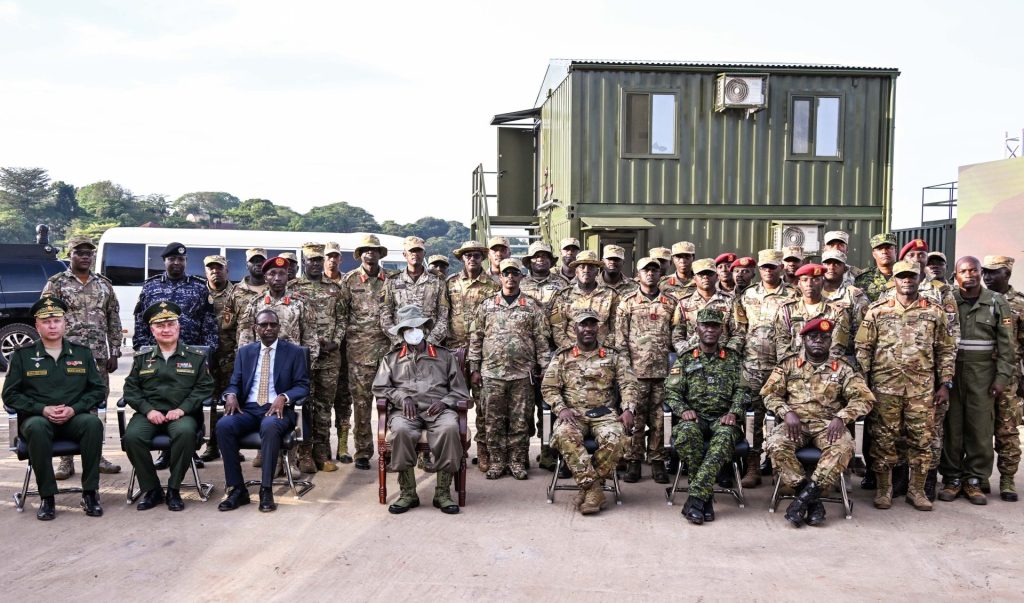
Uganda has commissioned a $53 million mechanised repair facility at Magamaga Cantonment in Jinja District, fully funded and donated by Russia, as part of a wider package of military infrastructure handed over to the Uganda People’s Defence Forces (UPDF) on October 21 and 22, 2026. The facility will overhaul heavy military vehicles and other complex equipment inside Uganda, reducing the army’s reliance on sending hardware abroad for repair. The handover, led by President Yoweri Museveni and a Russian delegation under Lieutenant General (ret.) Aleksandr Kshimovskii, is the latest and largest installment in a bilateral defence-technical relationship that stretches back more than five decades and has recently expanded to include marine security infrastructure, training technology and a pledge of further equipment supply.
What Happened
Over two days, Museveni, in his capacity as Commander-in-Chief of the UPDF, toured and formally commissioned four separate Russian-funded sites. On October 21, he opened a digital multimedia training classroom at the Mechanised Warfare College in Kalama, Mubende District, built to train crews on the BRDM-2MS armoured reconnaissance vehicle using simulations before live field exercises. The same day, he inspected newly delivered marine assets at the 15 Marine Brigade pier in Entebbe, including coastal surveillance radar, eight patrol boats, a floating dock, protective barriers, marine workshops, firefighting equipment, field ambulances and specialised transport vehicles.
On October 22, the program moved to the 154 Marine Battalion School at Kalangalo, where Museveni urged UPDF commanders to adopt “more automation, more AI, more range” in future training and operations, before concluding at Magamaga Cantonment with the commissioning of the mechanised major repair facility, valued at $53 million and described by Uganda’s Ministry of Defence and Veteran Affairs as a full donation from the Russian government under the two countries’ bilateral defence cooperation framework. Local reporting gives the shilling-denominated value as roughly 219–230 billion, a discrepancy that has not been resolved between outlets.
Defence Minister Kiryowa Kiwanuka credited Museveni’s continued engagement with Moscow for sustaining the relationship and opening further avenues for military-technical assistance, and pledged that UPDF leadership would maintain the new facilities to extend their service life. Kshimovskii said Russia “is ready to supply the necessary equipment” and would continue developing cooperation with Uganda. Museveni, who thanked President Vladimir Putin personally for “this gift,” pressed Russian officers on a longer-term goal beyond receiving hardware: “What if we made them here with the Russians?” He added that Uganda should “not only get the good equipment but also learn from them,” pointing toward eventual joint local production of military materiel.
The Product/System
The Magamaga facility is a mechanised major repair plant, intended to handle the overhaul of heavy military vehicles and other complex mechanised equipment that the UPDF currently has to send outside the country, or rely on foreign technicians to service domestically. Its scope has not been itemized publicly beyond “heavy military vehicles and complex machinery,” but it sits alongside Uganda’s existing Russian-built maintenance infrastructure: a helicopter maintenance, repair and overhaul (MRO) unit opened at Nakasongola Air Force Base in 2022, which an earlier commissioning in April 2023 tied to the training of roughly 200 Ugandan engineers. The Kalama classroom and Entebbe marine assets commissioned in the same cycle are smaller, more specialized additions — one training-focused, the other operational — but all four sites were delivered and funded through the same Russian government cooperation channel, Rosoboronexport’s government-to-government track rather than a commercial export contract.
Who Uses It
The facility and its associated equipment belong exclusively to the UPDF, confirmed by official statements from Uganda’s State House and Ministry of Defence and Veteran Affairs. There is no indication of third-country access or a regional-training role at this stage, distinguishing it from some African maintenance hubs that double as regional service centers for neighboring forces.
Export/Procurement History
Uganda’s reliance on Russian-origin hardware dates to a 1965 military agreement under which the Soviet Union trained more than 20 Ugandan pilots and 50 technicians. The relationship was formalized in its modern form through a 2003 Military and Technical Cooperation Agreement and reinforced by a government-to-government agreement following a 2012 Museveni visit to Moscow. The most consequential hardware transfer under that framework was the order of six Su-30MK2 fighters, reportedly worth around $740 million, signed in 2010–2011 and completed with final deliveries in June 2012; Ugandan pilots and ground crew subsequently trained in Russia. Other reported Russian-origin equipment in UPDF service includes T-72 and T-90S tanks, Kornet anti-tank guided missiles, and Mi-24 and Mi-28 attack helicopters. The pattern fits a broader trend documented in Russia’s wider arms-export relationships, where legacy Soviet-era ties keep African militaries tied to Russian maintenance and training long after the original sales. The October 2026 commissioning extends this track record from fighter aircraft and armor toward maintenance infrastructure and marine security hardware, and Kshimovskii’s pledge of continued equipment supply suggests further transfers are likely, though none have been named.
Global Competitors
Uganda has historically diversified its defence partnerships rather than relying on Russia alone, maintaining long-running security cooperation with the United States, which has supported counter-terrorism and peacekeeping-related training, and with China, which has supplied vehicles and infrastructure assistance elsewhere on the continent. France and other European partners have offered training and equipment to regional forces in the Great Lakes area. The Magamaga handover does not displace those relationships, but it demonstrates that Russia, through government-funded infrastructure donations rather than arms sales alone, is positioning itself as a maintenance and sustainment partner in East Africa at a time when it is also courting African buyers for combat drones and other systems, with mixed delivery results elsewhere on the continent.
Why It Matters
The commissioning lands days before Russia’s own Africa-focused summit diplomacy in Moscow in late October 2026, where Russian officials pursued a wider set of defence-industrial engagements with African governments, including Ethiopia’s announced delivery of Su-35 fighters. For Uganda, a repair and overhaul facility is a lower-profile but strategically significant form of assistance: it targets the UPDF’s long-standing dependence on foreign maintenance for Russian-origin platforms, a vulnerability shared by several African militaries operating Soviet- and Russian-legacy equipment. Museveni’s explicit push for eventual joint manufacturing, rather than simply accepting donated hardware, signals an attempt to use the relationship to build sustainable domestic capacity rather than perpetual dependency — though whether Russia follows through on technology transfer, as opposed to equipment donation, remains unproven.
What Happens Next
Officials on both sides described the October commissioning as part of an ongoing, rather than concluded, cooperation track. Kshimovskii’s pledge of continued equipment supply and “technical backstopping” leaves open the possibility of further facility handovers or hardware transfers, and Museveni’s calls for local manufacturing partnerships with Russian firms have not yet been matched by any announced joint-production agreement. Parliamentary or budgetary scrutiny of the shilling-denominated value of the donation has not been reported, and the discrepancy between the 219 billion and 230 billion shilling figures cited by Ugandan outlets remains unresolved.
FAQ
What did Russia donate to Uganda in October 2026?
A $53 million mechanised major repair facility at Magamaga Cantonment in Jinja District, plus a training classroom at Kalama and marine security assets at Entebbe, all funded by the Russian government under the two countries’ bilateral defence cooperation framework.
Who signed or announced the handover?
President Yoweri Museveni, as UPDF Commander-in-Chief, with Defence Minister Kiryowa Kiwanuka, received the facilities from a Russian delegation led by Lieutenant General (ret.) Aleksandr Kshimovskii on October 21–22, 2026.
Does Uganda operate Russian fighter jets?
Yes. Uganda ordered six Su-30MK2 fighters from Russia in 2010–2011, worth a reported $740 million, with deliveries completed in 2012.
Is this part of a wider Russian push into Africa?
The Magamaga handover preceded Russia’s late-October 2026 Africa-focused diplomacy in Moscow, where Russian officials also confirmed Su-35 fighter deliveries to Ethiopia and pitched combat drones to other African governments, though drone deliveries have reportedly lagged pledges.
Will the facility let Uganda build its own military equipment?
Not yet. Museveni raised the idea of joint manufacturing with Russian partners, but no production or technology-transfer agreement has been announced; the facility’s confirmed role is repair and overhaul of existing heavy equipment.
Sources
- Uganda State House, “President Museveni Commissions Military Facilities Under Uganda-Russia Defence Cooperation,” October 22, 2026 — official account of the commissioning, quotes and site list. statehouse.go.ug
- Daily Monitor, “Museveni commissions $53m Russian-backed military facilities, urges UPDF to embrace AI,” October 2026 — value, location detail and additional quotes. monitor.co.ug
- SoftPower News, “Museveni Commissions $53m Russian-Donated Military Repair Facility in Jinja” — corroborating report on value and location. softpower.ug
- AllAfrica, “Uganda: Museveni Launches New Military Facilities Under Uganda-Russia Defence Partnership,” October 23, 2026 — independent wire confirmation. allafrica.com
- DefenceWeb, “Uganda commissions Russian-donated military repair facility” — regional defence-trade confirmation. defenceweb.co.za
- Monitor, “Russia says Uganda to buy six more jets” — background on earlier Su-30MK2 procurement. monitor.co.ug