Hellfire vs JAGM: America’s Most Famous Air-to-Ground Missiles Explained
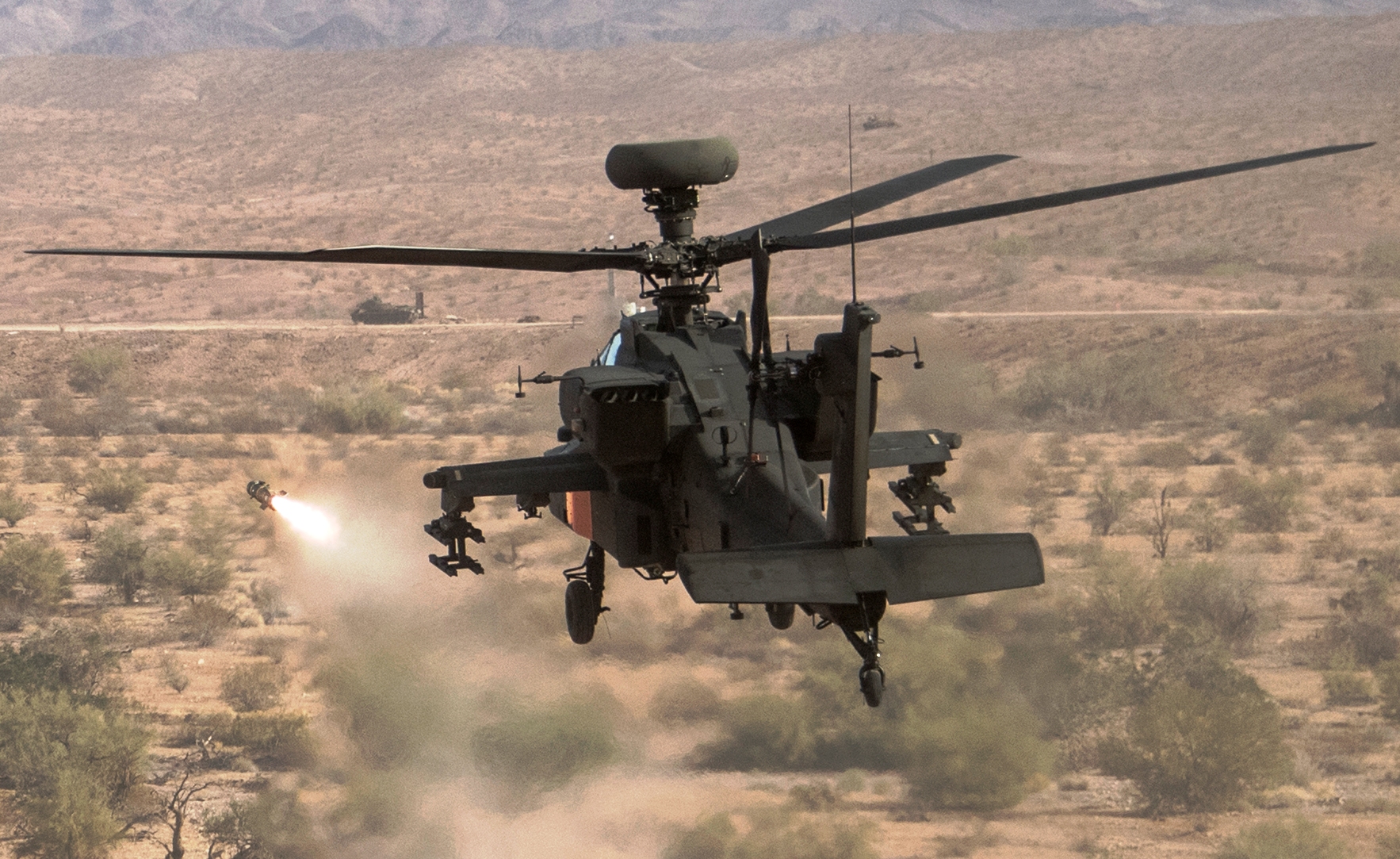
For four decades, the Hellfire has been the signature weapon of American attack helicopters and armed drones. Its successor, the Joint Air-to-Ground Missile (JAGM), is now replacing it across the US military. Here is how both missiles work, how they differ and why the change matters.
- AGM-114 Hellfire entered service in the 1980s as an anti-tank missile
- Fired from Apaches, Reapers, ships and ground vehicles
- AGM-179 JAGM adds a radar seeker to laser guidance
- JAGM range is about 8 km from helicopters, more in the MR version
- Hellfire is used by dozens of countries
The AGM-114 Hellfire
The Hellfire, short for “helicopter launched, fire and forget”, was developed in the 1970s to let the AH-64 Apache destroy Soviet tanks. It entered service in the 1980s. Despite its name, most versions use semi-active laser guidance: a laser designator on the aircraft, a drone or a soldier on the ground marks the target, and the missile follows the reflected beam. Range is roughly 8 kilometres.
A missile for every job
Over time the Hellfire evolved far beyond its anti-tank role. The AGM-114K has a tandem shaped-charge warhead to defeat reactive armour. The radar-guided AGM-114L Longbow version gives the Apache true fire-and-forget capability in bad weather. Thermobaric and blast-fragmentation versions target buildings and troops, and the AGM-114R combines several effects in one missile. Most famously, MQ-1 Predator and MQ-9 Reaper drones turned the Hellfire into the main weapon of precision strikes in Afghanistan, Iraq and beyond.
Enter JAGM
The AGM-179 JAGM, built by Lockheed Martin, looks similar to the Hellfire and uses the same launch rails, but it has a dual-mode seeker. It combines semi-active laser guidance with a millimetre-wave radar, so it can hit moving targets, work through smoke, dust and bad weather, and be launched either with a laser designator or in fire-and-forget mode. Its range from helicopters is about 8 kilometres, and a JAGM Medium Range version roughly doubles that.
Who uses them?
Dozens of countries operate the Hellfire on helicopters such as the AH-64 Apache, AH-1Z Viper and MH-60R Seahawk, on drones and on small warships. JAGM is entering service with the US Army, Marine Corps and Navy, and foreign customers buying new Apaches and Vipers are increasingly choosing it.
Hellfire vs JAGM: key differences
The Hellfire is cheaper, combat-proven and available in huge numbers. JAGM is more expensive but more flexible: one missile can do the jobs of several Hellfire variants, it is far better against moving and well-protected targets, and it reduces the risk to the crew by allowing fire-and-forget attacks.
Verdict
The Hellfire will keep flying for years, especially on drones and with export customers. But the future of US air-to-ground precision belongs to JAGM, a missile that takes the Hellfire’s proven formula and adapts it for a battlefield full of electronic warfare, moving targets and air defences.
Featured image: Tad Browning, U.S. Army Operational Test Command Public Affairs / Public domain, via Wikimedia Commons